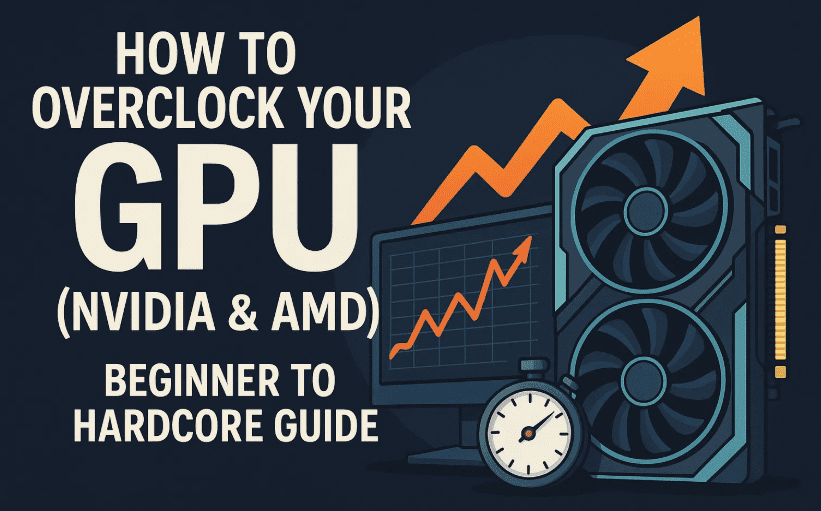
If you’re into gaming or graphics-heavy workloads, squeezing out every bit of performance from your graphics card is pure satisfaction. Overclocking your GPU can boost frame rates, improve rendering speeds, and help your rig punch above its weight class. But—yes, there’s always a but—doing it wrong can overheat or damage your hardware.
In this detailed guide, we’ll walk through the three levels of GPU overclocking—from beginner-friendly methods to hardcore BIOS mods and curve tuning. Whether you’re using an NVIDIA or AMD GPU, this guide will have you covered.
🚨 Disclaimer
Overclocking your GPU can void your warranty or damage your hardware if not done properly. Proceed with caution and do your research on your specific GPU model before flashing BIOS or tuning voltage curves. This guide is for educational purposes only.
🧰 Tools You’ll Need
Before diving in, here are the tools you’ll need:
- MSI Afterburner (for NVIDIA) – Download here
- 3DMark Benchmark Tool – Download from Steam or Official Site
- TechPowerUp GPU BIOS Database – Visit here
- NVFlash (for BIOS flashing) – Download here
- GPU-Z (to check PerfCap reasons) – Get it here
🎯 Level 1: The Easy Way – Auto Overclocking
Let’s begin with the easiest method—Auto Overclocking, especially handy if you’re a beginner or don’t want to take risks manually tuning voltages.
For NVIDIA Users
- Open MSI Afterburner.
- Click the OC Scanner button (check under the settings gear icon).
- Click Scan and let it find a stable overclock.
- After completion, click Apply.
- Test your system using:
- 3DMark Time Spy stress test.
- Your favorite games at high settings.
- Save the stable profile in Afterburner.
- Enable “Run at Startup” for automatic overclocking on boot.
For AMD Users
- Open Radeon Software (Adrenalin).
- Navigate to Performance → Tuning.
- Under Auto Tuning, choose Overclock GPU.
- Test stability just like for NVIDIA (3DMark + in-game).
🔍 Pro Tip: Even auto-OC profiles can be unstable under certain games. Always verify stability with both synthetic benchmarks and real-world testing.
⚙️ Level 2: Manual Tuning – The Normal Way
Now that we’ve mastered the basics, let’s step it up a notch.
Step-by-Step Process (for NVIDIA with Afterburner):
- Max out Power Limit to unlock your GPU’s full potential.
- Gradually increase Core Clock (MHz) in small steps (e.g., +50MHz).
- Apply the setting and run a stress test (3DMark).
- If stable, increase again (e.g., +100MHz total).
- Repeat until:
- You see artifacts or crashes → lower clock.
- Benchmarks show decreased score → throttling due to heat.
- Fine-tune memory clock if needed. Be careful—memory overclocks can introduce graphical glitches or instability.
- Save your final stable profile.
For AMD:
- Go to Radeon Software → Tuning → Manual.
- Push Power Tuning to max.
- Gradually increase GPU Clock and Memory Clock.
- Monitor Junction Temperature and Power Draw.
- Test as you go—just like with NVIDIA.
💡 Remember: Not all GPUs overclock the same. This randomness is known as the silicon lottery.
🔥 Level 3: The Hardcore Way – Curve Tuning & BIOS Flashing
Alright, overclocking warriors—it’s time for the serious stuff. This step is not for the faint-hearted, but it’s where you can push your GPU to its ultimate limit.
🔧 BIOS Flashing (NVIDIA Only)
If your card is power-limited, you’ll need a new BIOS to remove the bottleneck.
Here’s what to do:
- Go to TechPowerUp’s BIOS Collection.
- Search for a BIOS with:
- Higher Power Limit.
- Same Power Connector Layout (e.g., 8-pin).
- Matching Display Ports (avoid breaking output ports).
- Download NVFlash and your new BIOS.
- Backup your current BIOS.
- Run Command Prompt as Administrator:
nvflash --protectoff nvflash yourbios.rom - Restart and check if GPU-Z shows the new Power Limit.
⚠️ Flashing a wrong BIOS can break your GPU. Only proceed if you’re confident.










🧠 Curve Tuning with MSI Afterburner
Now let’s master the Frequency/Voltage Curve for fine-tuned performance or undervolting.
Steps:
- Click the Curve Editor (small graph icon near Core Clock).
- Find the voltage point where you want to lock (e.g., 1.05V or 1.093V).
- Drag that point vertically to your desired clock (e.g., 2085MHz).
- Press Ctrl + L to lock the curve.
- Click Apply.
- Run tests to verify:
- Stability.
- Reasonable temperatures.
- If it overheats, lower voltage (e.g., try 1.05V) and repeat.
🧊 This method can also be used for undervolting—to lower heat and power draw, great for laptops or compact builds.
🧪 How to Test Your Overclock
Test thoroughly with:
- 3DMark Time Spy or Port Royal
- In-game tests: CSGO, Cyberpunk, Tomb Raider, etc.
- Monitor temps with HWInfo or GPU-Z
If:
- Game crashes → reduce clock or raise voltage.
- Artifacting → reduce memory clock.
- Throttling → improve cooling or reduce voltage.
❓ Frequently Asked Questions
Q1: Will overclocking void my GPU warranty?
A: For most brands, yes, especially if flashing BIOS. Software-level tuning (like Afterburner) may not void it—but check your vendor’s policy.
Q2: Is curve tuning safe?
A: Yes, if done carefully. It allows precise control and is often safer than random boosting.
Q3: What about laptop GPUs?
A: You’re often limited to memory tuning only. Most laptop GPUs have strict thermal and voltage constraints.
🏁 Final Thoughts
Overclocking your GPU is a blend of science and art. With the right tools and patience, you can unlock more power from your graphics card than you might expect. Just always keep an eye on temps, voltages, and system stability.
Whether you’re going for a slight FPS boost or full-on BIOS-flashing glory, this guide should set you on the right track.
Happy overclocking, and may the silicon lottery be ever in your favor!
🏷️ Tags
gpu overclocking, msi afterburner, curve tuning, bios flash, nvidia gpu, amd gpu, graphics card tweak, undervolting, gaming optimization, 3dmark, time spy, techpowerup
🔖 Hashtags
#GPUOverclocking #MSIAfterburner #NVIDIAOC #AMDGPU #CurveTuning #GraphicsCard #GamingPerformance #BIOSFlash #Undervolting #TechTips #PCGaming #SiliconLottery #HardwareGuide #3DMark #Benchmarking