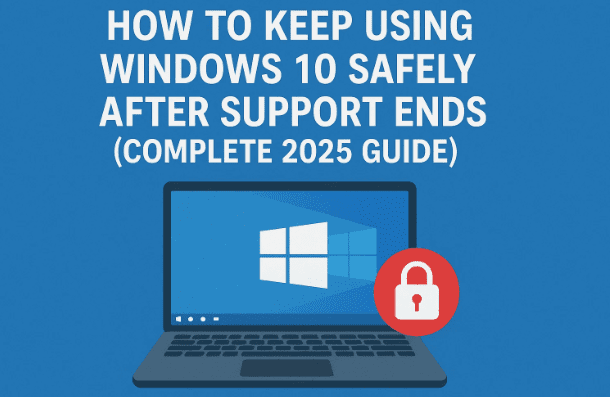
When Microsoft officially ends support for Windows 10, millions of users around the world will face a critical decision: upgrade to Windows 11, switch to Linux, or continue using Windows 10. But what if you love Windows 10’s simplicity, stability, and performance and aren’t ready to let go?
The good news is — you can keep using Windows 10 safely even after its end of support, provided you follow the right precautions and habits. This guide walks you through how to do exactly that — step-by-step, in detail, and with practical examples to help you make informed choices.
1. 🕓 Understanding What “End of Support” Means
Before we dive into safety measures, it’s important to clarify what end of support actually means.
When Microsoft ends support for Windows 10, it stops providing:
- Monthly security updates
- Feature updates
- Bug fixes and performance improvements
However, the operating system will continue to work. Your apps, files, and most hardware will still function as they do today. You just won’t receive new patches from Microsoft.
This is similar to what happened when Windows 7 support ended in January 2020. Many users continued using it safely for years afterward by following smart computing practices — and the same principle applies here.
2. 🧩 The Two-Step Protection Strategy
So, how can you continue using Windows 10 safely after support ends?
It boils down to two main steps — both of which you should already be doing:
- Practice Safe Computing
- Use Reliable Security Software
If you consistently follow these, you can drastically reduce your chances of being infected or compromised, even without regular Windows updates.
Let’s explore each one in detail.
3. 🧠 Step 1 – Practice Safe Computing
Practicing safe computing isn’t about installing fancy software — it’s about building habits that make it harder for malware to reach your PC in the first place.





Think of it as digital hygiene. Just like washing your hands prevents disease, safe computing prevents digital infections.
Here are the key practices:
1️⃣ Keep All Other Software Updated
Even if Windows 10 itself stops receiving updates, third-party software like browsers (Chrome, Firefox, Brave), office suites (LibreOffice, WPS Office), and drivers often continue to update for years.
Keeping these current patches many of the security holes that attackers target.
2️⃣ Use a Modern Browser
Browsers are your first line of defense. Continue using browsers that support Windows 10 — Google Chrome, Mozilla Firefox, or Brave will likely continue updates for some time. If support ends, consider switching to Ungoogled Chromium or Librewolf which maintain strong privacy and stability.
3️⃣ Avoid Suspicious Downloads and Email Attachments
The majority of attacks rely on human error — clicking unsafe links, downloading cracked software, or opening unknown attachments. Avoid sites offering “free” versions of paid software; they’re a common source of hidden malware.
4️⃣ Secure Your Online Accounts
Use two-factor authentication (2FA) wherever possible and strong, unique passwords. A compromised account can do more damage than an outdated OS.
5️⃣ Backup Regularly
Maintain automated backups using Windows’ built-in File History, Macrium Reflect, or external drives. If something goes wrong, you’ll have your data safe — even if malware strikes.
6️⃣ Secure Your Network
Use a reliable router with updated firmware, enable WPA3 encryption on Wi-Fi, and avoid public networks without a VPN. Your connection is often the easiest entry point for attackers.
7️⃣ Maintain Physical Security
It sounds basic, but don’t overlook it — unattended PCs can be exploited easily.
💡 Expert Insight:
Most infections today don’t happen because of unpatched OS vulnerabilities — they happen because users unknowingly download malware or use weak passwords.
So far, so good! Let’s move to the second part of your defense system.
4. 🛡️ Step 2 – Use Good Security Software
The next step is to ensure you’re protected by reliable, up-to-date antivirus and anti-malware software.
🧰 Windows Security (Defender) – Still a Great Option
Windows 10 already includes Windows Security (formerly Windows Defender). It provides real-time protection, automatic updates, and cloud-based threat detection.
Even after Windows 10’s end of support, Microsoft has confirmed that it will continue providing security definition updates for Windows Security until at least 2028.
That means Defender will still recognize and block new viruses, even if the OS itself no longer gets full updates.
🧩 Alternative Security Suites
If you prefer third-party software, consider these reputable options:
- Bitdefender (bitdefender.com) – Excellent real-time protection
- Kaspersky Standard (kaspersky.com) – Strong against phishing and ransomware
- ESET NOD32 (eset.com) – Lightweight and precise
- Malwarebytes Premium (malwarebytes.com) – Great companion to Windows Defender
🔄 Once installed, these tools will automatically disable Windows Defender to avoid conflicts.
Between your careful habits and up-to-date antivirus, you’ve now got what we can call two-step protection — your habits block 95% of threats, and your security software covers the rest.
5. 📅 Extended Security Updates (ESU): Should You Get Them?
Microsoft offers a paid option called Extended Security Updates (ESU) for organizations — and possibly for individuals via select partners — that provides security patches for one or more extra years beyond the official cutoff.
However, for most home users, it’s optional.
Here’s what to know:
- ESU simply extends the end-of-support deadline temporarily (typically one year).
- After that, you’ll still need to rely on safe practices and security software.
- If you’re a business handling sensitive data, ESU might be worth it; for personal users, it’s not essential.
6. 🧩 Are Security Updates Really That Critical?
It’s natural to think: “Without Microsoft updates, I’m doomed.” But let’s analyze this calmly.
For malware to infect you through a Windows vulnerability, nine things must all happen:
- A bug must exist in Windows.
- The bug must be exploitable as a security weakness.
- Hackers must know about it.
- They must develop a working exploit.
- They must find a way to deliver it to your PC (usually malware).
- You must download or open that malware.
- Your antivirus must fail to detect it.
- You must run or execute it.
- Your antivirus must again fail to stop it.
If any one of these steps fails, you remain safe.
Regular updates only help with the first two steps. Your habits and antivirus cover the other seven.
In other words, you control most of the security chain.
7. 🔒 Why Windows 10 Is Still Safer Than You Think
Here’s something most people overlook:
Windows 10 is no longer changing. That means no new code — and no new bugs.
Most vulnerabilities arise when new features are added. Since Microsoft will stop modifying Windows 10, the likelihood of new vulnerabilities drops dramatically.
Furthermore, hackers prefer going after newer, more widely used systems. When millions migrate to Windows 11, the hacker focus shifts — making older systems a less tempting target.
8. ⚖️ Addressing Common Objections
There are two frequent fears when support ends:
❗ Objection 1: “Hackers are waiting for support to end to unleash attacks.”
This theory suggests that cybercriminals are stockpiling zero-day exploits for after support ends.
However, this didn’t happen with Windows 7. Despite similar fears, there was no major wave of attacks.
Why? Because attackers exploit systems as soon as they can, not years later. Holding back gives competitors time to patch or detect the vulnerability.
❗ Objection 2: “New vulnerabilities will keep appearing forever.”
While minor bugs might still exist, major new vulnerabilities are unlikely. With no new updates being introduced, Windows 10’s internal structure remains static — reducing the chances of new flaws.
9. 🧩 Software Compatibility After End of Support
One genuine issue you may face isn’t from Microsoft — but from third-party developers.
Over time, software vendors may stop supporting Windows 10. You might see messages like “This app requires Windows 11 or later.”
However:
- Most software will continue working for years.
- Some developers still support Windows 7 even today (years after its retirement).
- Only cutting-edge programs using new APIs will drop compatibility early.
If a program you use stops updating for Windows 10, you can:
- Keep using the last supported version.
- Find an alternative compatible app.
- Run the newer app via virtualization (using VirtualBox or Linux dual boot).
10. 💬 FAQs About Windows 10 After End of Support
Q1. Can I use Windows 10 after October 2025?
✅ Yes. Your PC will keep working — you just won’t get new updates from Microsoft.
Q2. Is Windows Defender still updated after 2025?
Yes. Microsoft confirmed security definition updates for Windows Defender (Windows Security) will continue until at least 2028.
Q3. Should I upgrade to Windows 11?
If your PC supports it and you’re comfortable with its interface, yes. Otherwise, sticking with Windows 10 using the two-step strategy is perfectly fine.
Q4. Will browsers stop supporting Windows 10?
Eventually, yes — but not immediately. Major browsers will continue supporting it for at least another couple of years after 2025.
Q5. Is Linux a better alternative?
For tech-savvy users, yes — Linux is lightweight, fast, and secure. But for most people comfortable with Windows 10, maintaining security habits is an easier path.
11. 🏁 Final Thoughts
The idea that Windows 10 becomes “instantly dangerous” after support ends is misleading. Security isn’t about perfection — it’s about reducing risk through smart practices and layered protection.
If your hardware isn’t compatible with Windows 11, don’t panic. Continue using Windows 10 by:
- Practicing safe computing.
- Using reliable, updated security software.
You’ll be as safe as most users running newer systems.
Eventually, when you’re ready, explore a transition — whether that’s to Windows 11, Linux, or a cloud-based OS. But until then, Windows 10 can remain your trustworthy companion — safely and securely.
Disclaimer:
This article is for informational purposes only. Windows 10 support timelines and security update policies may change over time. Always verify details on Microsoft’s official website before making major system decisions. Use these steps at your own discretion and back up your data regularly.
#Windows10 #CyberSecurity #TechTips #SafeComputing #WindowsDefender #MicrosoftUpdate #DataProtection