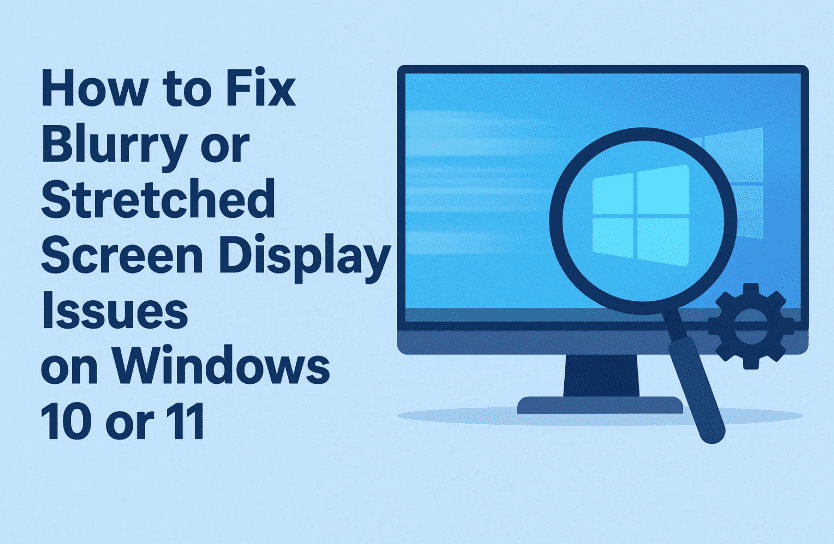
If your screen looks blurry, stretched, or distorted on your Windows 10 or 11 computer, you’re not alone. This issue is quite common, especially after a Windows update, graphics driver malfunction, or incorrect display settings. But don’t worry — in this guide, I’ll walk you through all the possible ways to fix the screen resolution issue step-by-step.
Let’s start by adjusting the basics and move our way toward more advanced solutions. Great, let’s dive in.
🧰 Step 1: Set Recommended Display Resolution and Scaling
First things first — most display issues arise when your resolution or scaling is not set to what your hardware supports best.
Here’s how to check and fix it:
- Right-click on the desktop and click Display settings.
- In the Display tab:
- Under Scale and Layout, set the Scale to Recommended (e.g., 100%, 125%, 150%).
- Under Display Resolution, choose the Recommended option.
- For example, many laptops default to 1366×768 or 1920×1080.
Using a dual screen?
- Scroll down in Display settings, select each monitor, and ensure both are using their respective recommended resolution.
Optional:
- Click Advanced Scaling Settings and leave the checkbox ticked: “Let Windows try to fix apps so they’re not blurry.”
🌀 Step 2: Set Correct Refresh Rate
After fixing resolution and scaling, let’s tweak the refresh rate — especially important for clarity and avoiding screen stretching.
- In Display settings, scroll down and click Advanced display settings.
- Locate Refresh rate and:
- Try setting it to the highest supported value (e.g., 60Hz or 75Hz).
- If the display becomes unstable, switch back to a lower rate.
This setting plays a vital role in maintaining sharp visuals on compatible screens.
🖥️ Step 3: Update Graphics Driver via Device Manager
If your screen still looks off, it might be due to an outdated or default Microsoft display driver.
Follow these steps:
- Right-click on the Start Menu and open Device Manager.
- Expand Display adapters.
- If it says Microsoft Basic Display Adapter, your actual graphics driver is missing.
- If it shows Intel HD, AMD, or NVIDIA, proceed.
- Right-click your display adapter and choose Update Driver.
- Select Search automatically for drivers.
💡 You can also try right-clicking again and selecting Scan for hardware changes if the display was working fine previously but suddenly looks stretched.
Also, expand Monitors in Device Manager and update that driver too.
🔄 Step 4: Check for Windows Updates
An outdated Windows version can also cause display issues, especially if a recent update disrupted driver compatibility.
- Press
Windows + Ito open Settings. - Go to Windows Update and click Check for updates.
- If updates are found, install and restart your PC.
🔍 Step 5: Repair Windows System Files
Sometimes corruption in system files may affect display settings. Here’s a reliable way to fix it.
- Open Command Prompt as administrator.
- Type the following command and press Enter:
sfc /scannow - Let it finish scanning. If it finds issues, it will attempt to repair them.
🔁 Restart your PC once the scan completes.


🧑💻 Step 6: Manually Download Manufacturer Display Drivers
If automatic driver updates didn’t solve it, let’s go the manual route and get your GPU drivers straight from your PC’s manufacturer.
How to identify your device:
- Open Command Prompt and type:
wmic csproduct get name- This gives you your PC model name or serial number.
- Go to the official driver website of your PC manufacturer:
- Enter your serial number or model name.
- Choose your OS (Windows 10/11).
- Download the latest Graphics Driver under Display/Video section.
- Run the downloaded installer (usually a
.exefile), and restart your PC.
That should restore proper display performance with manufacturer-optimized drivers.
❓ FAQs
Q1. Why does my screen look blurry even after setting the recommended resolution?
Sometimes apps don’t scale properly. Try going to Advanced Scaling and letting Windows fix blurry apps.
Q2. What if my driver says “Microsoft Basic Display Adapter”?
This means your system doesn’t recognize the actual GPU. You must download and install the correct display driver from the manufacturer’s website.
Q3. Can outdated BIOS cause display issues?
Rarely, but if you’ve tried everything and still face problems, check if there’s a BIOS update available from your manufacturer’s support page.
✅ Conclusion
So far we’ve tackled all the possible culprits — from display settings to drivers and system files — that could cause a blurry or stretched screen on your Windows PC. By following these steps carefully, you’re likely to solve the issue without needing to reinstall Windows.
And remember, keeping your drivers and system updated is the key to smooth and crisp display performance.
🏷️ Tags:
blurry display windows, screen stretched fix, resolution fix windows 11, fix display settings windows, intel hd graphics update, refresh rate screen fix, update display driver, sfc scan repair
🔖 Hashtags:
#Windows11 #DisplayFix #BlurryScreen #StretchedResolution #WindowsTips #DeviceManager #TechSupport
🛑 Disclaimer: Always ensure you’re downloading drivers directly from official websites. Incorrect drivers can harm your system. Also, make sure you restart your PC after every driver or system update for proper changes to take effect.