If you’re a creator, there’s one thing that can ruin your morning faster than a burnt piece of toast — waking up to zero new subscribers.
You pour your time, creativity, and emotions into your content… only to see the subscriber count stay stubbornly still. It feels discouraging, doesn’t it?
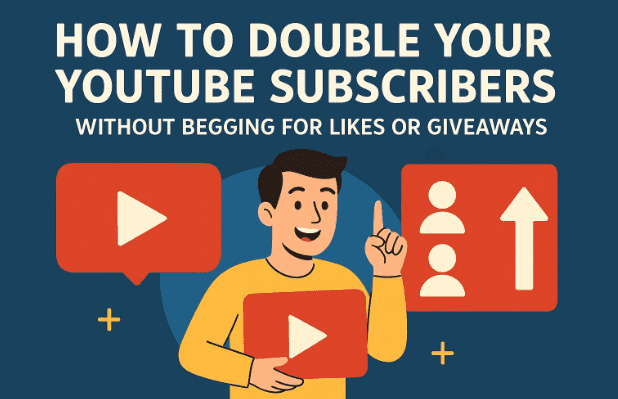
But here’s the truth: you don’t need flashy giveaways or clickbait thumbnails to grow faster. You just need to understand viewer psychology — and the right timing to ask for the subscription.
Let’s break it down step by step, using proven strategies, relatable examples, and data-backed logic from YouTube itself.
1. Why Most Creators Struggle to Gain Subscribers
YouTube isn’t about views, it’s about retention and relationship.
Most creators focus entirely on metrics — number of views, likes, or shorts performance — but forget that subscriptions happen when viewers feel emotionally connected or deeply satisfied with your content.
Unfortunately, many creators try to shortcut that connection. They start their videos like this:
“Hey guys, don’t forget to like, share, and subscribe!”
Here’s the problem: you’re asking for commitment before connection.
Think of YouTube as a relationship. You wouldn’t propose marriage before introducing yourself, right? Yet, that’s what early “subscribe” requests do — they push people away instead of pulling them in.
2. The Real Mistake: Asking Too Early
Let’s move to the next insight — timing.
Many creators pop the “subscribe” request within the first five seconds of the video, right after an old-school intro animation.
It’s as awkward as proposing in a supermarket aisle before you’ve even had a proper conversation.
Why is this a problem?
Because the viewer hasn’t yet seen the value you bring. They don’t know if your content is worth their time, let alone their subscription.
So, the first impression you create becomes one of self-promotion, not connection.
The fix, however, is beautifully simple — earn interest first, then ask.




3. What Happens in the First 15 Seconds
Think of the first 15 seconds of your YouTube video as your first date with the viewer.
This is when they decide whether they want to keep watching — or click away.
In those opening seconds, you must:
- Hook attention with a relatable problem.
- Deliver immediate value or curiosity.
- Set expectations (“In this video, you’ll learn how to double subscribers…”).
The goal is not to show who you are but why you matter to them.
Just like you wouldn’t start a date by bragging about yourself, don’t start your video by bragging about your channel. Instead, start by solving something or teasing a solution that keeps them watching.
4. The Science Behind Viewer Commitment
Psychology plays a massive role here.
According to studies in behavioral marketing, people are more likely to commit to something after receiving value — a principle known as reciprocity.
YouTube’s algorithm indirectly rewards this behavior too. When viewers stay longer, engage naturally, and click subscribe out of interest rather than impulse, the algorithm interprets it as genuine engagement — boosting your overall reach.
So when you earn a subscriber after they’ve watched 50–70% of your video, it’s not just one new fan; it’s a signal to YouTube that your content truly connects.
5. The Right Way to Ask for a Subscription
Now that we understand why timing matters, let’s see how to ask effectively.
The key is to ask at the right moment — when the viewer already trusts your knowledge or enjoys your storytelling.
For example:
- Deliver your main value (solution, insight, or story).
- Then, transition naturally with something like: “If you found that useful, you’ll love what’s coming next — so subscribe to stay ahead.”
Or use curiosity as leverage:
“This was just one part of the full strategy — make sure to subscribe so you don’t miss the next step.”
Notice that both lines are polite, valuable, and specific. You’re not demanding attention; you’re inviting it.
6. A Real Example: Two Videos, Same Views — Different Results
Let’s bring this to life with a real-world comparison.
Imagine two videos, both with 100,000 views.
- Video A: The creator asked for a subscription at the beginning.
- Video B: The creator asked only after the main content was delivered — towards the end.
Here’s the result:
- Video A gained 930 subscribers.
- Video B gained almost double — over 1,800 subscribers.
Surprising, right? Especially considering that by the end of the video, only 35% of viewers were still watching.
But those 35% were the most invested, meaning they were far more likely to act.
It’s not about reaching everyone — it’s about convincing the right people at the right moment.
7. Understanding Viewer Retention Metrics
Before you plan your “subscribe moment,” you need to study retention analytics inside YouTube Studio.
Go to:
- YouTube Studio → Analytics → Audience → Retention Graph
Here, you’ll see where people drop off. Usually:
- The first 15 seconds lose the most viewers.
- Then there’s a stable middle.
- Finally, a second dip before the outro.
Your goal is to place your call-to-action just before that final dip — around the 65–80% mark of your video.
That’s when viewers are most loyal and receptive. Asking earlier wastes your request; asking too late means they’ve already left.
8. How to Plan the Perfect “Subscribe Moment”
Now let’s plan it strategically.
Here’s a clear structure to follow for every video:
Step 1: The Hook (0–15 seconds)
Start with a problem, not a greeting. Example:
“You know what’s worse than posting daily? Posting daily and still getting zero subscribers.”
This grabs attention instantly.
Step 2: The Value Segment (15 seconds–3 minutes)
Deliver quick insights or teach something actionable. Build credibility before asking for anything.
Step 3: The Call to Subscribe (3–4 minutes or near 70% watch time)
Transition naturally:
“If this is already helping, imagine what you’ll learn in the next part — subscribe so you don’t miss it.”
Step 4: The Soft Outro
End with a forward link:
“Now that you’ve learned how to earn subscribers, here’s how to improve your click-through rate next.”
This gives them a sense of progress, not pressure.
9. Alternative CTAs That Build Trust
Instead of always saying “subscribe,” use variations that sound natural and friendly.
Here are a few ideas:
- “Join the channel if you found this useful — I post new tutorials every week.”
- “Stick around; there’s more where this came from.”
- “Let’s grow together — hit subscribe if this connected with you.”
You can even personalize it based on your niche:
- For tech channels: “Subscribe for smarter tech hacks every week.”
- For creators: “Join the creator lab — no fluff, just results.”
By making your CTA about value, not vanity, you attract an audience that stays long-term.
10. Common Mistakes Creators Still Make
Even with the right formula, many YouTubers unknowingly sabotage their subscriber growth. Let’s highlight the top few:
- Overly long intros – Nobody wants to watch a 15-second animated logo. Get to the point fast.
- Multiple CTAs – “Like, comment, share, subscribe” all at once dilutes your ask. Focus on one main goal.
- No preview of value – If your viewer doesn’t know what they’ll get, they won’t invest.
- Ignoring audience emotion – Facts educate, but emotions convert. Use storytelling to build connection.
- No engagement after subscription – Respond to comments and community posts. Subscribers need recognition to stay active.
11. Quick Checklist for Every Upload
Before you hit publish, review this 7-point checklist to maximize subscriber conversions:
✅ Does your hook clearly state a problem or goal?
✅ Did you delay your “subscribe” request until after the main value?
✅ Is your intro under 10 seconds?
✅ Did you use one strong call-to-action, not four weak ones?
✅ Does your ending guide the viewer to the next related video?
✅ Did you analyze audience retention in YouTube Studio?
✅ Have you replied to at least 10 comments on your last video?
Tick all of these boxes, and your subscription rate will rise — not by luck, but by design.
12. FAQs
Q1. Should I never ask to subscribe at the start?
You can, but only briefly and creatively — for example, use humor or a short one-liner before jumping into content. The main CTA should still come later.
Q2. How many times should I ask per video?
Once clearly, and once subtly. Avoid repeating it multiple times unless contextually relevant.
Q3. What’s a good subscription rate per 1,000 views?
Typically, 0.5% to 2% is average. Anything above that means your content builds strong trust.
Q4. Should I use on-screen graphics for the CTA?
Yes, but keep it minimal — a simple animation or bell icon near the lower third of the screen works best.
Q5. Can Shorts follow the same rule?
For YouTube Shorts, yes — but place your CTA in the caption or final 3 seconds, since Shorts are faster-paced.
13. Final Thoughts
At its core, YouTube is about relationships.
Subscribers aren’t earned by shouting louder — they’re earned by understanding human timing and behavior.
When you stop begging for attention and start earning it through clarity, consistency, and timing, your channel naturally grows.
It’s not a trick or algorithm hack — it’s trust, built over time, one video at a time.
So next time you upload, remember this:
Don’t propose in the first five seconds. Earn the connection — then make the invite.
If this article helped you rethink your subscriber strategy, explore more insights on YouTube analytics, content retention, and viewer psychology in our next guide.
Disclaimer:
This article is for educational purposes. The statistics and methods discussed are based on general YouTube analytics insights and creator behavior patterns as of 2025. Actual results may vary by niche, audience type, and content consistency.
Tags: YouTube growth tips, increase subscribers, YouTube analytics, YouTube retention strategy, creator psychology, call to action, YouTube engagement, YouTube content strategy, audience retention, content marketing
Hashtags: #YouTubeTips #CreatorGrowth #SubscriberStrategy #YouTubeAnalytics #ContentCreation #VideoMarketing #YouTubeGuide