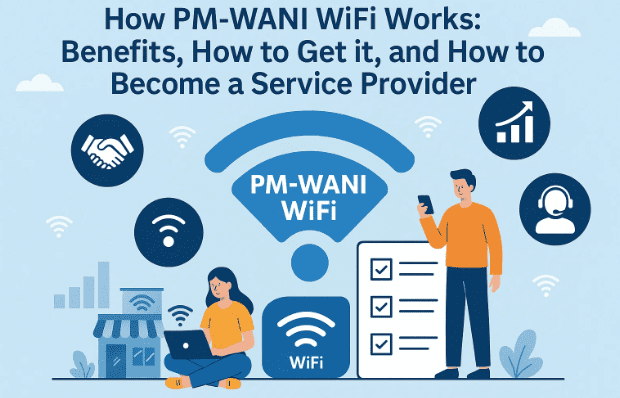
Imagine getting affordable WiFi access in your town or village — maybe even from the shop next door — and the same system giving you the opportunity to become the one offering it. That’s the promise behind PM-WANI, the Indian government’s scheme to democratize internet access.
In this article, we’ll take a deep dive into PM-WANI: what benefits it offers, how you (as a user) can connect, and how you (as an entrepreneur or shop owner) can become a service provider. I’ll walk through each step with clarity, add supporting facts, highlight challenges, and answer common questions — so you don’t need to guess.
So far, we’ve set the stage. Let’s move on to the basics: what PM-WANI is and why it matters.
What Is PM-WANI?
Let’s begin with the framework and goals behind PM-WANI.
- PM-WANI stands for Prime Minister’s Wi-Fi Access Network Interface. It is a public framework established by the Department of Telecommunications (DoT) to expand affordable WiFi access across India via public hotspots.
- The idea is to allow local businesses — small shops, kiosks, homes — to host WiFi access points that people can use for internet connectivity, with minimal regulatory burden.
- PM-WANI divides the system into multiple roles: PDO (Public Data Office), PDOA (Public Data Office Aggregator), and App Provider. These roles work together to deliver, authenticate, and bill the services.
- As of March 2025, over 278,439 PM-WANI compliant WiFi hotspots had been set up in India.
- Also, by December 2024, there were 1,819,674 unique PM-WANI users and total data consumption of roughly 58.55 petabytes.
The scheme is designed to drive digital inclusion, entrepreneurship, and low-cost access — especially in underserved or rural areas.
Benefits for Users & Service Providers
Before getting into how it works, let’s see what you stand to gain — both as a WiFi user and as someone wanting to provide the service.
For Users / Customers
- Very low-cost internet access: The PM-WANI plans are among the cheapest you’ll find. For example: ₹6 for 1 GB (1 day), ₹9 for 2 GB (2 days), up to plans like ₹99 for 100 GB (30 days).
- Wide accessibility in villages, towns, or areas where wired broadband or fiber is expensive or not available.
- Multiple choices of hotspots: Because all PDOs are connected via aggregators and apps, you can switch among hotspots within reach (if compliant).
- No need for licenses or heavy regulation: For users, connecting via a hotspot is transparent — just authenticate via the app.
For Service Providers / Entrepreneurs
- Earnings potential: As a PDO (Public Data Office), you can sell data plans to nearby users and generate income.
- Minimal regulatory overhead: PDOs don’t need telecom licenses or registration fees for last-mile public WiFi.
- Support structure via PDOA: The aggregator handles user authentication, billing, and portal management, reducing your burden.
- Flexibility: You can start small (one shop, one hotspot) and later expand to multiple zones as demand grows.
So, you get both access and a chance to create a micro-business.
How PM-WANI Works: Technical & Operational Flow
Let’s now dig into how the system operates behind the scenes. This section will explain the roles and the step-by-step flow of connecting a user or enabling a hotspot.
Key Roles & Responsibilities
Before jumps into the steps, here are the main players:
| Role | Responsibility |
|---|---|
| PDO (Public Data Office) | Sets up and maintains WiFi access points. Provides last-mile connectivity to users. |
| PDOA (Public Data Office Aggregator) | Aggregates multiple PDOs, handles accounting, authentication, billing, authorization. |
| App Provider | Builds the user-facing mobile or web app to discover hotspots, manage user login and payment, and interface with PDOA. |
| Central Registry / C-DoT | Maintains registry of all PDOs, PDOAs, App Providers, and ensures compliance with standards. |
Now, let’s go through the process of how a user gets internet access and how a PDO is set up.
Step-by-Step: How a User Connects
- Install/Use an App Provider’s app
The user downloads a PM-WANI compliant app (from an approved app provider). The app helps discover nearby WiFi hotspots. - Discover WiFi Hotspots
In the app, the user sees a list of nearby WiFi access points (PDOs) that are compliant with PM-WANI. - Choose a hotspot and data plan
The user selects a hotspot and a plan (for example, 1 GB for ₹6) via the app interface. - Authenticate via the captive portal / authorization
When the user tries to connect, the hotspot (PDO) triggers an authentication request that goes via the PDOA. The app & PDOA authorizes and issues a token/session. - Connect & use internet
Once authorized, the user’s device gets internet access for the duration/amount specified. - Logging and accounting
The usage is tracked, billed, and managed by the aggregator or the app provider infrastructure, which then compensates the PDO.
This setup ensures that multiple PDOs can serve users seamlessly, with authentication and billing centralized via the aggregator and app layer.








Step-by-Step: How to Become a PDO / Service Provider
Here’s how you (as a shopkeeper or entrepreneur) can become a PDO and start providing WiFi to your local area.
So far, we’ve understood how the system works. Next up: how you can get started.
Step 1: Verify connectivity & location
You should have a stable broadband/ISP connection (from any major ISP) in your shop or premises. The location should be such that users are within wireless range (some radius depending on the hotspot hardware).
Step 2: Identify or partner with a PDOA
To connect your hotspot to the larger PM-WANI system, you must be aggregated under a PDOA (aggregator). The PDOA handles the backend: authentication, billing, and interfacing with apps and the central registry.
Step 3: Register as a PDO
- You fill out the “Enquiry Form / PDO registration” on the PM-WANI central registry website.
- You provide essential details like name, address, mobile, internet provider, etc.
- There is no license fee. PBS guidelines state PDOs don’t require telecom license or fees.)
Step 4: Get WANI-compliant hardware
You need equipment (router, access point) that meets PM-WANI / DoT technical specs. Some companies manufacture “PM-WANI compliant devices.”
Step 5: Connect hardware and configure
- Connect your broadband line to the router / access point.
- Integrate with PDOA’s software or captive portal so authentication and billing parts can happen.
- Test connectivity, authentication, session handing.
Step 6: Go live & maintain
You start offering WiFi, manage users, monitor performance, and scale gradually. Use the tools your aggregator provides to monitor usage, billing, and customer feedback.
Step 7 (optional): Expand area or scale
As demand grows, you may deploy more hotspots or cover adjacent zones, always under the same PDOA or scaling via multiple PDOAs.
Sample Pricing & Plans
Here are example data plans under PM-WANI (as of current public information):
- ₹6 → 1 GB (1 day)
- ₹9 → 2 GB (2 days)
- ₹18 → 5 GB
- ₹25 → 20 GB
- ₹49 → 40 GB
- ₹99 → 100 GB (30 days)
These are currently among the cheapest data options in India relative to typical broadband or mobile data rates.
Challenges, Limitations & Things to Watch Out
While promising, PM-WANI also has challenges:
- Coverage limitations in metro or fiber zones
In major cities or areas where fiber / high-speed broadband is already available, PM-WANI may not be attractive or even allowed due to existing ISP contracts or competition. - Hardware & maintenance costs
Even though software and backend costs are low, you must invest in quality hotspot hardware, power backup, and reliable maintenance. - Fluctuating speeds and capacity
As your user base scales, the same access point may not serve all users at high speeds — congestion, interference, and backhaul capacity matter. - Aggregator & app ecosystem dependency
You depend on your chosen PDOA and app provider for authentication, payments, support. If they fail or mismanage, your service suffers. - Regulation and compliance changes
Policies, technical specs, or revenue-sharing rules may evolve — you must stay updated with DoT / C-DoT guidelines. - User trust & adoption
Getting users to trust new, small hotspots for daily internet use may take time. Reliability, uptime, and support matter.
These caveats don’t invalidate PM-WANI but highlight where vigilance and planning are needed.
Q&A – Frequently Asked Questions
Q: Do I need a telecom license to become a PDO?
No. The PM-WANI framework explicitly states PDOs do not require telecom or licensing fees. (PM-WANI)
Q: Who are PDOAs and how are they selected?
PDOAs are aggregators that manage authentication, billing, and connecting multiple PDOs. Entities (companies, ISPs) register as PDOAs through DoT processes.
Q: Which hardware do I need to run a PM-WANI hotspot?
You need WANI-compliant WiFi routers/access points that meet DoT specifications. Some vendors already sell compliant devices.
Q: Can I switch among PM-WANI hotspots using the same login?
Yes — as long as the hotspots are under interoperable PDOAs and the same app, users may roam among them seamlessly.
Q: Is unlimited data offered under PM-WANI?
As of now, public data shows fixed-amount plans (1 GB, 5 GB, 100 GB, etc.). Unlimited plans are not reliably documented in official sources.
Q: How many hotspots exist currently?
As of March 2025, about 278,439 hotspots are registered under the PM-WANI scheme.
Q: How many users and how much data is consumed?
By December 2024, ~1,819,674 users and 58.55 petabytes of data were recorded.
Real-World Example & Use Case
Let’s illustrate with a hypothetical scenario:
Raj runs a neighborhood grocery shop in a small town. He has a good broadband line (say 100 Mbps). He applies to become a PDO, registers on PM-WANI registry, connects with a PDOA, sets up a WANI-compliant router. He offers local neighbors affordable WiFi (₹9 for 2 GB). Over time, 50 users in radius connect daily. Raj earns a modest but steady supplemental income. As demand grows, he adds another hotspot at his franchise or next street, becoming a small WiFi entrepreneur.
In rural or semi-urban areas where wired broadband is expensive or patchy, many more shops like Raj’s could multiply coverage — bridging the digital divide.
How to Get Started: For Users & Providers
If You Want PM-WANI WiFi as a User
- Install a PM-WANI compliant app (from a registered app provider).
- Discover nearby hotspots in the app.
- Choose a data plan & pay in the app.
- Authenticate and connect via the captive portal.
- Use the internet.
If You Want to Become a PDO
- Check you have a reliable ISP broadband connection.
- Find a PDOA or aggregator that you will partner with.
- Register as PDO via the PM-WANI registry (via pmwani.gov.in) — fill the PDO enquiry form.
- Acquire a WANI-compliant access point (router) & set it up.
- Integrate with aggregator’s backend (authentication, billing).
- Go live, monitor usage, and scale.
Disclaimer
This article is meant for informational and educational purposes only. The PM-WANI scheme, policies, numbers, and processes are subject to change by the Government of India, DoT, or C-DoT. Readers should always refer to official PM-WANI or DoT resources (such as pmwani.gov.in or DoT’s WANI framework) for the latest guidelines before making business decisions.
#PMWANI #PublicWiFi #DigitalIndia #WiFiHotspot #LowCostInternet #PDO #PDOA #TechInIndia #InternetAccess #Connectivity