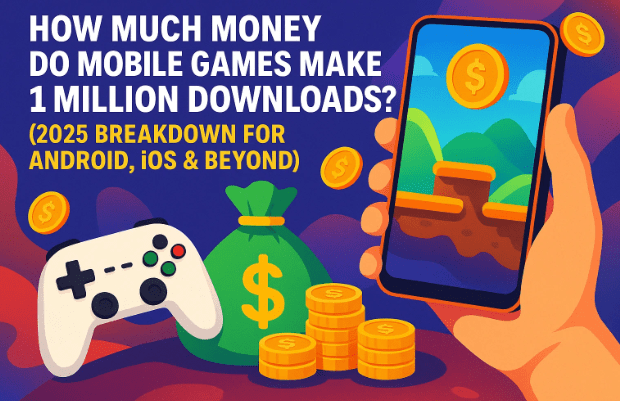
Every aspiring game developer wonders this at some point:
“If my mobile game gets one million downloads, how much money will it actually make?”
It’s a fascinating question — because download numbers often create illusions. A million downloads sounds like instant success, but in reality, it can mean anything between a few hundred dollars and a six-figure sum, depending on your monetization model, audience, and timing.
In this article, we’ll analyze realistic earnings for a mobile game that hit one million downloads on Android, along with its performance on other platforms like iOS, Xbox, Switch, Steam, and even HTML5.
We’ll also discuss how revenue adds up over time, what “mistakes” most indie developers make, and why porting to multiple platforms might be the smartest move you can make in 2025.
Do 1 Million Downloads Guarantee Big Money? 💰
Let’s start with the harsh truth — no, they don’t.
A game with 1 million downloads can earn anywhere from $1,000 to $150,000+, depending on factors such as:
- Whether it’s free with ads or premium (paid upfront)
- Your country’s ad CPM rates
- Retention, engagement, and in-app purchase conversion rates
- Cross-platform presence and organic discoverability
So while 1 million installs is a great milestone, it’s not the final measure of success. The next question becomes: how efficiently can you monetize that audience?
The Background: A Solo Developer’s Journey 🧑💻
Let’s imagine a solo developer who created a pixel-art sci-fi shooter in 2020. It wasn’t a perfect game — it had rough level design, long missions without checkpoints, and poor onboarding.
But it had one big advantage: it was finished and released.
The developer handled story, design, coding, and marketing alone, with minor help for art and music. And despite being an imperfect product, it reached over 1 million downloads on Android alone and earned respectable revenue across multiple platforms.






This story isn’t about a viral hit. It’s about consistency, persistence, and smart publishing decisions.
Game Metrics That Affect Revenue 📊
Before diving into the actual numbers, it’s important to understand why some games with the same number of downloads perform differently financially.
1. Retention Rate
This measures how many players return after installing the game.
- Day-1 retention: 15 % (meaning 85 % of players quit after first launch).
- Day-7 retention: often below 5 %.
The lower the retention, the fewer ad impressions and purchases.
2. Average Playtime
The game had an average playtime of 19 minutes for a campaign lasting nearly four hours. Players who drop off early reduce both engagement and ad revenue potential.
3. Monetization Strategy
There were two versions of the game:
- A free version with ads.
- A premium (paid) version without ads.
Both models contributed differently to total revenue.
Android Revenue Breakdown (Ads + Premium) 🤖
Now let’s get to the exciting part — the actual earnings from 1 million+ Android downloads.
The developer used Yodo1 Mediation (similar to AdMob) for ad management, combining multiple ad networks for better fill rates.
Here’s the breakdown:
| Source | Revenue (USD) | Notes |
|---|---|---|
| Free version (with ads) | $12,000 | Banner + interstitial ads from Yodo1 Mediation |
| Premium version (paid app) | $45,000 | Sales from Google Play Store |
| Earlier AdMob Mediation | $2,000 | Initial months before switching networks |
| Total Android revenue | $85,447 | From ~1 million downloads |
Most of these downloads were organic, with minimal marketing spend. Even years later, the game continues to generate a few hundred dollars monthly from ads and residual purchases.
That steady tail of revenue shows how long-term passive income can exist even for older titles.
iOS Revenue Breakdown (Ads + In-App Purchases) 🍎
The iOS version performed more modestly, with around 229 k downloads. However, because iOS players typically yield higher ad CPMs and purchase rates, it still contributed significantly.
| Source | Revenue (USD) |
|---|---|
| Ads | $7,367 |
| In-App Purchases (IAPs)** | $9,390 |
| Total iOS revenue | $16,757 |
Interestingly, while downloads were only about 20 % of Android’s, the iOS version earned almost 20 % of total revenue — showing better monetization per user.
Console & PC Platforms (Xbox, Switch, Steam, HTML5) 🎮
After the mobile release, the developer took a bold step — porting the same game to other platforms instead of building something entirely new.
Let’s see how those smaller channels performed:
| Platform | Approx Revenue | Notes |
|---|---|---|
| Xbox | $13,000 | Modest but steady; benefited from Game Pass exposure |
| Nintendo Switch | $3,000+ | Niche audience, but good for brand visibility |
| Steam (PC) | $625 | Oversaturated market, minimal visibility |
| HTML5 (Web) | $150 | Used mainly for promotional traffic |
While individually small, these figures add up — and highlight how diversifying platforms can multiply revenue over time.
Total Lifetime Revenue Summary 💵
Let’s consolidate everything:
| Platform | Total Downloads | Total Revenue (USD) |
|---|---|---|
| Android | ~1,000,000 + | $85,447 |
| iOS | ~229,000 | $16,757 |
| Xbox | N/A | $13,000 |
| Nintendo Switch | N/A | $3,000 |
| Steam | N/A | $625 |
| HTML5 | N/A | $150 |
| Total Lifetime Revenue | — | ≈ $119,000 USD |
That’s roughly $120 k earned across multiple platforms over several years — not a fortune, but for a solo indie project with minimal investment, it’s a meaningful success.
Why Porting Your Game to Multiple Platforms Matters 🌍
So far, we’ve looked at the raw numbers. Now let’s understand why this worked despite weak metrics.
The smartest move was porting the game to as many platforms as possible — Android, iOS, Xbox, Switch, Steam, HTML5.
Here’s why it makes such a difference:
1. Exposure to Different Audiences
Every platform has a unique user base. Android brings volume, iOS brings spending power, consoles bring dedicated gamers.
2. Long-Tail Earnings
Even years after launch, small monthly earnings across platforms accumulate into a stable passive income.
3. Portfolio Value
Publishers and investors prefer developers who have cross-platform experience — it signals technical depth and business awareness.
4. Reduced Risk
If one platform underperforms (for instance, Steam sales), others like Android or Xbox can keep the overall revenue steady.
💡 Tip for Indie Devs: Use game engines like Unity or Godot 4 to export to multiple targets easily. Build modular code from day one to simplify porting later.
Lessons for Indie Developers 🧭
Let’s step back and talk about what this story teaches us.
🕹️ 1. Finish Something — Even if It’s Not Perfect
The biggest milestone isn’t one million downloads — it’s shipping a complete, playable game. An imperfect finished product beats an eternal prototype.
💡 2. Focus on Retention and Design Early
Even great marketing can’t save a poor onboarding experience. Retention and replayability directly translate into higher ad and IAP revenue.
🌍 3. Port Everything You Can
Don’t limit yourself to one store. Export it to every platform that fits your genre. Even small gains compound over years.
💸 4. Passive Income Takes Time
Revenue may trickle in slowly, but if your game remains visible and playable, that trickle can last for years.
❤️ 5. Build With Heart
Players notice sincerity. A rough game made with care often outperforms a soulless copy-paste clone. Authenticity builds word-of-mouth visibility.
Frequently Asked Questions (FAQs) ❓
Q1. Do all games with 1 million downloads make over $100 k?
No. Monetization depends on ad fill rates, retention, and user demographics. Some hit 1 million installs and barely reach $5 k in ads.
Q2. Which is more profitable — free or paid games?
Free games get more downloads and ad revenue; paid games earn less volume but more per purchase. Combining both versions often works best.
Q3. How can indie developers get featured on App Store or Google Play?
Focus on visual quality, unique gameplay, and good localization. Both platforms promote games that align with seasonal or editorial themes.
Q4. How long can a mobile game keep earning?
If it’s stable, discoverable, and available worldwide, it can earn small but consistent amounts for years — even after you stop active updates.
Q5. Should I release on consoles?
If your game performs decently on mobile and uses a controller-friendly layout, yes. Xbox and Switch ports can add exposure and moderate sales.
Disclaimer ⚠️
The revenue figures discussed in this article are based on a real indie developer’s experience but rounded for clarity. Actual results vary depending on region, ads CPM, user base, and platform policies.
Game development income should not be considered guaranteed. Always back up financial data, track analytics, and follow respective store guidelines before publishing.
#GameDev #IndieGame #MobileGames #AppRevenue #AndroidEarnings #iOSEarnings #GameDevelopment #PassiveIncome #IndieDevJourney #GameDesign