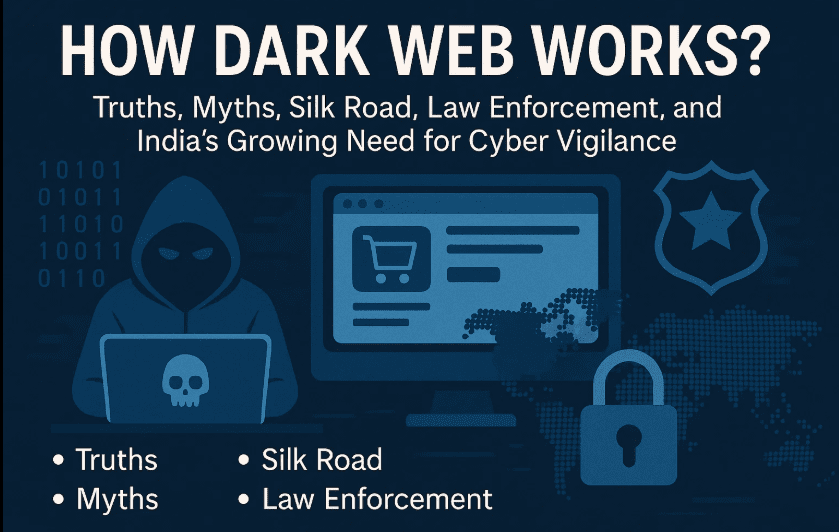
When we hear the term “Dark Web,” what comes to mind is a shadowy world filled with criminals, hackers, and hidden marketplaces. But what exactly is the dark web? How does it work? Why can’t it be shut down? How do police track illegal activities on it? What are red rooms? And how is the Indian government dealing with this growing threat?
In this detailed article, we’ll unravel all these questions step by step, explain the origin of the dark web, how encryption works on platforms like Tor, and look at some high-profile cases like Silk Road and Alphabay. We’ll also explore what India can do to tackle this emerging cyber threat.
🌐 What Is the Dark Web?
Let’s begin by understanding the internet in layers:
- Surface Web: The regular internet – Google, Facebook, Wikipedia.
- Deep Web: Content not indexed by search engines – like your email inbox, private databases.
- Dark Web: A hidden part of the internet that is intentionally concealed and can only be accessed using special tools like the Tor browser.
The dark web is where things get murky. It’s anonymous, encrypted, and inaccessible via traditional browsers. But how did it even come into existence?
🧬 Origin of the Dark Web: The Tor Project
The dark web as we know it began with the Tor Project (The Onion Router), developed in the 1990s by scientists at the U.S. Naval Research Laboratory—Paul Syverson, Michael G. Reed, and David Goldschlag.
Initially, it was a defense mechanism to protect American intelligence agents online. It was created so that spies could communicate securely without revealing their locations, even if they were being monitored. But it came with a problem—if only spies used Tor, they’d stand out easily.
So, the U.S. decided to make Tor open-source and public. As regular users flooded the network, government agents became indistinguishable from the crowd.
Ironically, a tool built for intelligence now powers one of the most lawless corners of the internet.
🧅 How the Tor Network Works (And Why It’s So Secure)
Let’s now understand how this works without skipping details.
Imagine you want to send a secret message. You put it in a small box, then lock it inside a bigger box, and then another bigger one. You send it, and each delivery person opens only the outermost box, revealing the next address.
Similarly, when you connect to the Tor network:











- Your data is encrypted in multiple layers.
- It bounces through at least three nodes (servers operated by volunteers).
- Each node only knows the next hop, not your origin or final destination.
This is called multi-layer encryption, like an onion’s layers—hence the .onion domain and the Tor browser’s onion icon.
Even your Internet Service Provider (ISP) can only see that you’re using Tor, not what you’re doing inside it.
🔍 Why Google Can’t Index .onion Websites
Unlike regular websites, .onion sites do not have DNS records. You can’t Google them. There’s no search engine indexing them like in the surface web. You must know the exact URL to access a dark web site, often shared privately via forums like Hidden Wiki.
🕵️ How Law Enforcement Tracks Criminals on the Dark Web
Let’s move to the next important aspect—police tracking. You may think it’s impossible, but it isn’t. Let’s understand how.
Even on the dark web:
- Mistakes made by users often lead to their identification.
- Metadata, old forum posts, and server leaks help law enforcement.
- Agencies act as undercover buyers, follow crypto transactions, and watch for human errors.
Let’s explore real-life examples next.
💣 The Silk Road Case: When the FBI Struck Back
Ross Ulbricht, a 26-year-old physics graduate and self-taught coder, launched Silk Road, a darknet marketplace selling fake IDs, drugs, weapons, and more—all paid via Bitcoin.
Despite being anonymous, a forgotten post Ross made in a forum about “Silk Road” helped the FBI connect the dots. After two years of surveillance, they arrested him in a San Francisco library while he was logged into the admin panel of Silk Road.
Ross was sentenced to life imprisonment.
💰 Alphabay: The Marketplace That Grew Ten Times Bigger
After Silk Road’s takedown, Alexandre Cazes, another 26-year-old tech whiz from Canada, launched Alphabay.
It was 10x larger than Silk Road. But Cazes made a mistake—during a registration error on the homepage, the admin’s email ID leaked, which matched a personal account. Then his crypto wallet transactions were traced, leading law enforcement to Thailand, where he lived.
They raided his home, found the admin panel open, and arrested him. Days later, Cazes was found dead in his jail cell. His death remains controversial.
🚔 Other Dark Web Cases That Shook the World
- Playpen: A child abuse website taken down via Operation Pacifier.
- Daisy’s Destruction: One of the most horrifying dark web cases ever (we’ll not elaborate here due to sensitivity).
- Shadow Brokers: A hacking group that leaked NSA tools on the dark web, which were later used in the WannaCry ransomware attacks in 2017.
🤔 Frequently Asked Questions About the Dark Web
Let’s now address some common questions people have:
Q1: What happens on the dark web?
The dark web hosts illegal activities like:
- Sale of weapons
- Fake passports and documents
- Stolen data
- Drugs
- Human trafficking
- Hacking tools
But it’s also used by:
- Whistleblowers
- Journalists
- Spy networks
Q2: Is the dark web dangerous?
Yes, especially if you:
- Click on illegal links
- Download malicious files
- Interact with hidden services without knowing their legitimacy
You may also be exposed to disturbing content.
Q3: Can police trace you on the dark web?
Absolutely. Despite encryption, human errors (like reused usernames, emails, crypto leaks) can lead law enforcement right to you.
Q4: Are Red Rooms real?
“Red Rooms” are alleged live-streamed torture sessions. While there’s no confirmed public evidence, many suspect such content exists, hidden deep in the web.
Q5: Can you hire a hitman on the dark web?
Most such services are scams, but the fact that such listings exist reflects the dangerous potential of the platform.
Q6: What if I open an illegal link by mistake?
Exit immediately. Don’t click, don’t interact. If you don’t engage further, you should be safe.
Q7: Is everything on the dark web illegal?
No. It also enables:
- Secure whistleblowing
- Political dissent under oppressive regimes
- Anonymous communication for journalists and activists
Q8: Can the dark web be shut down?
Not really. It is decentralized, with no central server or location. As long as people run Tor nodes, the dark web will continue to exist.
🇮🇳 India and the Dark Web: A Growing Threat
India has seen rising dark web activity since 2020, especially during the lockdown period. Contributing factors:
- Growing interest in cryptocurrency
- Rise of hacking communities
- Lack of awareness
Indian Law Enforcement Units Involved:
- CERT-IN (Indian Computer Emergency Response Team)
- NIA
- CBI
- Cyber Cells across states
These agencies work in coordination to track and report dark web threats.
🛡️ How Can India Respond Better?
Let’s now explore the next steps India can take to manage dark web threats more effectively.
✅ 1. Set Up a National Dark Web Monitoring Cell
- Monitor and maintain lists of active .onion domains.
- Detect illegal activities like drug trade, human trafficking.
✅ 2. Make Crypto Wallet KYC Mandatory
- Traceability of transactions should be enforced.
- If you’re clean, you won’t be affected.
✅ 3. Propose Global Cybersecurity Treaties
- Collaborate with Interpol, Europol, FBI, and others.
- Facilitate cross-border investigation and extradition.
✅ 4. Launch Public Reporting Platforms
- Allow anonymous users to report illegal dark web content.
- Provide whistleblower protection.
✅ 5. Build a Real-Time Cyber Threat Grid
- Share data instantly across state cyber units.
- Involve ISPs and VPN providers for collaboration.
✅ 6. Reform Education and Digital Ethics
- Teach school children about online safety.
- Train teachers and parents to guide internet usage.
🧠 Final Thoughts: A World We Must Understand, Not Ignore
The dark web is not just a collection of hidden websites. It’s a reflection of the darker sides of human behavior, enabled by modern tech.
While it gives power to those who want to speak the truth in dangerous regimes, it also gives cover to those committing horrific crimes.
We must:
- Educate ourselves.
- Protect our children.
- Strengthen national cybersecurity.
- Build a balance between privacy and law enforcement.
✅ Tags:
dark web explained, tor browser guide, onion sites, silk road story, alphabay takedown, cyber security India, dark web police tracking, hidden wiki, dark web india, internet safety, deep web vs dark web, cybercrime monitoring
✅ Hashtags:
#DarkWeb #SilkRoad #Alphabay #CyberSecurity #TorBrowser #IndiaCyberCrime #OnionWebsites #PrivacyVsSecurity #Whistleblowers #VPNMyths #CyberAwareness #DigitalSafety