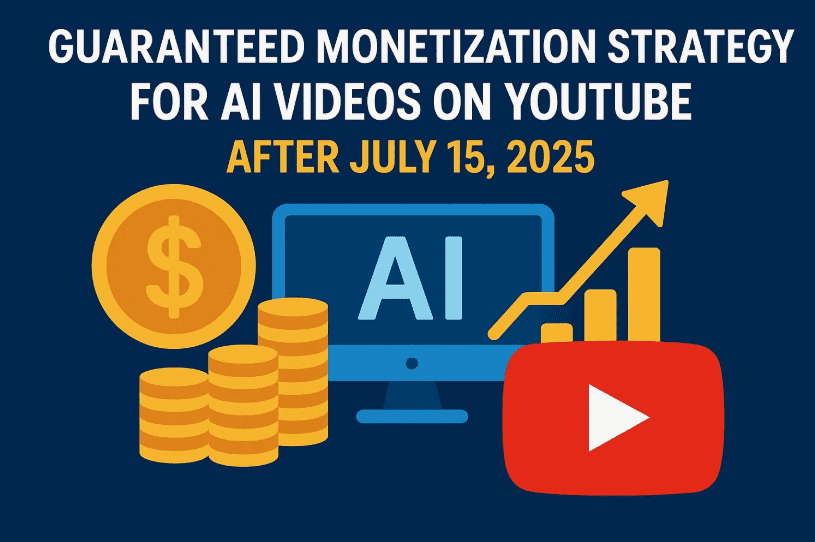
With YouTube’s recent policy update effective from July 15, 2025, AI-generated videos will no longer qualify for monetization — unless you follow the right strategy. This has created panic among content creators who rely on AI tools like ChatGPT, Eleven Labs, Midjourney, and Runway for video production.
But here’s the good news: you can still monetize AI-generated videos, as long as you avoid “low-effort” content and add significant human contribution. This article offers a full, no-shortcuts guide to help you continue monetizing your content on YouTube — even when using AI.
Let’s break it down step-by-step so you know exactly what to do to stay compliant while getting paid.
🚨 YouTube’s New AI Monetization Rule Explained
YouTube has clarified that content created entirely by AI without human involvement is now considered low-effort and not suitable for monetization.
Here’s what will no longer work:
- Purely AI-written scripts with no personalization or editing
- Voiceovers generated using tools like Eleven Labs with no human narration
- AI-generated characters, animations, or avatars with no creator voice, face, or live engagement
So how do you make AI work for you instead of against you?
🧬 How to Monetize AI Videos in 2025 – The Right Way
1. Use AI as an Assistant, Not a Replacement
YouTube isn’t against AI — it’s against creators who let AI do all the work.
Let’s say you use ChatGPT to generate a video script:
- Don’t copy it word-for-word.
- Add your own tips, commentary, or examples.
- Rewrite it in your natural tone of voice.
Human input = higher value content = monetization approved.
2. Narrate the Video Yourself (Face Cam or Voice)
AI voiceovers like Eleven Labs sound realistic, but YouTube now flags videos that depend solely on AI voice generation.
Here’s what you can do:








- Record your own voice (even if it’s not perfect)
- Use AI voiceover only as reference visuals while your own voice explains or comments
- If you use AI voice for visual B-rolls, disclose it on-screen (e.g., “AI voice used for reference visuals only”)
3. Don’t Use Fully AI-Generated Visuals for the Whole Video
You can still use AI visuals from tools like Midjourney or Runway, but do it sparingly.
What works:
- Mix short AI visuals with real footage, face cam, or screen recordings
- Use Midjourney to create visual examples, not the entire video
What doesn’t work:
- A 100% AI-generated avatar talking to the camera using a ChatGPT script and Eleven Labs voice — that’s low-effort content and won’t get monetized.
🤔 Still Confused? Here’s a Real Use Case
Wrong Way (Won’t Be Monetized)
- ChatGPT writes the full script
- Eleven Labs reads it out
- Runway or Kaiber generates the visuals
- You upload it as-is
Right Way (Will Be Monetized)
- ChatGPT gives you an outline
- You rewrite the script in your own words
- You record a face cam or voiceover
- Add visuals from Midjourney or stock footage for support
- Keep AI visuals under 10–15 seconds per clip, disclose when used
⚠️ Warning: Lo-Effort Content Goes Beyond AI
Even if your video doesn’t use AI, it can still be flagged if it’s low-effort:
- Random video compilations
- Mobile-shot footage with no context or editing
- Re-uploaded content from other platforms
YouTube now requires creators to add real value to every video — whether through commentary, storytelling, education, or live presence.
📰 Copyright Concerns with AI Content
Another emerging issue is copyright attribution. Some countries and platforms are moving toward rules where AI-generated content may not be protected under traditional copyright laws.
This means:
- If you generate an entire video using AI, you might not be legally recognized as its author
- In future updates, YouTube could request disclosure of what portion of your video is AI-generated
So it’s best to ensure a human element — voice, scriptwriting, editing, or visuals — is always part of the final content.
🥇 Final Tips for AI Video Creators
Let’s recap the safe strategy for guaranteed monetization:
- ✅ Use ChatGPT for brainstorming and structuring, not final scripts
- ✅ Add personal experience, case studies, or commentary
- ✅ Use your voice or face in at least part of the video
- ✅ Add visual value — screen recordings, stock footage, or animations
- ✅ Keep AI-generated visuals/voices minimal and clearly disclosed
- ✅ Avoid spammy, low-effort content dumps or clickbait AI gimmicks
So far, so good! If you’re serious about building a monetized YouTube channel using AI tools, make sure you focus on adding your own effort into each step.
💡 Frequently Asked Questions (FAQs)
Q1. Can I still use ChatGPT to help write scripts?
Yes, but always customize the output and add your own insights.
Q2. Are AI voices banned entirely?
No, but your video must include human input (voice or face) to get monetized.
Q3. Is Midjourney or Runway-generated footage allowed?
Yes, but do not rely entirely on them for full videos. Use AI visuals for reference only.
Q4. Will YouTube take down my old AI videos?
No, but they may demonetize them if flagged as low-effort.
Q5. Can I make Shorts or Reels with AI and still go viral?
Yes! You can use AI for Instagram Reels or YouTube Shorts to gain reach, even if monetization is limited.
🔖 Tags:
ai content monetization, youtube ai policy 2025, chatgpt youtube content, eleven labs monetization, midjourney video policy, low-effort content, ai visuals, ai voiceover youtube, youtube copyright and ai, ai creator strategy
📅 Hashtags:
#AIContent2025 #YouTubeMonetization #ChatGPTYouTube #MidjourneyAI #YouTubeRules #ContentCreation #AIVideo #YouTubeTips #LowEffortContent #ElevenLabs