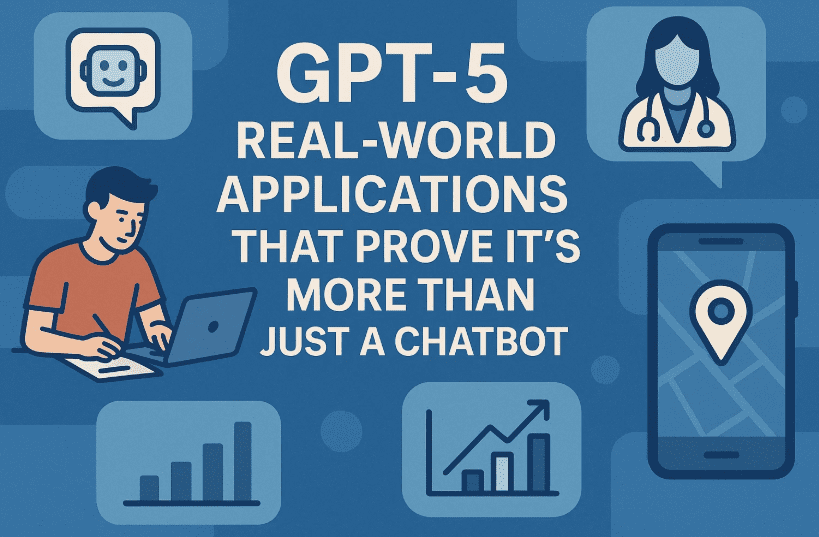
The AI world has been buzzing with anticipation, and it finally happened — GPT-5 is real. OpenAI hasn’t made an official blog post calling it “GPT-5,” but what we are witnessing through the newest version of ChatGPT in early access (especially via team or enterprise accounts) is unlike any model before it. This is not just an iteration — it’s a leap.
In this article, we’ll explore real-world use cases that prove GPT-5 (or the next-gen model being tested now) is a paradigm shift in how we think about AI assistance, development, and autonomous systems.
A Quick Recap: What Makes GPT-5 Different?
Before we dive into the examples, let’s look at what defines GPT-5:
- Massively improved reasoning across multi-step logic.
- Real-time feedback and debugging in coding scenarios.
- Persistent working memory (on Team/Enterprise).
- Better agentic behavior — GPT-5 follows complex plans.
- Live web browsing and tool use with full context.
- Multi-modal intelligence including better voice and image processing.
All these abilities combine to make GPT-5 not just a chatbot — but a virtual co-worker.
Let’s Dive Into Real Use Cases That Prove GPT-5’s Power
1. Building Complex Apps with Autonomous Planning
Earlier models needed you to spoon-feed tasks step-by-step. But with GPT-5, you can say:
“Create a React web app with a navbar, login/signup page, and a product dashboard using Tailwind CSS. Include a sidebar with icons.”
Within a few seconds, GPT-5:
- Creates an app layout plan.
- Splits it into multiple components.
- Writes modular code (with reusable logic).
- Automatically sets up dependencies (React Router, Tailwind).
- Offers you a ready-to-run GitHub repo or exportable ZIP.
That level of autonomy was never this clean in GPT-4 or earlier.
2. Debugging in Real-Time — GPT-5 Acts Like a Senior Developer
Let’s say you paste a large stack trace from a Python web app using Django.
GPT-5 not only:
- Highlights the issue,
- Explains what caused it,
- Shows the diff to fix it,
- But it also rewrites only the required lines, maintaining context.
Example:






“I’m getting a CSRF token mismatch error on form submission.”
GPT-5 not only solves it but:
- Suggests security-safe options,
- Adds missing CSRF tags,
- And even guides you on testing it in DevTools.
3. Long-Term Project Management with Memory
If you’re using GPTs with memory (Team/Enterprise), it remembers:
- Your file structure,
- Previous naming conventions,
- Your coding style.
So you can come back days later and say:
“Let’s add a checkout feature to the eCommerce app we built last week.”
And it continues where you left off. That’s huge for startups, solo developers, or digital creators.
4. True Software Agents for SEO and Web Research
GPT-5 connected with tools like WebPilot or ChatGPT’s Browse Mode now acts like an actual SEO assistant.
Give it this:
“Research top ranking articles on ‘How to start a newsletter in 2025’, extract key takeaways, then suggest how I can rank on Google.”
It will:
- Visit 10+ pages.
- Extract headlines, H2s, internal links.
- Run SERP analysis.
- Suggest keywords + title improvements.
- And even write a sample blog with schema markup.
This goes far beyond what GPT-4’s browsing could do. The output now feels like something a junior SEO writer would deliver.
5. AI Pair Programming with CodeRabbit + GPT-5
Using CodeRabbit (a VS Code extension that taps GPT-4 or 5), you can:
- Summon a pair programmer inline.
- Have it explain blocks of code in human-like detail.
- Request test cases automatically.
- Auto-document your functions.
When using GPT-5 via CodeRabbit, the quality jumps:
- Fewer hallucinations.
- Real suggestions based on context.
- Faster refactoring.
CodeRabbit: https://coderabbit.ai
6. Content Strategy Planning at Scale
Let’s say you want to grow your blog or YouTube channel.
You can now say:
“Give me a 30-day content calendar based on trending topics in the Linux and open-source space. Prioritize keywords with low competition but rising interest.”
GPT-5 will:
- Use browsing to identify real-time trends.
- Cluster keywords.
- Provide daily titles with ideal upload time.
- Suggest CTAs and distribution strategies.
Earlier models would do this to an extent, but GPT-5’s results are much more usable — and strategic.
7. Live Website + PDF + Image Understanding Combined
Here’s a use case involving three modalities at once:
You upload a blurry chart from a scanned PDF, paste a URL to a blog post, and ask: “Summarize both, and extract top 3 data-driven insights.”
GPT-5:
- Decodes the image using OCR,
- Reads the blog with browsing,
- Combines both sources into a concise summary.
That’s AI comprehension — not just token prediction.
8. Voice Agent Use Cases (Multimodal GPT-5)
With GPT-4o’s real-time voice (soon to merge fully with GPT-5’s brain), you can:
- Speak casually like: “Hey, review my resume and suggest how to frame it better for a product role.”
- It talks back naturally.
- You interrupt, it recalculates.
- Tone adapts.
Coming months will likely see this turn into a true AI voice assistant — rivaling Jarvis from Iron Man.
Real People Using GPT-5 Already Say This:
- “It feels like a trained engineer rather than a chatbot.”
- “I gave it a vague idea, and it delivered a working MVP in hours.”
- “This thing writes better English than me — and I’m a writer.”
- “It knows when not to do something. GPT-4 used to just guess.”
FAQs About GPT-5
Q: Is GPT-5 officially released?
A: OpenAI hasn’t labeled it “GPT-5,” but early access team users, researchers, and developers confirm the model powering ChatGPT now shows major capability leaps.
Q: Is GPT-5 multimodal?
A: Yes, the current version understands text, images, code, files, and even live voice — though voice mode is still being rolled out fully.
Q: Can I try GPT-5 for free?
A: You need ChatGPT Plus or Team plans. The free plan still uses GPT-3.5.
Q: Is GPT-5 open-source?
A: No. GPT-5 is still a proprietary model by OpenAI.
Final Thoughts
GPT-5 is not a theoretical model anymore. Whether it’s officially branded that way or not, the latest version of ChatGPT and its connected tools are showing capabilities far beyond what GPT-4 delivered. If you’re a developer, creator, researcher, marketer, or startup founder — now is the time to explore what GPT-5 can do for your workflow.
We’ll be seeing more autonomous agents, voice integrations, software co-builders, and strategic assistants powered by this leap.
This is no longer just AI. This is augmented thinking.
Tags:
GPT-5, ChatGPT, OpenAI, GPT-4 vs GPT-5, coding with GPT, AI assistants, ChatGPT agents, software development with AI, content strategy AI, multimodal GPT
Hashtags:
#gpt5 #chatgpt #openai #aiagent #codetools #chatgptteam #gpt5usecases #artificialintelligence #aidevelopment #futureofwork