For over 25 years, Google’s business model has been a simple, yet incredibly powerful one. It’s a model that turned the company into one of the most dominant forces in the world, generating over $200 billion annually. That model, however, is now changing. Google is betting big on a new era—the age of artificial intelligence—and in doing so, it’s fundamentally shifting how we advertise, research, and interact online. This monumental change, spurred by the rise of conversational AI, is poised to redefine the entire internet.
The Old Guard: A Keyword-Driven World
To understand the magnitude of this change, let’s first look at the old model. It was beautifully straightforward. You, the user, would type a specific query into the search bar, like “best running shoes.” In response, Google would show you a mix of organic links and sponsored links, or ads. If you clicked on a sponsored link, Google made money. Simple, right? This system was the backbone of Google’s empire for a quarter-century. It worked because user queries were simple, direct, and keyword-based. They were transactional questions like:
- Best pizza near me
- How to lose weight
- Best running shoes
But then, something shifted. Users started to change their behavior. They began engaging with conversational AI tools like ChatGPT, and their questions became more complex, nuanced, and human. The query “best running shoes” transformed into a rich, detailed conversation: “I’m training for my first marathon. I have a history of foot problems, and my budget is only $300. Which shoe would be right for me?”
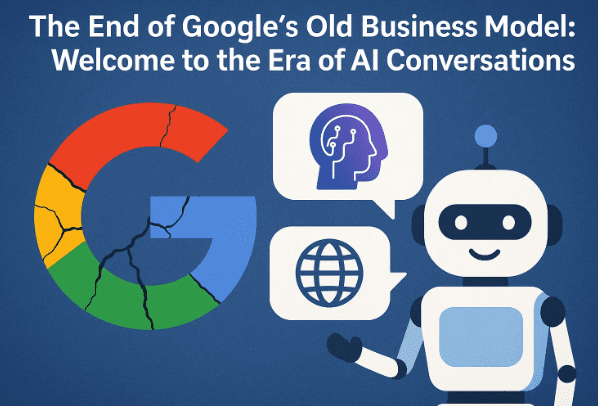
Do you see the difference? This isn’t just a keyword anymore; it’s a full-fledged story. This conversational shift didn’t go unnoticed by Google. The company realized that if it clung to its old keyword-based model, users would simply move to other platforms that offered a more natural, conversational experience.
So, Google faced a choice: fight it or own it. Google chose to own it. The era of simple keywords is over. The era of conversation relevance has begun.
Understanding the New AI-First Search Landscape
In this new AI-first world, search queries are no longer just typed words. They are conversations that often include context about budget, personal problems, preferences, and goals. Google’s AI doesn’t just read the words you type; it reads your entire digital footprint. Have you been watching marathon training videos on YouTube? Have you looked up running plans? Did you recently buy running gear? The AI is keeping track of all of this, and this data is used to determine which ads are relevant to your conversational query.
This change is so profound that even Google Ads campaigns are evolving. Performance Max and Max for Search campaigns are now optimized for AI, meaning the competition isn’t about keyword relevance anymore—it’s about conversational relevance. Think about it: yesterday, you were competing on a single keyword like “shoes.” Today, you have to compete to be a part of the user’s entire story. Are you ready for that?
And that’s not all. There’s another massive shift happening. Google’s AI is now actively “stalking” your brand. It’s meticulously analyzing what’s happening across your entire digital presence. This isn’t just a cursory glance; the AI is reading:
- The content on your website
- The tone of your social media posts
- The sentiment of your customer reviews
- The narrative in your PR articles
Everything. The AI is reading everything.
Take a luxury brand like Rolex, for instance. They consistently repeat the same story across all their channels: premium quality, heritage, and precision. Google’s AI gets a clear signal: this is a brand for a premium audience. But what if your website is outdated, your social media presence is inconsistent, and your reviews are full of customer complaints? The AI is training on that data, too, and it’s training against you. Google refers to this as feed hygiene—garbage in, garbage out. If your product feed only contains basic information like a SKU and a price, the output will also be “garbage.” However, if you describe your product in a conversational way—for example, “ideal for video editing,” “12-hour battery life,” or “lightweight for students”—the AI will understand its value and deliver it to the right audience.
So, it’s time to ask yourself: what are you feeding the AI? Are you giving it a clean, honest story, or are you just serving up digital junk?




The New Rules of the Game: Your AI Training Ground
Google Ads is no longer just a control panel; it’s now an AI training ground. If you only track leads, the AI will bring you more leads, but they might be low-quality. But if you provide a clear signal that a lead became a customer, a repeat buyer, or has a high lifetime value (LTV), the AI will find you more customers just like them.
Think of it this way: if you reward an employee for doing sloppy work, they will continue to do sloppy work. If you reward them for excellent performance, they’ll deliver high-quality results. The AI works the same way. It will give you more of what you reward it for.
The Big Question: What Happens to Clicks?
With so much of the user’s journey happening within the AI conversation, a major question arises: what will happen to clicks? If users get their answers and solutions directly from the AI, they may stop clicking on external links to websites. And since Google’s entire business model was built on clicks, what’s next?
This is perhaps the biggest unknown. The AI conversations may keep users “inside” for longer, resulting in fewer overall clicks. However, the clicks that do occur will have a much deeper intent. A user who has spent five minutes explaining their budget, problem, and goals to an AI is likely to be a highly qualified prospect, ready to buy. Google’s new model may be based on “per impression,” “in-chat action,” or “in-AI conversation,” but for now, it’s not clear. The landscape is changing rapidly.
One thing is certain: the companies that train Google’s AI with clean, high-quality data first will be the winners. It will become nearly impossible for competitors to catch up. The game is no longer about keyword optimization; it’s about Large Language Model (LLM) optimization. LLMs like Google’s AI mode, ChatGPT, and Gemini don’t just see a query as a collection of keywords; they understand it as a full conversation and respond accordingly.
A Step-by-Step Guide to Winning in the Conversational Era
The shift to a conversational, AI-driven digital world requires a new approach. Here’s a breakdown of what you can do today to prepare your business for this new era.
Step 1: Rethink Your Product and Content
Forget the basic, dry product descriptions. It’s time to make your content conversational. The goal is to provide the AI with a narrative it can understand and use to attract the right audience.
- Make your Product Feed Conversational: Instead of just listing features, explain the benefits in a way a real person would. For a laptop, don’t just say “Intel i7 processor.” Instead, write something like, “This laptop is ideal for high-end video editing and graphic design.”
- Create an FAQ-Style Product Page: Build a Product Details Page (PDP) that answers common questions. This not only helps the user but also provides excellent training data for the AI. Use customer calls, emails, and social media comments to identify the top 20 questions users have.
- Build a Content Engine: Regularly create content that answers your customers’ questions. This could be in the form of blog posts, short videos, or social media updates. This content serves as a valuable signal to the AI, proving your brand’s expertise and relevance.
Step 2: Track Revenue, Not Just Leads
In the past, many businesses focused solely on generating leads. But a lead is a meaningless metric if it doesn’t turn into a paying customer. In the AI era, it’s critical to track the full customer journey.
- Go Beyond Leads: Implement systems to track revenue and Lifetime Value (LTV). The more you tell the AI which leads became valuable, repeat customers, the better it will get at finding you more of those customers.
- Embrace CRM Integration: Connect your customer relationship management (CRM) software to your Google Ads account. This allows you to send signals back to the AI about which leads have a high LTV, helping it optimize for better-quality conversions.
Step 3: Optimize Your Campaigns for the AI
It’s time to leverage the tools Google has given us to win in this new environment.
- Run Performance Max and Max for Search Campaigns: These campaigns are designed to work with Google’s AI. They help the AI understand your business goals and find the right audience in a conversational context.
- Regularly Review Triggered Conversations: Set a weekly reminder to review which conversational queries triggered your ads. This feedback loop is crucial for refining your content and improving your feed hygiene.
Step 4: Ensure Data and Brand Consistency
The AI is reading your entire digital footprint. Any inconsistencies will confuse it and work against you.
- Maintain a Consistent Brand Persona: Make sure your tone and messaging are consistent across all your channels—your website, social media, customer service, and reviews. A unified brand story is a strong signal for the AI.
- Address Negative Reviews: Respond to customer complaints and show that you’re actively working to resolve them. This demonstrates a commitment to customer satisfaction and gives the AI a positive signal about your brand.
- Clean Up Your Feeds: As Google says, “garbage in, garbage out.” Take the time to clean up your product feeds and marketing data. Ensure all information is accurate, up-to-date, and provides a clear narrative.
Frequently Asked Questions (FAQs)
Q: Is this change only for large businesses with a big budget?
A: Not at all. Even small businesses can win in this new era. Focus on building a single, strong brand persona. Use your customer feedback to create a rich, conversational experience. The key isn’t a massive budget; it’s a clean, consistent, and honest signal.
Q: What is the biggest mistake businesses are making right now?
A: The biggest mistake is continuing to treat digital marketing like a keyword game. Many businesses are still focused on keyword optimization, while the game has moved on to conversational relevance. They’re feeding the AI “garbage” data and then wondering why their results are poor.
Q: What is the first thing I should do today?
A: Start with your feed hygiene. Review your product descriptions, website content, and social media profiles. Look for inconsistencies and opportunities to add a more conversational tone. Think of yourself as an educator, not a salesperson.
The Future Belongs to the Conversationalists
The world of digital advertising is changing, and there’s no going back. The era of keywords is over; the era of conversation is here. Google is no longer just reading your ads—it’s reading your entire story. The brands that provide clear, consistent, and honest signals will write the dictionary for the AI. And when you write the dictionary, the translation will always be in your favor.
The question is no longer “what keywords do you want to rank for?” The question is “what do you want Google’s AI to learn about you?” Do you want it to see you as a source of cheap traffic or as a provider of the right customers? The decision is yours.
Disclaimer: This article is an analysis of a major shift in Google’s business model and its potential impact on digital marketing. While the trends and concepts discussed are based on publicly available information and expert opinion, the digital landscape is constantly evolving. The specifics of Google’s future business models (e.g., how it will monetize clicks) are still being developed. Readers should consider this information as a guide to future-proofing their strategies and stay updated on the latest developments from Google. You can learn more about Google’s AI initiatives on their official website: https://www.google.com/
Tags: google, google ads, google ai, digital marketing, seo, ppc, conversational marketing, ai, artificial intelligence, performance max, feed hygiene, llm, large language models
#google #googleads #digitalmarketing #ai #seo #ppc #conversationalmarketing #feedhygiene #llm #futureofmarketing