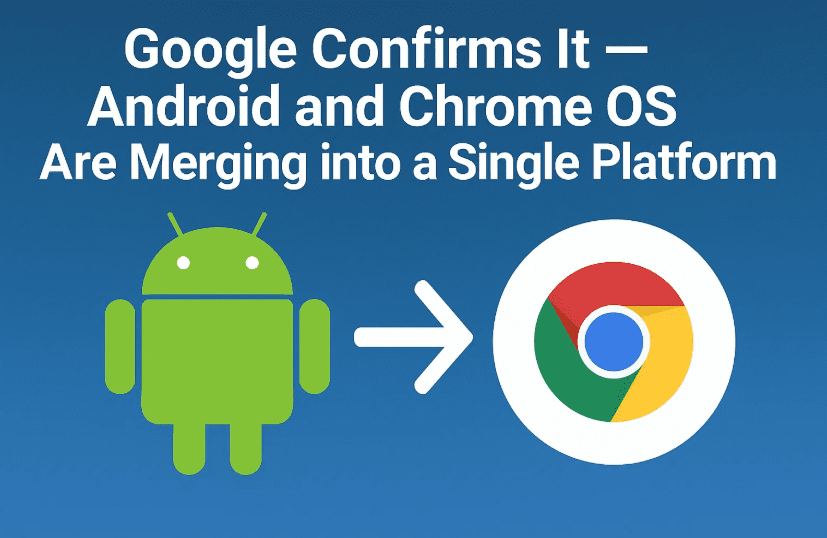
In one of the most significant announcements in recent tech history, Google has officially confirmed that Android and Chrome OS will merge into a unified platform. This long-rumored development marks a monumental shift in the company’s software strategy, with wide-ranging implications for developers, users, manufacturers, and the future of mobile and desktop computing.
Let’s dive deep into what this merger means, how it will work, why it’s happening now, and what changes you can expect as the Android-Chrome OS convergence begins.
🌐 The Confirmation: Chrome OS and Android Will Become One
Let’s start with what made this official. The news came from Samir Samat, President of the Android ecosystem at Google, during a recent interview with Techraar. While the conversation wasn’t directly focused on the topic, a casual remark turned into a headline-making confirmation.
Samir noted:
“We’re going to be combining Chrome OS and Android into a single platform, and I’m very interested in how people are using their laptops these days.”
That single statement confirmed years of speculation: Google is unifying its two largest operating systems into one platform — an Android-powered OS that can support phones, tablets, and laptops with full desktop-class capabilities.
🔄 Timeline: How We Got Here
This isn’t a sudden shift. Let’s rewind briefly and look at the clues leading up to this:
1. June 2024 Blog Post from Chrome OS Team
Google announced they were integrating the “Android-based tech stack” into Chrome OS. At the time, it seemed like a backend enhancement.
2. Rumors of Chrome OS Being Rebuilt on Android
Throughout 2024, leaks and insider reports suggested future Chromebooks might ship with Android as the base OS.
3. Adaptive Apps Initiative at Google I/O 2024
Google introduced new developer tools to make apps responsive across screen sizes — foreshadowing a unified platform.
Now, with Samir Samat’s comment, these puzzle pieces have come together.










🚀 Why This Merger Is a Big Deal
So far, we’ve done a good job setting the context. Now let’s unpack the impact.
This is not just a backend integration. It represents:
- A shift in how Android works on laptops.
- A complete redesign of the developer and user ecosystem.
- A shot at competing directly with iPadOS, Windows 11, and even macOS in the productivity market.
Let’s explore why this could be game-changing:
🖥️ Android Will Finally Have a Desktop-Class Experience
For years, Android has struggled to provide a true desktop alternative. While manufacturers have introduced desktop-like modes (e.g., Samsung DeX), none matched the performance or consistency of Chrome OS or iPadOS.
But now, with this merger:
- Advanced windowing, multi-window support, and external monitor compatibility will be native to Android.
- Android will get keyboard and mouse-first UIs, not just touchscreen-first designs.
- A desktop version of Google Chrome (with support for extensions from the Chrome Web Store) is reportedly in development for Android.
This allows Android to evolve from mobile-only to a multi-form productivity OS.
📱 Consolidating Fragmentation for Developers
One of Android’s greatest challenges has always been device diversity — phones, tablets, Chromebooks, Android Auto, Wear OS, and more.
With this merger:
- Chrome OS and Android will become one target platform.
- Developers will only need to build and optimize once — not separately for phones and Chromebooks.
- Google’s Adaptive Apps Framework (introduced at Google I/O) will help apps dynamically adjust layout, UI, and controls across all screen sizes.
For developers, this means:
- Fewer compatibility issues.
- Faster rollout of updates.
- Stronger incentive to build robust tablet and desktop apps.
💻 A More Competitive Android Laptop Ecosystem
Apple has spent years turning iPadOS into a legitimate laptop alternative. Google is now stepping into that race seriously.
With the Android-Chrome OS merger:
- Android laptops and tablets could support desktop-class applications, like full IDEs, productivity suites, and creative tools.
- Google can now compete head-to-head with iPad Pro and even Surface devices, leveraging Android’s open nature and Play Store.
This also encourages hardware manufacturers to create:
- Detachable tablets
- Foldables with real desktop mode
- Budget Android laptops for education and enterprise
🧠 Boosting AI Innovation
According to Google’s June 2024 blog post, one of the goals of this transition is to:
“Accelerate the pace of AI innovation at the core of Chrome OS.”
What this really means:
- Google wants to combine internal development teams.
- This allows for faster rollout of AI features across all devices.
- There’s less redundancy in maintaining separate feature sets for Android and Chrome OS.
Expect to see more:
- Gemini AI integration at the OS level.
- Real-time AI enhancements across Android-powered devices.
- Smoother updates and performance consistency.
🔄 How Will This Transition Work?
Let’s move to the next step — what about current devices?
Here’s what Google has said so far:
✅ Seamless Transition for Existing Chrome OS Devices
Google has promised:
- A smooth migration path for existing Chromebooks.
- Continued software support during the transition.
- No major disruptions for now.
However, several questions remain open…
❓ Unanswered Questions (But Worth Considering)
This section addresses some of the key concerns we know you might have:
Q1: Will Current Chrome OS Devices Get the New Android-Based Platform?
Answer: Likely yes, if the hardware supports it. But Google hasn’t shared performance requirements or rollout dates.
Q2: Will This Impact Google’s 8–10 Year Support Promise for Chromebooks?
Answer: Unknown. Chrome OS is known for long update windows. Whether that tradition continues under Android is unclear.
Q3: How Will UI/UX Change for Chrome OS Users?
Answer: Google says it aims to preserve the familiar user experience. But with Android under the hood, changes are inevitable.
Q4: What About Education and Enterprise Users?
Answer: Chrome OS dominates classrooms and business environments. Google must maintain security, device management, and simplicity — or risk backlash.
📊 Summary Table: What’s Changing
| Feature Area | Chrome OS Now | Future Unified Platform |
|---|---|---|
| Base OS | Chrome OS (custom Linux) | Android-based tech stack |
| App Ecosystem | Android + Web apps | Unified Android apps + Web |
| Desktop Experience | Limited multitasking | True multi-window + extensions |
| Updates | Long-term AUE support | Unknown, but likely similar |
| Target Devices | Laptops, Tablets | Phones, Tablets, Laptops |
| Developer Workflow | Separate for each platform | Single target across all form factors |
| AI Integration | Light Gemini features | Core-level AI support |
✍️ Final Thoughts: A Long-Awaited Shift
This merger was a long time coming. While Android dominates in mobile, it never quite made the jump to desktop or hybrid form factors. Chrome OS filled that void, but its limitations in app variety and offline functionality held it back.
By combining the two:
- Google reduces internal redundancy.
- Developers get a better platform to build on.
- Users finally get an Android device that works like a real computer.
Of course, there’s still a lot to prove. Execution matters. If this transformation is handled with care — preserving Chrome OS’s simplicity while adding Android’s flexibility — it could be the best move Google has made in over a decade.
Tags:
Android, Chrome OS, Android merger, Google operating systems, Android desktop, Chromebook future, Gemini AI, Adaptive apps, Android 16, Chrome OS to Android transition, mobile productivity, unified Android platform
Hashtags:
#Android #ChromeOS #GoogleUpdate #AndroidDesktop #GeminiAI #AndroidEcosystem #UnifiedPlatform #AndroidLaptops #ChromebookFuture #MobileProductivity