USB-A vs USB-C: The Quiet Revolution Happening Inside Your Cables
Every tech user knows this moment: your phone is dying, your laptop needs charging, and your external drive refuses to connect. You reach into your drawer of tangled cables—your personal “tech roulette”—and hope you pick the right one.
Does it fit? Is it upside down? Is this the wrong generation entirely?
That little moment of frustration is actually the result of decades of technological evolution. And the shift we’re experiencing today—from USB-A to USB-C—is one of the biggest and most transformative changes in the history of everyday electronics.
Let’s walk through this revolution together, in a simple, narrative style that connects past to present.
🌅 1. A World Before USB: When PCs Were a Mess
Before we move forward, we need to go back to the 1990s—a time when computers were powerful, yes, but deeply inconvenient.
Setting up a PC felt like wiring a spaceship:
- Serial ports for mice
- Parallel ports for printers
- PS/2 ports for keyboards
- FireWire for cameras
- SCSI for external drives
- Proprietary ports on almost every brand
Nothing worked with anything else. Every accessory demanded its own special cable. If you remember that era, you remember the frustration.
The world needed a unified connector, something that every device could agree on.
🔌 2. Enter USB-A: The First True Universal Connector
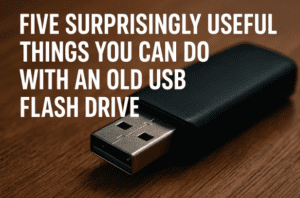
In the mid-1990s, USB was born—Universal Serial Bus—and at the center of it was the iconic rectangular USB-A connector. It promised what its name claimed: universality.
USB-A transformed everything:
- One port for keyboards, mice, printers
- Plug-and-play simplicity
- A single shape across brands
- A standard that became instantly recognizable
Its early 12 Mbps speed felt lightning fast at the time.








Over the next two decades, USB-A appeared everywhere:
- Desktops and laptops
- TVs and gaming consoles
- Cars, speakers, chargers, power banks
- External drives and cameras
USB-A didn’t just simplify our tech.
It unified our entire digital ecosystem.
But as devices evolved, USB-A struggled to keep up.
🔄 3. The Limitations of USB-A Become Impossible to Ignore
For years, people joked that plugging in a USB-A cable required three attempts:
wrong → wrong → correct.
Funny, yes. But it revealed a deeper issue:
USB-A had physical limits
- It was directional, not reversible.
- It was large, especially for thin devices.
- It could carry only limited power.
- It couldn’t natively carry video output.
- It wasn’t built for the demands of modern devices.
Phones shrank. Laptops thinned. Tablets became powerful tools. Storage devices exploded in speed.
USB-A, though improved through standards like USB 2.0 and USB 3.0, was still physically locked to a 1990s design.
The modern world needed something new.
🚀 4. USB-C Arrives: A Reinvention of What a Connector Should Be
When USB-C appeared in the mid-2010s, it wasn’t just a replacement for USB-A.
It was a complete reimagining of the connector itself.
The first thing users noticed?
No right-side-up. No wrong-side-up.
USB-C is fully reversible. It connects instantly, every time.
But the real revolution is hidden in what USB-C can do.
USB-C was engineered to be truly universal:
- Data
- Power
- Video output
- Storage
- Networking
- Audio
- Charging
- Docking stations
- External GPUs
Instead of needing five different ports on your laptop, USB-C combined them all into one compact connector.
⚡ 5. The Power of USB-C: More Than Just a Shape
USB-C’s design is only the beginning. Its real strength comes from the protocols it supports:
USB-C can carry:
- Up to 240 watts of power (USB-PD 3.1)
- High-resolution 4K and even 8K video
- Thunderbolt and USB4’s ultra-fast data speeds
- DisplayPort and HDMI via Alt Modes
- Networking connections
- Fast file transfers for cameras and SSDs
That means a single cable can:
- Charge your phone
- Power your laptop
- Run an external monitor
- Transfer data at blazing speeds
- Connect storage, audio gear, or docks
USB-A could never do this—not even close.
🌍 6. The World Adopts USB-C: A Standard Becomes Global
At first, the shift was slow. But when momentum hit, it was unstoppable.
Big names moved first:
- Apple moved MacBooks to USB-C.
- Then iPads.
- Then even the iPhone.
- Nintendo adopted USB-C for the Switch.
- PC manufacturers redesigned laptops around USB-C.
- Power banks, headphones, cameras, monitors—all began standardizing.
And today, regulatory bodies like the EU have mandated USB-C as a common charging standard to reduce e-waste.
The world finally has a connector truly worthy of the word universal.
🔄 7. USB-A vs USB-C: A Simple Comparison Table
| Feature | USB-A | USB-C |
|---|---|---|
| Reversible | ❌ No | ✅ Yes |
| Power Delivery | ⚡ Up to ~12W | ⚡ Up to 240W |
| Video Output | ❌ No | ✅ Yes |
| Data Speeds | Good | Much higher (USB4/Thunderbolt) |
| Size | Large | Compact |
| Future-proof | Limited | Very high |
| Multi-function | Low | Extremely high |
USB-A built the digital age.
USB-C is building the future.
🔮 8. What This Shift Really Means
The transition from USB-A to USB-C is more than a change in shape. It’s a change in philosophy.
USB-A belongs to the era of bulky desktop computers.
USB-C belongs to the era of flexible work, thin devices, shared chargers, and universal compatibility.
We’re living through the moment where one standard hands the torch to another—quietly, but profoundly.
And even though USB-A isn’t disappearing overnight, USB-C is rapidly becoming the connector that powers all our digital lives.
❓ FAQ: USB-A vs USB-C
1. Will USB-A disappear completely?
Not immediately. Many accessories still use it, and older devices will be around for years. But new technology is overwhelmingly USBC-first.
2. Can I use adapters between USB-A and USB-C?
Yes, and they work well for basic tasks like charging or slow data transfer. But advanced features like high-wattage charging or video output may require pure USB-C cables.
3. Are all USB-C cables the same?
No! USB-C is a shape, not a speed.
Some cables support USB 2.0 speeds, others support USB4 or Thunderbolt. Always check specs.
4. Why did regulators push for USB-C?
To reduce e-waste and simplify charging. One cable for everything means fewer old chargers in landfills.
#USBC #USBA #TechHistory #Connectivity #Gadgets #DTPtips