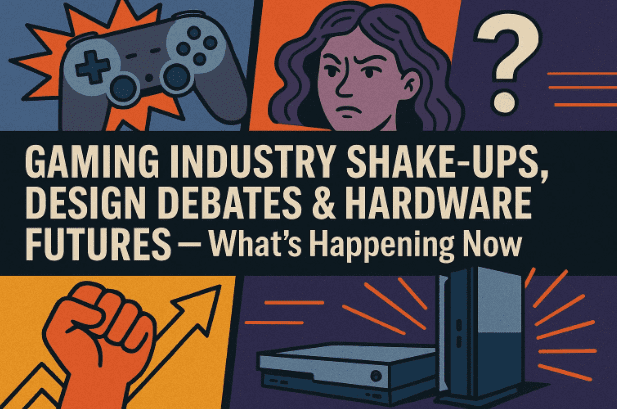
It’s been a busy time in the gaming world: hardware, design, business—they’re all shifting. And while you might skim the headlines, digging into the details gives you a clearer picture of where the industry is headed. In this article, I’m going to walk you through three major developments you should know about: a major hardware hint from Microsoft, a design debate from Final Fantasy VII Rebirth’s director, and even deeper trouble at Amazon’s gaming operations. Let’s unpack them one by one.
1. Microsoft’s Big Hint About the Next Xbox
Let’s move to our first topic—hardware and strategy—and why one executive’s comments might signal a shift bigger than just a new console.
What happened
Satya Nadella, CEO of Microsoft, recently made remarks that the next-generation Xbox won’t just act like a traditional console, but might more closely resemble a PC—or at least blur the lines between console and PC. Reports suggest the upcoming device could run full Windows, provide access to multiple PC game stores (e.g., Steam, Blizzard, Riot), and allow mouse + keyboard gaming alongside controller play.
Nadella said: “We built the console because we wanted to build a better PC… I kind of want to revisit some of that conventional wisdom.” He also emphasized that Microsoft wants to “be everywhere on every platform” (console, PC, mobile, cloud).
Why this matters
If this pans out, the next Xbox could be much more than “just another console.” It might become the bridge between PC gaming and console gaming. For gamers, that means:
- Potential access to games normally tied to PC (or other consoles) on this Xbox/PC hybrid.
- More flexibility in how you play: controller, mouse/keyboard, cloud streaming.
- A single device meant to do double duty: console ease + PC openness.
From a business perspective, this signals Microsoft’s recognition that the gaming market is broader than just console vs PC—it’s about platforms, services, access, and attention (e.g., mobile, cloud, streaming).
Key themes & implications
- Platform convergence: The idea that console + PC + cloud will merge into fewer, more capable devices.
- Game-store openness: If you can run Steam, Blizzard, etc., the device becomes more than an Xbox ecosystem—it becomes a universal gaming machine.
- Business model shift: Console hardware sell isn’t the only value; services, subscriptions, ecosystem matter more.
- Competitive landscape: Microsoft acknowledges that its competition isn’t just other consoles—it’s other forms of entertainment (e.g., short-form video) competing for your time and attention.
Questions you might have
Q: Does this mean Microsoft will stop making Xbox consoles?
A: No. Microsoft has stated that it is still active in console hardware. This isn’t about abandoning consoles but evolving them.
Q: When might this new hybrid come out?
A: Some reports suggest as early as 2027 for a next-gen Xbox/PC hybrid.
Q: What does this mean for current Xbox owners?
A: Possibly nothing immediate—your current console remains valid. But it may signal that future devices will be more PC-centric and offer wider gaming access.
2. The “Yellow Paint” Debate in Game Design
So far, we’ve covered hardware and business. Now let’s switch gears into game design, and how a visual cue can spark a big conversation.
The core of the debate
In his interview, Naoki Hamaguchi—director of Final Fantasy VII Rebirth—addressed the ongoing controversy over using bright yellow paint (or similar markers) in games to indicate climbable surfaces or interactable objects.








He said:
“I get there is a debate about that, whether that fits with that world or not… I think as a game, there is definitely a need for that kind of thing in a lot of ways.”
So, he accepts both sides: some players dislike it (it breaks immersion), others find it helpful or even essential (for clarity, accessibility).
Why this is a big deal
It’s easy to dismiss this as a minor design quirk, but it touches larger themes:
- Accessibility vs immersion: Clear visual cues may break a world’s aesthetic but help players who otherwise would be stuck or frustrated.
- Player experience and onboarding: Games are becoming more open, complex, photorealistic—if you don’t guide players, they might miss what they should do.
- Design trade-offs: How do you balance visual clarity and artistic subtlety? Where is the line between “helpful” and “hand-holding”?
Design context & history
The marker-painting trick isn’t new: older games used white cloths, arrows, or other indicators (for example, in the Uncharted series). Hamaguchi referenced how as games become more realistic visually, the distinction between scenery and playable surface becomes harder to detect.
My take
I appreciate Hamaguchi’s honesty: he doesn’t pretend the yellow paint is perfect, but he argues that guidance is required. It’s a recognition that game worlds, while immersive, can also confuse the player if design fails to signal “this is interactable.”
It also raises an interesting question for developers: Could you design the world so well that markers are unnecessary? Or will they always be needed in some form?
Q&A on this topic
Q: Isn’t yellow paint lazy design?
A: It can be, if used poorly or obtrusively. But Hamaguchi’s argument is that when done with intent and subtlety, visual cues serve gameplay and reduce player frustration.
Q: Does this degrade immersion?
A: Potentially yes—but design is also about English: “What can the player do?” If the world looks gorgeous but doesn’t communicate interaction, players stall. So a balance needs to be struck.
Q: Will we see less or no yellow paint in future games?
A: Possibly yes—or you might see more refined visual cues (less “paint”, more environmental context). But the guiding principle—help players know what they can do—will remain.
3. Massive Layoffs at Amazon Impact Its Gaming Division
Now for the business side again—and this time, the story is sobering. The gaming industry isn’t only about new consoles or design debates—it’s also about survival, strategy and tough decisions.
What’s going on
Amazon has announced around 14,000 job cuts across the company, and its gaming division—Amazon Games—has been hit particularly hard. Internal memos say the company is “halting a significant amount of first-party AAA game development work — specifically around MMOs”.
One specific sign: Amazon’s in-house MMO New World is reportedly ceasing new content updates, though servers will remain online through at least 2026. There is also strong indication that the company’s ambitious LOTR MMO has been cancelled.
Why this is significant
Several reasons:
- MMO development is expensive and long-term: Shutting part of this shows that Amazon is reassessing its strategy in a major way.
- Streaming and cloud impact: Amazon’s shift to its cloud service – Luna – is part of the narrative. The company appears to be pivoting away from heavy first-party game development into different directions.
- Industry impact: A major player scaling back means fewer new MMOs from big publishers, more risk in AAA development, and possible shifts in how games are monetised and supported.
What this might mean for gamers & developers
- Existing Amazon-published games may get less investment, slower updates, or be sunset earlier.
- Game development studios may face more pressure to prove profitability or pivot to live-service/casual games instead of big AAA launches.
- Rationalisation in the industry: With hardware and platforms evolving (as noted earlier), companies might lean into services, cloud, mobile, rather than traditional console/PC big-budget games.
My view
It’s a reminder that the gaming business is not just art and fun—it’s also economics, risk and management. Even big names can pull back if the model doesn’t work. For players, that means being aware of business signals: changes to your favourite games, or studios shutting down.
Questions on this topic
Q: Will my Amazon-published MMO shut down next?
A: Not necessarily, but the risk is higher. Amazon has declared support through 2026 for New World, which gives some runway. But fewer resources means slower content or earlier end-of-life planning.
Q: What does this say about the future of MMOs?
A: It suggests that big AAA MMOs are riskier than before. Live-services still exist, but publishers may favour smaller-scale or hybrid business models (cloud, cross-platform) rather than massive traditional MMO launches.
Q: How does this affect the cloud gaming angle?
A: It seems Amazon is sharpening focus on its cloud service and cross-platform opportunities rather than building big first-party console/PC exclusives. This may accelerate cloud-based or “as a service” game models.
4. Pulling It All Together: What These Three Trends Tell Us
So we’ve talked about:
- Microsoft’s hardware/strategy pivot
- A design debate about player guidance
- A major business shake-up at Amazon Games
What connects them?
The convergence of platforms
Microsoft is plain about it: console, PC, cloud and mobile are merging. We’re moving from “console vs PC” to “platform strategy, services, access.” The Amazon situation underscores that companies which can’t align quickly may get left behind.
The user-experience and design imperative
Game design discussions (like the yellow paint debate) highlight that as games become more complex, we can’t assume players will intuitively know what to do. The hardware and business shifts amplify the need: games must run across platforms, for diverse players, with clear cues and seamless experience.
Economics and sustainability
Big budgets, big hardware, big launches—these are riskier now. Amazon cutting back signals that even big players must justify scale, efficiency, and profitability. For gamers, that might mean fewer “big blockbuster only” games and more focus on services, recurring content, cross-platform play.
What you should watch for
- Next-gen Xbox announcements: architecture, PC-capability, cross-platform support.
- How major game studios handle design and accessibility: will marker systems evolve across devices?
- Which companies pivot away from big internal studios and how game portfolios change: more cloud, less big console exclusives maybe.
5. Final Thoughts
Games are not just made—they’re launched, supported, marketed, and evolved. The hints from Microsoft, the design choices discussed by developers, the business decisions at Amazon—all of these influence what you experience as a player.
It’s an exciting time because things are in flux—platforms converging, design expectations shifting, business models realigning. And that means opportunity: for better devices, smarter games, more choice—but also complexity: not everything will succeed, and things may change faster than you expect.
From gamer to designer to industry watcher, paying attention to these three fronts gives you an edge: you’ll better understand why your console might look more like a PC, why you’re seeing more visual cues in games, or why your favourite game studio’s update schedule has changed.
Disclaimer:
This article is based on publicly available comments, interviews and reports. Some details (especially about future hardware and business decisions) are speculative and subject to change. Gaming companies often adjust strategy and plans behind the scenes.
#GamingIndustry #NextGenXbox #PCConsoleHybrid #GameDesign #AccessibilityInGames #MMOIndustry #GamingBusiness #AmazonGames #FF7Rebirth #ConsoleVsPC