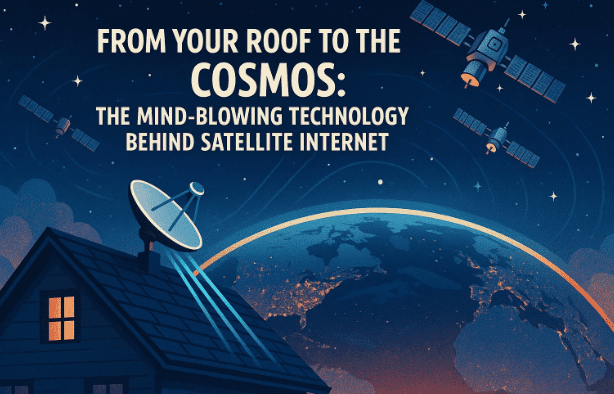
Have you ever stopped to truly think about how satellite internet works? It’s a technological marvel that feels straight out of a sci-fi movie. A dish the size of a large pizza sits on your roof, beaming an internet connection to a satellite orbiting 550 kilometers above Earth. That satellite is hurtling through space at an astonishing 27,000 km/h, and yet, your dish is able to maintain a perfect, high-speed connection. Data is flying back and forth at hundreds of megabits per second, with both the dish and the satellite constantly adjusting to stay aligned.
The fact that this all works is nothing short of incredible. What’s even crazier is that your dish is constantly switching between different satellites, connecting with a new one every few minutes as the previous one zips out of its line of sight. If this sounds like magic, you’re not alone. The underlying technology is a complex blend of physics and engineering. In this article, we’re going to pull back the curtain and explore the key technologies that make this “magic” a reality.
First, let’s start by looking at what’s inside the dish itself and how it generates a powerful beam of data that can reach space. Then, we’ll see how this dish continuously steers that beam to track a moving satellite. Finally, we’ll dive into how the dish and the satellite fill that beam with the data that lets you stream your favorite movies and shows. It’s a lot to cover, but once you understand these concepts, you’ll see why this is a truly revolutionary technology.
The Brains of the Operation: Inside the Satellite Dish
Before we dive into the nuts and bolts, it’s important to understand the difference between the Starlink dish, affectionately nicknamed “Dishy McFlatface,” and a traditional satellite TV dish.
A typical satellite TV dish uses a large, curved parabolic reflector to focus signals from a broadcast satellite. These satellites orbit at a much higher altitude, about 35,000 kilometers, and they simply beam a wide signal down to Earth. These TV dishes are one-way streets—they can only receive signals; they can’t send data back.
Dishy, on the other hand, is a two-way communication device. It both sends and receives internet data. While the Starlink satellites are “only” 550 kilometers away—about 60 times closer than TV satellites—that’s still an immense distance for a wireless signal. To overcome this, the beams between Dishy and the satellite need to be incredibly focused and powerful.
So, let’s take a closer look at what makes Dishy tick. If you were to open one up, the first thing you’d notice is the presence of a few motors on the back, along with an ethernet cable. These motors are only used for the initial setup to get the dish pointed in the right general direction. They don’t continuously track the satellite. The real secret is inside.
Once you remove the aluminum backplate, you’ll find a massive printed circuit board (PCB). This isn’t your average circuit board. It’s covered in a dense pattern of small and large microchips, with intricate copper traces connecting everything. On the other side, there are thousands of tiny copper circles arranged in a hexagonal grid. These circles, and the layers beneath them, are actually what form the antennas.
In total, a Starlink dish contains 1,280 antennas working together. This is where the magic really begins. This massive array of antennas operates as a single unit, known as a phased array. Unlike a single antenna that sends signals in a wide, expanding shell, this array works together to create a single, powerful, and highly directional beam of electromagnetic waves.
How a Phased Array Creates a Powerful Beam
To understand how a phased array works, let’s break it down into a simpler concept. Imagine you have a single light bulb. The light spreads out in all directions, and from far away, it’s very faint. Now imagine you have 1,280 light bulbs and you can focus all their light into a single, powerful spotlight. That’s essentially what a phased array does with radio waves.
Each of the tiny antennas in the dish transmits a high-frequency signal. When all of these signals are emitted at the exact same time (in phase), they interfere with each other. This isn’t a bad thing; it’s a phenomenon called constructive and destructive interference.











- Constructive Interference: In certain areas, the waves from all the antennas combine perfectly, their peaks and troughs lining up. This amplifies the signal, creating a powerful, concentrated beam.
- Destructive Interference: In other areas, the waves from different antennas are out of sync, with the peaks of one wave canceling out the troughs of another. This effectively eliminates the signal in those directions.
By combining the signals from all 1,280 antennas, the dish can form a single, laser-like beam with an intensity and directionality that can easily travel the hundreds of kilometers to a satellite in orbit. The effective power of this main beam is actually much more than the sum of its parts—it’s closer to 3,500 times that of a single antenna. This is because all the energy is concentrated into one very narrow beam, rather than being wasted in all directions.
The Art of Steering: How Dishy Tracks a Satellite
We’ve established how the dish creates a powerful beam, but how does it aim that beam at a satellite moving at an incredible speed? This is where the motors on the back of the dish take a backseat and the real technology steps in. The solution is something called phased array beam steering.
This is where the concept of phase shifting becomes crucial. A signal’s phase refers to its position in time—like shifting a wave to the left or right. It’s measured in degrees, with a full 360-degree shift bringing the wave back to where it started. By precisely changing the phase of the signal sent to each individual antenna in the array, the dish can alter how the waves interfere with each other.
Instead of a beam propagating straight up, by applying a slight phase shift to each antenna, the dish can effectively “tilt” the wave front, causing the main beam of constructive interference to be angled in a specific direction. By continuously calculating and adjusting the phase of each of the 1,280 antennas, the dish can steer the beam electronically, without any mechanical movement. This process is incredibly fast, allowing the dish to track a satellite with perfect precision.
The dish’s software uses a few key pieces of information to make these calculations:
- Its own GPS coordinates.
- The known orbital position of the Starlink satellites.
Based on this data, the dish’s central processor computes the exact phase shift required for each antenna every few microseconds. This allows the dish to instantly and perfectly aim the beam at a satellite that is constantly moving across the sky. This is what enables Starlink to provide a stable, high-speed connection from a satellite that’s zipping past at over 27,000 km/h.
The Language of Data: Sending and Receiving Information
Now that we know how the beam is formed and steered, the final puzzle piece is understanding how actual data—like your favorite TV show—is encoded within that beam.
The signals sent between the dish and the satellite are high-frequency sinusoidal waves. They are not simple on/off binary pulses. Instead, the dish encodes data by varying both the amplitude (strength) and phase (timing) of the transmitted signal.
This method, known as Quadrature Amplitude Modulation (QAM), works by assigning a specific combination of amplitude and phase to a group of binary bits. For example, Starlink uses a technique called 64-QAM, which assigns a unique amplitude and phase combination to every possible 6-bit value.
Imagine a graph where the distance from the center represents the amplitude and the angle represents the phase. Each of the 64 possible 6-bit values (from 000000 to 111111) is represented by a specific point on this graph. When the dish needs to send a certain 6-bit value, it transmits a signal with the corresponding amplitude and phase. The satellite receives this signal, decodes the amplitude and phase, and translates it back into the original 6-bit value.
These 6-bit groupings, called “symbols,” are sent at an incredibly fast rate—as quickly as every 10 nanoseconds. This allows the system to transfer hundreds of millions of bits per second. The data stream is shared between downloading and uploading, with the dish spending a small fraction of a second (about 74 milliseconds) to send data and the rest of the time to receive it. These time slots are distributed throughout the second to maintain low latency, which is crucial for things like online gaming and web browsing.
This entire process, from encoding the data to forming the beam and steering it to a rapidly moving satellite, happens seamlessly, allowing you to stream multiple HD movies at the same time.
Q&A
Q: Why does Starlink need so many satellites if they can communicate over such long distances?
A: This is a great question. While the phased array technology allows for a powerful and focused beam, a single satellite can only cover a relatively small area on the ground. Unlike a traditional TV satellite in a higher orbit that can cover an entire continent, Starlink satellites are in a much lower orbit to achieve very low latency (the time it takes for data to travel from your dish to the satellite and back). This low latency is essential for a good internet experience. To provide continuous, global coverage, thousands of satellites are required to ensure there’s always one in the field of view of any dish on the ground.
Q: Do phased arrays have other applications?
A: Yes, absolutely. Phased array technology is used in many other applications. For example, it’s used in military radar systems, allowing them to track multiple targets without physically moving the radar dish. It’s also used on commercial airlines to provide in-flight Wi-Fi, which is essentially a smaller version of the Starlink dish that connects to a satellite to provide internet access to passengers.
Q: What is the biggest difference between a traditional satellite TV dish and a Starlink dish?
A: The biggest difference is the function. A TV dish is a passive receiver that can only pick up signals. A Starlink dish is an active transceiver that can both send and receive data. This two-way communication, combined with the phased array technology, is what makes satellite internet possible and so much more technologically advanced than satellite TV.
Disclaimer: This article provides a simplified overview of complex engineering and physics concepts for educational purposes. The actual technology is far more intricate, involving multiple layers of complexity and design. The intention is to give a general understanding of the principles, not to serve as a technical engineering guide.
Tags: Starlink, satellite internet, phased array, Elon Musk, satellite technology, how it works, internet, dishy, broadband, technology explained
Hashtags: #Starlink #SatelliteInternet #PhasedArray #TechExplained #SatelliteDish #ElonMusk #Technology #HowItWorks #Internet #Broadband