If a kid in 2040 asks, “What was Google?”, you might smile—not because Google disappears, but because search itself won’t look like ‘search’ anymore. The way we find, digest, and act on information is shifting from typing queries into a box to thinking through problems with always-on assistants. This article explores that shift with a clear-eyed, no-shortcuts tour: what’s real today, what’s plausible tomorrow, and how to prepare without burning everything you’ve built around SEO, ads, or content.
We’ll take our time, layer in context, correct a few misconceptions from the original script, and flag what’s speculative. When software or platforms are mentioned, we link you to their official sites so you can verify, try, or dismiss them yourself.
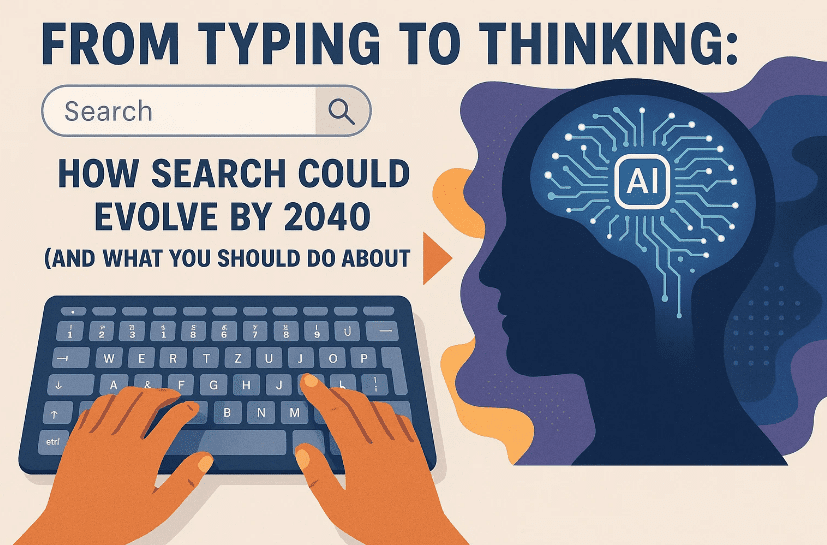
Table of Contents
- 1. 🔎 The Big Shift: From “10 Blue Links” to “Direct Answers”
- 2. 🧭 Answer Engines vs. Search Engines: What’s the Difference?
- 3. 🤖 Google’s Countermoves: Gemini, AI Overviews & Project Astra
- 4. 🧠 Thought Interfaces: From Voice Assistants to Brain–Computer Interfaces
- 5. 📉 Will SEO, Ads, and Web Traffic Collapse? The Data (and the Nuance)
- 6. 🧰 A Practical Playbook: How to Prepare (Individuals, Teams, Businesses)
- 7. 🕵️♀️ Ethics, Safety & Trust: The Part Everyone Wants to Skip (Please Don’t)
- 8. 🌅 Three Futures for 2030–2040: Conservative, Transformational, Wildcard
- 9. ❓Q&A: Your Most Likely Questions, Answered
- Tags & Hashtags
1. 🔎 The Big Shift: From “10 Blue Links” to “Direct Answers”
For 25 years, “search” meant this: type words, get a page of links, click around, piece together your own answer. But a new pattern has taken root: you ask a question, and an assistant composes the answer with citations. Some call these tools “answer engines.” The user experience skips the scavenger hunt—you land on clarity.
Let’s pause before we list products. The point isn’t that one company “wins” but that behavior is changing:
- Less browsing; more synthesis. People want context, not just links.
- Less switching; more staying. Answers emerge inside the assistant, not across five tabs.
- Less keyword voodoo; more intent. Assistants translate messy, human questions into structured steps and show sources.
This shift started as a novelty; by 2024–2025 it went mainstream as big platforms folded generative AI into search. Google launched AI Overviews to summarize results at the top of the page—first in the U.S., then expanding globally.
Okay, so far so good. Now let’s get specific about answer engines vs. search engines—and why the distinction matters.
2. 🧭 Answer Engines vs. Search Engines: What’s the Difference?
Before we dive into lists, a quick human moment: if “I’ll just Google it” has been muscle memory for years, switching feels weird. That’s normal. The goal here isn’t to dunk on search engines—it’s to understand where each tool shines.
What an “answer engine” does differently
- Synthesizes across multiple sources to produce a direct, readable response.
- Cites those sources inline so you can click through and verify.
- Guides follow-up (“ask another angle,” “compare these two studies,” “show me the data table”).
One notable example is Perplexity—an “answer engine” that surfaces real-time, citation-backed responses and offers a “Pro/Deep” or “Copilot/Pro Search” mode for guided research. (You can try it here: perplexity.ai.)
By contrast, a classic search engine (like Google as most of us know it) ranks pages and expects you to assemble the answer. That’s changing inside Google, though, which brings us to…
3. 🤖 Google’s Countermoves: Gemini, AI Overviews & Project Astra
It’s tempting to say “Google will be obsolete by 2040,” but the reality is more like adaptation than extinction. Google has rolled out AI Overviews, began unifying its assistant under Gemini across apps, and previewed a research prototype called Project Astra that points to an assistant that can see, listen, understand your screen, and respond in real time.
- AI Overviews: Summaries at the top of search results; Google said it would reach hundreds of millions at launch and “over a billion” by year’s end (2024). This sits above links and changes how users interact with the page.
- Gemini: Google’s everyday AI assistant, available on web and mobile, tied into your Google life (Gmail, Calendar, Maps, YouTube, Photos). Try it here: gemini.google.com and learn more here: gemini.google/about.
- Project Astra: A multimodal agent demoed at Google I/O 2024 that recognizes objects from video, remembers context, and answers in near real-time—the kind of assistant that can watch and respond rather than only read text. (See Google’s post and press coverage from I/O.)
So yes—search is turning into “assist”. The field isn’t one company vs. another; it’s a feature race to see who can deliver faster, more reliable, more transparent answers with fewer steps.




We’ve covered the human layer (expectations) and the platform layer (features). Let’s move to the interface layer—the one you feel in your hands, eyes, and, perhaps one day, your mind.
4. 🧠 Thought Interfaces: From Voice Assistants to Brain–Computer Interfaces
The original script imagines a 2040 world where you think a question and the answer appears in your mind. That’s dramatic—and we should be careful. Here’s the grounded version, step by step:
- Voice and Vision Today: Assistants already understand speech, images, and screens. Demos like Project Astra show a path to assistants that watch your camera feed or interpret what’s on your display and talk back intelligently. That’s a big leap from text in a box.
- Brain–Computer Interfaces (BCIs): Companies like Neuralink (and competitors) are developing implants to connect brain signals to computers—initially for medical applications (e.g., helping people with paralysis communicate or control devices). The FDA cleared Neuralink for its first in-human trial in 2023; the company announced its first human implant in January 2024 and is iterating from early experiences. (To be precise: the original script’s “woman trial approved” wording was off; the milestone was first-in-human clinical study approval.)
- Where This Might Go by 2040: Thought-to-text control for basic commands and communication is plausible in niche contexts, especially for medical need. Mainstream “mind OS” that streams answers into your consciousness? That’s speculative and hinges on safety, ethics, regulation, and major technical leaps. Responsible reporting means calling that out for what it is: an ambitious scenario, not a scheduled product launch.
- Adjacent Paths: Not all “thoughtful” interfaces are surgical. Expect wearables (non-invasive EEG, eye-tracking, subvocalization sensors) to flourish for hands-free control and a softer on-ramp to “thinking instead of typing.”
The takeaway: interaction costs will keep falling—from typing to talking to gesturing to (in limited contexts) thinking. That alone transforms how we “search.”
5. 📉 Will SEO, Ads, and Web Traffic Collapse? The Data (and the Nuance)
Here’s where anxiety spikes. If assistants answer up top, do people still click links? Some studies and industry analyses suggest lower click-through when AI summaries are present. For example, Pew Research reported users clicked less often when an AI summary appeared; industry sources and SEO studies debate reductions ranging from single-digits to large drops depending on query type. Meanwhile, Google publicly argues that overall click volume has remained “relatively stable” year-over-year, and that impact varies by site type. Both can be partly true, depending on which queries, which users, and which time windows you examine.
A few grounded points, stepping carefully through the noise:
- AI Overviews are expanding as a surface. Whether they appear in 13% of queries or nearly half depends on the dataset and timeframe you look at—but they’re clearly a major SERP feature already.
- Publisher outcomes diverge. Sites with original research, multimedia, community, or tools may see relative resilience; thin “what-is X” content is more exposed. (This aligns with both Google’s statements and independent observations.)
- SEO isn’t “over,” but the playbook is changing. Visibility increasingly means being cited in the answer, showing evidence, and producing things worth embedding (data, diagrams, calculators, demos)—not just ranking on a page. Industry tracking reports echo that shift.
We’ve named the elephant. Now, let’s do something about it.
6. 🧰 A Practical Playbook: How to Prepare (Individuals, Teams, Businesses)
So far, we’ve done a good job mapping the landscape. Next up: concrete steps. Take a breath—this isn’t about chasing every trend. It’s about building resilient habits and assets.
A) For Individuals and Professionals
Before we bullet anything, a quick mindset: imagination beats memorization. In a world of answer engines, the advantage shifts to people who ask better questions, sequence smarter follow-ups, and check sources instinctively.
- Practice prompt chains. Don’t stop at the first answer. Ask: “What’s the strongest counter-argument?” “Show me the primary source.” “Summarize limitations.”
- Use multi-GNSS thinking for facts—multi-sources. Cross-verify across at least two reputable sources (journalism, docs, standards bodies).
- Bookmark official homes:
- Google Gemini: https://gemini.google.com (and overview at https://gemini.google/about) (Gemini, Gemini)
- Google’s AI Overviews background: https://blog.google/products/search/generative-ai-google-search-may-2024/ (blog.google)
- Perplexity answer engine: https://www.perplexity.ai/ (Perplexity AI)
- Neuralink (BCI): https://neuralink.com/ (context via FDA news: Reuters) (Reuters)
- Keep writing/visualizing. Tools compress time; your voice and sense-making are the durable edge.
B) For Content Teams & Educators
Let’s move to the next step where impact is biggest.
- Design for answers, not only rankings. Create explainers, tables, timelines, glossaries, checklists that assistants can easily quote and cite.
- Evidence everywhere. Add citations, data, and original visuals—be the source others cite.
- Chunk content. Clear headings, schema, and accessible markup help models extract the right bits. (Numerous SEO/AI guides now emphasize answer-friendly structure.)
- Add interactivity. Tools, calculators, and visualizers survive shifts better than generic prose because assistants refer or embed them.
- Teach “source hygiene.” If you run a classroom or a company wiki, make source-checking part of the workflow.
C) For Businesses & Product Teams
- Build an “answers footprint.” Publish original data (benchmarks, studies) and APIs/embeds assistants can reference.
- Instrument for new surfaces. Track referral types (AI snippets, brand mentions in summaries) and measure assisted exposure, not just classic organic clicks.
- Content risk map. Identify assets likely to be cannibalized by summaries (basic definitions) vs. assets that create net new demand (tools, reports, product demos).
- Train your people. A two-hour internal workshop on answer-engine workflows pays off faster than random tool spend.
7. 🕵️♀️ Ethics, Safety & Trust: The Part Everyone Wants to Skip (Please Don’t)
When assistants summarize, errors compound. When cameras and screens are in the loop, privacy risks expand. When we inch toward thought interfaces, safety and consent become existential.
- Source transparency. Favor assistants that show sources and let you click through (Perplexity does this by default; Google is adding links within and around AI Overviews).
- Data discipline. Don’t paste sensitive information into public models; use enterprise tools with clear data-use policies.
- Human-in-the-loop. For consequential decisions (medical, legal, finance), treat AI as draft, not verdict.
- BCI ethics. Even discussing “mind OS” requires humility: Neuralink and peers are in early human trials with medical focus. Treat consumer-grade mind-reading claims skeptically and demand regulatory oversight and informed consent.
You’ll be glad you slowed down here.
8. 🌅 Three Futures for 2030–2040: Conservative, Transformational, Wildcard
Let’s move to scenarios. These aren’t predictions; they’re maps so you’re not surprised.
1) Conservative (Most Likely Short-Term)
Search and assistants coexist. AI Overviews, answer engines, and classic SERPs blend. Publishers adapt, focusing on evidence-rich assets and interactive experiences. Traffic patterns change by category, but the web remains central.
2) Transformational (Medium-Term)
Assistants become first stop for many tasks. Gemini’s vision (folding Astra-like live capabilities into products) lands: real-time help across camera, screen, and apps. Perplexity-style citation-rich answers become the norm. Search still exists, but feels like a fallback—a research step rather than step one.
3) Wildcard (Speculative)
BCIs go from clinical to consumer-adjacent in select niches (assistive tech, some industrial pros). Non-invasive wearables get good enough to replace many keyboard tasks. “Think a query, see an answer” exists—but carefully sandboxed and nowhere near ubiquitous. (Treat this as a maybe, not a plan.)
9. ❓Q&A: Your Most Likely Questions, Answered
Q1. Is Google “over” by 2040?
A: Unlikely. Google is integrating generative AI aggressively (AI Overviews, Gemini, Project Astra). The shape of search changes; the company iterates.
Q2. What makes Perplexity different enough to matter?
A: It’s designed as an answer engine first—concise responses + citations by default, with deeper “Pro/Guided” research modes. That user flow—answer now, verify fast—changes behavior.
Q3. Will AI summaries destroy my traffic?
A: Impact varies by query, content type, and audience. Some categories see drops; others see stable or even better engagement if they’re embedded or cited. Plan for multi-surface visibility (answers + tools + community), not just blue-link rankings.
Q4. Is “mind OS” real or sci-fi?
A: Sci-fi for mainstream use, clinical reality for assistive cases. Neuralink has first-in-human approval and early implants; scaling to consumer thought-browsing requires leaps in safety, reliability, ethics, and regulation.
Q5. How do I future-proof a site or brand?
A: Create things worth citing or using: original studies, calculators, data visualizations, how-to demos. Make your content the source assistants rely on, not a derivative of someone else’s summary. Track assistant referrals and not just “organic” clicks.
Disclaimer: This article is for informational purposes. It is not medical, legal, or financial advice. Links to software are provided for convenience—evaluate privacy, data-use, and security policies before you adopt any tool. Where future-looking statements appear, they are scenarios, not guarantees.
Tags: AI search, answer engines, Google Gemini, Project Astra, Perplexity AI, AI Overviews, SEO strategy, content strategy, brain–computer interfaces, Neuralink, privacy, citations, multimodal, voice search, thought interfaces, research workflow
Hashtags: #AI #Search #Gemini #ProjectAstra #PerplexityAI #SEO #ContentStrategy #BCI #Neuralink #Privacy #Citations #Multimodal #FutureOfWork