When the original Samsung Galaxy S dropped in 2010, few could imagine how the S-series would grow, layer by layer, into one of the most defining lines of Android flagships. Over time Samsung pushed displays, cameras, materials, AI, battery tech—and sometimes treading back on features when needed. Let’s walk through how each generation contributed, what changed, why some features came or went, and where things stand with the Galaxy S25.
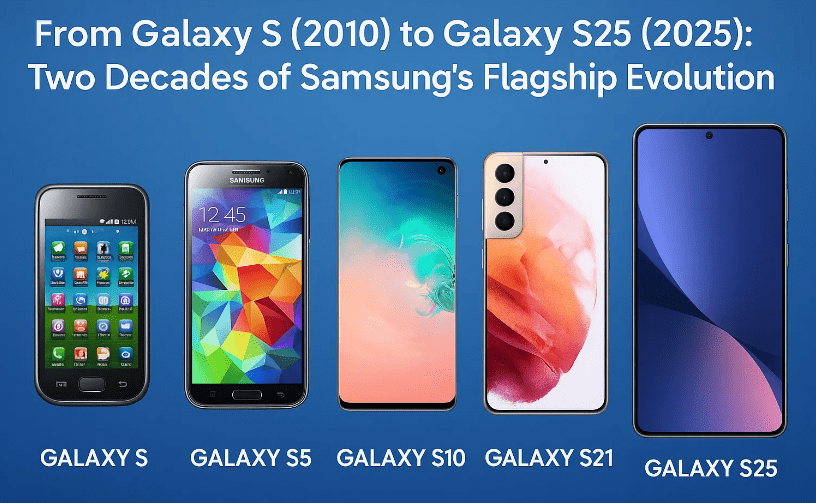
1. The Beginning: Galaxy S (2010)
Let’s rewind. Back in 2010, smartphones were still finding their identity. Apple had paved paths, Android was growing fast, and Samsung launched the Galaxy S to stake its claim in flagships.
Here’s what it offered:
- 4-inch Super AMOLED display — vibrant for that time.
- Samsung’s “Hummingbird” chipset (1.0 GHz), 512 MB RAM.
- 5 MP rear camera capable of HD video.
- 1500 mAh battery.
- Swipe keyboard input (gesture typing) included.
Why it stood out: The display quality made games, media and browsing pop. Samsung’s Super AMOLED technology offered richer color contrast and deep blacks, which many competitors didn’t have. Also, features like gesture typing were early signs of usability focus.
Sales & impact: The Galaxy S sold over 24 million units over its life. That’s a strong start, giving Samsung confidence to invest in each subsequent generation.
2. The Rise: S2 & S3 – Big Screens, Moving Parts
Samsung didn’t sit still after the S. The S2 came in 2011 and then S3 in 2012/2013. Each added more power, more screen, smarter software.
Galaxy S2 (2011)
- 4.3-inch Super AMOLED Plus display.
- Dual-core 1.2 GHz “Exynos” 4210/4412 (region dependent) processor.
- 1 GB RAM.
- 8 MP rear camera + 2 MP front.
- Sleeker, lighter build than its predecessor.
What changed: Faster CPU, more RAM, better display, and a front camera that made video chats more usable. Sales also took off further — over 40 million units globally.
Galaxy S3 (2012)
- 4.8-inch HD resolution screen.
- Quad-core CPU (1.4 GHz).
- 1 GB RAM (in many models), still upgraded cameras.
- Software additions: Smart Stay (screen stays lit when you look), Best Photo (auto-picks the best from burst shots), S Voice (Samsung’s virtual assistant beginnings).
Why S3 clicked: It combined big screen + smoother performance + novelty in user-friendly features. People loved the screen real estate, the “smart” behaviors. Sold over 70 million units.
3. Refinement and Risks: S4, S5, S6 – Features, Materials, Controversies
As phones matured, the S series started stacking more features. Not all experiments were loved; not all changes were perfect. But many moved the phone forward.
Galaxy S4 (2013)
- 5.0-inch Full HD (1080p) Super AMOLED.
- “Octa-core” or high-clocked quad-core (depending on market), ~2 GB RAM.
- 13 MP main camera.
- Battery around 2600 mAh.
- New features: Air Gesture (control without touching screen), Smart Scroll (scroll by tilting/eye tracking), etc.
Notable variants:
- S4 Active — rugged version, water & dust resistant (IP67).
- S4 Zoom — hybrid camera/phone with 10× optical zoom.
Sales & legacy: Over 80 million units sold. S4 remains one of the most successful Galaxy S models. Some features were gimmicky (Air Gesture etc.), but they showed Samsung pushing hardware/software integration.









Galaxy S5 (2014)
- 5.1-inch Full HD Super AMOLED.
- Snapdragon 801 CPU (in many markets), 2 GB RAM.
- Camera: 16 MP with improved focusing, video ability.
- Added fingerprint sensor, heart-rate monitor.
- Battery ~2800 mAh.
What people liked & disliked: The fingerprint sensor was a big win (security, ease), but design got criticism: plastic back, design feel was less premium. Also variants: S5 Active, S5 Plus etc. First half of S-series where expectations on design started rising significantly.
Galaxy S6 Series (2015)
This was a major turning point in materials and premium feel.
- Switch from plastic to glass + metal frames.
- Galaxy S6 Edge introduced curved dual edges, Edge panels etc.
- Wireless charging support (Qi / PMA).
- Removed removable battery and microSD card slot (controversial).
Why this matters: Samsung put a strong bet on design and materials. It signaled that flagship buyers expected not just specs but premium build. The removal of microSD/removable battery sparked debate: convenience vs design / engineering constraints.
4. Stability & Innovation: S7 to S10 – Cameras, Display, New Form Factors
With the mid-2010s behind, Samsung stabilized many features and began refining the camera, display, and overall experience.
Galaxy S7 / S7 Edge (2016)
- Re-introduced water resistance (IP68), brought back microSD.
- Excellent camera with Dual Pixel autofocus for better low light.
- Edge version had larger screen and battery.
Galaxy S8 / S8+ (2017)
- Design changes: Infinity Display, minimal bezels, new aspect ratios.
- Iris scanning plus facial recognition introduced.
- New assistant: Bixby.
Galaxy S9 / S9+ (2018)
- Continued refinement: variable aperture camera (one of the first in phones) to adjust to lighting; ultra-slow motion video (960 fps).
- Moved fingerprint sensor positioning to more ergonomic location.
Galaxy S10 Series (2019)
- Multiple variants: S10e (smaller, flat screen), S10, S10+, later S10 5G.
- Higher screen resolutions (QHD+), HDR10+ support.
- Triple (or more) cameras became standard: wide, ultra-wide, telephoto lenses.
- Big advances in front camera, storage, RAM.
5. The Race for Spec: S20 to S23 – High Performance & Higher Expectations
As the flagship phone market matured, Samsung pushed larger zooms, higher megapixels, faster displays.
Galaxy S20 Series (2020)
- Dynamic AMOLED 2X displays with 120 Hz refresh rates.
- Huge cameras: S20 Ultra had a 108 MP sensor, 100× “Space Zoom” digital zoom, massive sensors.
- Performance boosts, better 5G support.
Galaxy S21 Series (2021)
- Refined design, better internals.
- S21 Ultra included S-Pen support for first time in S-series (traditionally Note).
Galaxy S22 / S22 Ultra (2022)
- S22 Ultra more tightly merged with Note legacy: built-in S-Pen slot, more camera flexibility.
Galaxy S23 Series (2023)
- Improvements in main camera sensors (200 MP in Ultra), software optimizations for low light, video, and performance.
6. Transition & AI Era: S24 – Design Shifts & AI Introduction
Before S25, the S24 generation signaled how Samsung was shifting from “just specs” to craft + intelligence.
- Materials: S24 Ultra introduced titanium frame, for better durability and premium feel.
- Plastic/glass finish refinements, more subdued designs.
- AI features started being emphasized: smarter cameras, software that adapts, better image processing.
- Displays improved, battery sizes, etc., refined but not huge spec leaps.
7. The Present: Galaxy S25 (2025) – What’s New & What Holds Over
So we reach 2025. The S25 series represents both continuation and refinement. Let’s break down what’s officially announced (from Samsung) and what specs have been confirmed.
So far we have done a good job tracking where Samsung came from. Now let’s move into what the S25 brings, and how it compares to the past.
What Samsung Confirms
From Samsung’s official pages and reliable leaks:
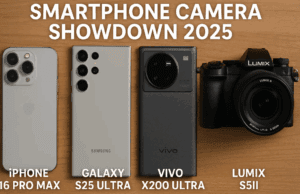
- The Galaxy S25 series (models: S25, S25+, S25 Ultra, S25 Edge, and FE) was announced 22 January 2025 and released starting February 7, 2025 (for main models). (Samsung Newsroom)
- They boast a new AI-integrated OS experience (One UI version with smarter features) and a powerful custom processor called Snapdragon 8 Elite for Galaxy. (Samsung Newsroom)
- Display tech: Dynamic LTPO AMOLED 2X, 120 Hz refresh rate (variable), HDR10+. Ultra version has very high peak brightness (2600 nits) and stronger protection (Gorilla Glass Armor etc.). (Samsung Newsroom)
- Camera systems:
‒ Standard S25 and S25+ have ~50 MP wide, 10 MP telephoto (3×), ultrawide etc.
‒ Ultra version pushes it with a 200 MP main sensor, better lenses, periscope zoom (5×), etc. (Wikipedia) - Battery & charging: variations depending on model. For example, S25+ and Ultra support faster wired charging (45W) vs standard models. Wireless charging supported; reverse charging. (Wikipedia)
- Materials and design: premium builds (aluminum, titanium on Ultra / Edge), better glass protection. Slim design for some variants (Edge is noted for being especially thin). (Wikipedia)
What Carries Over or Improves
- Battery capacities are similar or slightly improved depending on model.
- Fingerprint sensors under display remain.
- Higher RAM across the board (12GB is more common now even for base models). (Wikipedia)
- Connectivity upgrades: better WiFi versions, improved 5G modems.
What’s Different / What Users Notice
- The Edge model is one of the thinnest in the S-series: about 5.8 mm thickness. (The Times of India)
- Ultra version with titanium frame and Gorilla Armor 2 glass offers better durability and scratch resistance. (Samsung)
- Stronger AI features: tools like Audio Eraser, auto noise reduction, more intelligent photography/video processing. These are more front-and-center than before. (Samsung)
S25 Spec Comparison to Recent S Models
Below is a comparison of key specs between S23 / S24 and S25 for major models (Ultra or high end) to highlight what’s new.
| Spec | Galaxy S23 Ultra (2023) | Galaxy S24 Ultra (2024) | Galaxy S25 Ultra (2025) |
|---|---|---|---|
| Main Camera | 200 MP | 200 MP | 200 MP (with improved lenses, better low-light, and AI processing) |
| Material / Body | Premium glass + metal | Titan-frame introduced, more robust build | Titanium + Armor glass, refined protection |
| Charging | 45W wired for Ultra, others lower; wireless etc. | Similar setup, slight tweaks in efficiency | S25+ / Ultra: 45W, others varied, wireless supported etc. |
| Display Peak Brightness | Very high (above 2000 nits in S24 Ultra) | Comparable, sometimes higher quoted nits (2600) in S25 Ultra etc. | |
| New Features | Improvements in camera, performance | AI integration more ambitious, new tools, thinner/slimmer models (Edge), enhanced durability etc. | S25 pushes further with tools like Audio Eraser, ProScaler, better AI OS integration. |
8. What Samsung Did Right (and When They Didn’t)
It’s critical to reflect: not every step was perfect. Some moves were risky; some features came back after being removed. These lessons often define fan satisfaction more than raw specs.
- Right moves:
- Moving to curved edges, then refining those designs (Edge series) gave a premium feel.
- Introducing features users actually use: fast autofocus, optical zoom, durable materials.
- Listening to critique: re-introducing water resistance, retaining microSD after removing it (S7), or adjusting design when fans reject the look.
- Consistent upgrades in performance and camera, enough to justify generation upgrades for many users.
- Challenges / missteps:
- Too much variation in models and confusing naming (Mini, Plus, Ultra, FE, Edge etc.) can dilute clarity.
- Some features felt gimmicky (e.g. Air Gesture in S4).
- Trade-offs like battery vs. thickness vs heat—slim phones sometimes suffer in battery life or thermal performance.
- Removing features that some users care deeply about (removable battery, microSD, etc.) always carries backlash.
9. Frequently Asked Questions (FAQs)
Here are some common questions about the Galaxy S evolution, especially around the S25 generation.
Q1: What is “Galaxy AI” in S25?
Samsung has been emphasizing AI-integrated OS and feature sets: things like Audio Eraser in videos, smarter image/video processing, predictive behavior, possibly more on-device processing. These features are meant to enhance everyday usage.
Q2: Is the S25 Edge just a slimmer S25+, or more than that?
More than just slimmer: the Edge model is one of the thinnest Galaxy S phones (≈ 5.8 mm), uses titanium in its design, has a 200 MP wide-angle camera, but it trades off some features (e.g. telephoto zoom) compared to Ultra. It is about premium build & aesthetics.
Q3: How has battery life kept up with slimming and more powerful components?
Samsung has had to balance battery capacity, efficiency of the processors, cooling (vapor chamber improvements), display tech (efficient LTPO, OLED panels) etc. Slim phones may have smaller batteries, but efficiency and optimization matter a lot. Also, features like adaptive refresh rate help reduce wasted power.
Q4: Are all models getting the same software support?
Samsung has committed to long support cycles. S25 models are said to get many years of Android/One UI updates. But base/trims may differ in features (AI, camera etc.). It’s always wise to check which variant (Ultra, Plus, FE etc.) you have.
Q5: Will S25 be a major leap over S24? Is upgrading worth it?
If you value camera enhancements, durability, AI features, and premium build, then yes. But if you already have a recent S-series flagship, differences might feel incremental. For many users, the choice depends on what matters more: specs vs everyday usability.
10. Final Thoughts
Over the last fifteen years, the Samsung Galaxy S series has matured from “look at that display” to “look how intelligently this device adapts to me.” The evolution isn’t linear: features come and go, trade-offs are made, fan reactions shape decisions. But there’s a throughline: each generation tries to push what a smartphone can do without losing sight of what people actually use it for.
The Galaxy S25 doesn’t reinvent the wheel—but it refines the ride. With stronger AI integration, better durability, and thoughtful design, it shows Samsung doubling down on what users value: performance, camera, feel, and reliability. For many, that’s more meaningful than raw numbers or spec sheets.
If you followed Samsung’s S-series from the original 2010 model to now, one thing is clear: innovation isn’t just about adding new features; it’s about keeping the best, fixing the worst, and moving forward with intention.
⚠️ Disclaimer
This article is based on publicly available specifications, official Samsung announcements & confirmed reliable leaks as of mid-2025. Details such as pricing, regional features, and availability may vary by country. Also, some rumored features may change before or after market release. Always refer to Samsung’s official site, especially for your country, for the most accurate and current information.
🔗 Official Links for Reference
- Samsung Galaxy S25 official product page: Samsung Galaxy S25 / S25 Ultra / S25 Edge (Samsung)
- Samsung Newsroom: “Galaxy S25 Series Sets the Standard of AI Phone” release (Samsung Newsroom)
Tags & Hashtags
Tags: Samsung Galaxy S, Galaxy S25, smartphone evolution, camera tech, Samsung AI features, display technology, battery innovation, flagship phones, specs compared
Hashtags: #Samsung #GalaxyS25 #Smartphones #TechEvolution #Camera #Display #AI #FlagshipPhones #Innovation