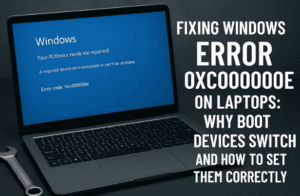
There is a moment of frustration that many users recognize: you press the power button on your computer, expecting the familiar Windows logo, but instead the screen flashes a worrying message — No Boot Device Found.
The first instinct is to assume something serious: maybe the SSD has disconnected, maybe the hard drive has crashed, or maybe the system is damaged. But in reality, this error often comes from a very simple misconfiguration inside the BIOS. Even when your SSD and HDD are fully functional, the system can sometimes fail to recognize the correct drive to boot from.
In today’s guide, let’s walk through this situation in a natural, story-like flow, understanding why it happens and how you can fix it in just a few minutes by adjusting one BIOS setting.
1. When the PC Shows a Boot Device Error
Before touching any settings, it’s important to understand what’s happening on the screen.
When the system starts and displays a Boot Device Not Found or No Boot Device message, it means:
“The BIOS could not find your Windows installation in the expected place.”
This has nothing to do with whether your SSD or hard drive is physically present. In many cases, both drives are installed perfectly. Yet the system still behaves as if there is no operating system.
This happens because the boot mode, boot priority, or UEFI setting might be incorrect.
A small BIOS reset, power fluctuation, firmware update, or hardware change is enough to misconfigure the setting.
And once this happens, Windows simply doesn’t load.
2. Restarting the System Correctly (ALT + CTRL + DELETE)
Your first step is straightforward: simply restart the machine without turning off the power.


You do that by pressing:
ALT + CTRL + DELETE
All three keys together restart the system instantly.
As soon as the system begins restarting, you prepare for the next step — entering the Boot Menu.
Dell systems use a very specific key for this purpose.
3. Entering Dell’s Boot Menu Using F12
As the system restarts and the Dell logo appears, tap:
F12 repeatedly
This opens Dell’s Boot Menu, where you can view and modify temporary and permanent boot options.
Many users don’t know that Dell’s F12 Boot Menu also allows quick access to BIOS functions that control how Windows loads. Inside this menu, you’ll notice several boot modes such as UEFI, Legacy, and additional options for secure boot, USB boot, and internal storage.
The error usually appears because the system is not using the correct UEFI boot setting.
4. The Critical Step: Enabling the Correct UEFI Boot Option
Once you enter the Boot Menu, move down the list until you locate the Boot Option Change, which typically appears under the UEFI-related settings.
The problem often originates from one simple reason:
UEFI is disabled, misconfigured, or not set as the active boot mode.
Modern systems — especially those running Windows 10 or Windows 11 — must boot in UEFI mode.
If this mode is disabled or incorrectly configured, the system no longer sees Windows, even when it is installed on the SSD.
Inside the Boot Menu:
- Navigate to the section under “UEFI Boot”.
- Enable the option if it is OFF.
- Apply the setting and confirm.
This one change immediately instructs the motherboard to recognize the SSD containing Windows again.
After accepting and applying the change, the system takes a few seconds, but the moment it reconfigures — Windows starts instantly.
5. Why Windows Now Starts Instantly
Once UEFI boot mode is corrected, something interesting happens.
The system, even if it has both SSD and HDD installed, goes straight to the SSD because:
- The SSD contains the UEFI bootloader.
- SSDs are inherently fast.
- BIOS no longer wastes time trying to search for Windows in the wrong device.
This is why the moment you apply the correct setting, Windows loads within seconds.
It feels almost magical — but in reality, it’s just proper configuration.
6. Restart Test: Does the Error Fully Disappear?
After fixing the setting, the next step is testing whether the system boots normally on restart.
You restart the PC.
You watch the screen carefully.
If everything is correct, the Dell logo stays for only a moment before Windows starts loading.
This confirms that the boot error was purely configuration-based, not hardware-related.
However, a restart is not the only test we should rely on.
A machine may restart properly but still fail during a cold boot (after shutdown).
So we continue the process.
7. Shutdown Test: Ensuring Permanent Stability
Once the system is fully booted into Windows, shut it down completely.
Then press the power button again.
This moment is important because if the BIOS change was truly effective, the system will again load Windows without hesitation.
The few seconds of wait feel longer than usual because you’re observing every little behavior, but once the Windows logo appears — the issue is officially resolved.
If the system boots correctly after shutdown, the problem is permanently fixed.
8. Why the Error Happens Even When Drives Are Working
A surprisingly large number of users assume the worst when this error appears, but the reality is more technical than alarming.
Typical reasons include:
- BIOS was reset due to low CMOS battery
- Boot mode accidentally switched from UEFI to Legacy
- Boot entry for Windows Boot Manager was disabled
- Multiple drives confused the boot sequence
- System firmware updates modified boot settings
- USB drives or external devices interfered with boot priority
All of these are routine and recoverable issues.
The internal SSD and HDD may be perfectly fine.
In fact, the system often runs faster than before once the correct boot mode is restored.
9. Important Safety Note
Changing BIOS settings is safe only when you know what each option does.
Disclaimer:
Beyond enabling UEFI boot mode or adjusting boot priorities, avoid modifying secure boot, virtualization, TPM, SATA modes, or firmware options unless you fully understand the consequences. Incorrect changes may affect Windows activation, BitLocker protection, or overall system stability.
If you are unsure, make only the adjustments described in this article.
10. Final Thoughts
Fixing a No Boot Device Found error feels intimidating at first, but once you understand the story behind it, the solution becomes extremely simple.
Computers behave logically — if they don’t know where Windows is located, they show an error.
Your job is simply to guide them back to the correct drive through the BIOS.
With one correct UEFI setting, the PC transforms from a non-booting machine into a fully functional system again.
And now, whenever anyone around you faces a similar problem, you’ll know exactly how to fix it — confidently, calmly, and without guessing.
#DellPC #BootErrorFix #Windows11 #UEFIBoot #TechGuide #dtptips