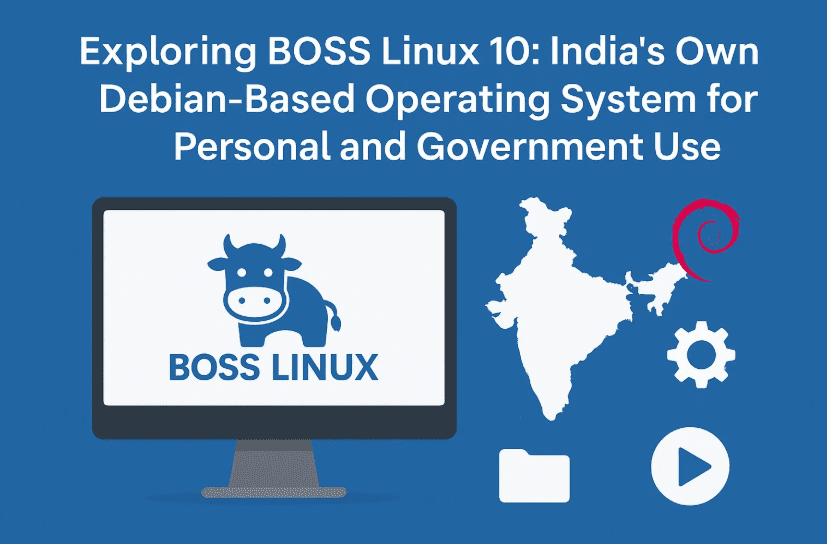
India’s push for digital sovereignty and technological independence has long included developing its own software infrastructure—and Linux has been a natural ally in that journey. Among the handful of Indian-made Linux distributions, BOSS Linux (Bharat Operating System Solutions) stands out as one of the most significant efforts by the Government of India to introduce a homegrown, Debian-based operating system for public and institutional use.
In this article, we’ll take a deep dive into BOSS Linux 10 “Pragya”—the flagship edition of this operating system. We’ll explore its origins, versions, system requirements, installation process, features, and discuss whether it’s ready to be adopted at scale. If you’re an Indian user curious about Linux or a tech enthusiast exploring government-backed FOSS alternatives, this is for you.
🇮🇳 What is BOSS Linux?
Let’s begin with the background. BOSS Linux was first developed in 2007 by C-DAC Chennai (Centre for Development of Advanced Computing), under the Ministry of Electronics and Information Technology (MeitY). The goal was to create an Indian Linux distribution tailored for local needs—supporting regional languages, government infrastructure, and promoting the use of Free and Open Source Software (FOSS) in the country.
While many Indian Linux distributions have come and gone, BOSS Linux and Maya OS remain the most prominent government-backed ones:
- Maya OS: Developed by DRDO, this one is designed strictly for defense applications and not available to the public.
- BOSS Linux: This is the only government-developed Linux distro that is available for personal, educational, and enterprise use.
So far, we’ve understood the purpose and background. Now let’s get into the different editions of BOSS Linux and what they offer.
🧩 Flavors of BOSS Linux: Which One is Right for You?
Before installing anything, it’s important to choose the right version. BOSS Linux 10 “Pragya” comes in four main editions, each designed for different use cases.
Let’s take a closer look at each:
1. BOSS Linux (Regular Edition / Pragya)
- Based on: Debian 10 (Buster)
- Desktop Environment: Cinnamon
- Purpose: Designed for general users, offices, and academic institutions.
- Target Audience: Government employees, college students, Linux learners.
This is the version we’ll focus on in the tutorial ahead.
2. EduBOSS (Educational Edition)
- Tailored for school environments, EduBOSS comes with:
- Educational games
- Drawing tools (like Paint)
- Science learning software
- Despite being useful in theory, EduBOSS isn’t widely adopted in Indian schools—largely due to limited computer infrastructure and the dominance of Windows.
3. BOSS Server
- Aimed at enterprises and developers, it includes:
- Web server stack
- Proxy server tools
- Mail and database server support
- System admin tools for deployments
This is similar to Ubuntu Server and is suited for IT infrastructure in government and corporate sectors.
4. BOSS MO (Minimal Edition)
- Designed for low-level hardware, driver development, or embedded systems.
- Lightweight, uses minimal resources.
- Not targeted at regular users—more suited to hardware-level programming environments.
Each version comes with 4 years of software support, which is generous for a government-distributed Linux OS.
🖥️ System Requirements for BOSS Linux 10 Pragya
The minimum system specs are fairly light and make it ideal for older machines as well:


- RAM: 2 GB (minimum)
- Storage: 15 GB hard drive space
- CPU: At least a 1 GHz Pentium processor
These requirements are easily met even by decade-old desktops and laptops, making BOSS Linux an option for digital inclusion initiatives.
📥 How to Download BOSS Linux 10 Pragya
Let’s move to the next step—downloading the ISO image. You can get it from the official BOSS Linux website.
🔗 Official Download Link: https://bosslinux.in/downloads
Steps:
- Visit the official downloads page.
- Scroll down to find the BOSS 10 Pragya ISO.
- Click on the “Download” button.
Once you have the ISO, you can either burn it to a USB drive (using tools like Rufus or balenaEtcher) or mount it to a virtual machine.
⚙️ Installation Process: Installing BOSS Linux in a Virtual Machine
Now that you have the ISO file, let’s go through the installation steps. For this demo, we used VirtualBox to test the installation process.
1. Boot the ISO
- Choose your language (English or supported Indian languages).
- Set your time zone and keyboard preferences.
- Proceed to the next step.
2. Partitioning the Disk
- Choose the option to “Use entire disk” if you’re testing on a VM or want a clean install.
- Confirm the partition structure and format.
3. Set Up User Credentials
- Create a hostname for your system (e.g.,
boss-linux-vm). - Enter your full name and set a username.
- Choose a secure password.
4. System Installation Begins
- The installer will now copy files and set up the base system.
- Wait patiently; this may take 5–10 minutes on a virtual machine.
5. First Boot
- Once the installation is complete, reboot the system.
- Log in using the credentials you just created.
Congratulations! You’ve now installed BOSS Linux.
🧪 First Impressions: What Does BOSS Linux Look Like?
Let’s now explore the desktop and check out what’s under the hood.
- Desktop Environment: Cinnamon, clean and familiar to users of Linux Mint.
- Preinstalled Software:
- Chromium browser (a nice touch not often seen in default distros)
- LibreOffice Suite
- Basic multimedia tools
- GNOME apps like Document Viewer, Archive Manager, Terminal, etc.
We checked the wallpapers and themes—and most of them are standard Cinnamon backgrounds, with a few BOSS-specific ones.
Nothing flashy or heavily customized—just a stable Cinnamon experience.
🔍 Checking System Info with Neofetch
Using neofetch, we confirmed:
- OS: BOSS Linux 10 Pragya
- Architecture: 64-bit
- Kernel: Linux 4.x (Debian Buster base)
- DE: Cinnamon
- Resolution: 800×600 (VirtualBox default)
No surprises here—it’s a clean, Debian-style system dressed with a few Indian elements.
🌐 Regional Language Support
One area where BOSS Linux tries to stand out is Indian language support. During setup, you can choose languages like:
- Hindi
- Tamil
- Bengali
- Gujarati
- Kannada
- Telugu
This can be very helpful for local government offices, educational institutes, or rural centers.
❓ Is BOSS Linux Worth Using?
Now for the big question—how does BOSS Linux stack up?
Pros:
- Lightweight, runs well on old hardware.
- Indian language support built-in.
- Clean and stable Debian base.
- Open-source and freely available.
Cons:
- Not much software customization—looks like stock Cinnamon.
- Lack of community support or frequent updates.
- Minimal real-world usage in public or private sectors.
- Educational and enterprise versions remain mostly underutilized.
❓ FAQs: Common Questions About BOSS Linux
Q: Is BOSS Linux suitable for beginners?
A: Yes, especially for those transitioning from Windows. The Cinnamon UI is friendly and familiar.
Q: Can BOSS Linux be used in schools?
A: Yes, EduBOSS exists for this purpose, but adoption in Indian schools is still low.
Q: Is it available in multiple Indian languages?
A: Yes, BOSS supports several regional languages out of the box.
Q: How often is BOSS Linux updated?
A: Major releases get 4 years of support, but community updates and frequent patches are limited.
Q: Can I replace Ubuntu or Mint with BOSS Linux?
A: Technically yes, but unless you need Indian language support or are working in a government ecosystem, Mint or Ubuntu might offer better support and ecosystem.
🧭 Final Thoughts: A Proud Attempt, But Needs Adoption
BOSS Linux is an important step in India’s digital journey. It ticks all the boxes for a self-reliant, FOSS-based national operating system—language support, Debian stability, educational and enterprise use cases.
But it lacks one thing—widespread usage.
Unless the Indian government mandates its use across schools, offices, and departments, it may continue to remain an experimental niche project.
Still, if you’re an Indian tech enthusiast, FOSS advocate, or curious Linux user, give BOSS Linux a spin and see where it stands in your workflow.
Tags:
boss linux, indian linux distro, government linux os, make in india software, cdac linux, debian based indian os, eduboss, maya os, linux mint alternative, linux in schools, foss india
Hashtags:
#BOSSLinux #LinuxIndia #FOSSIndia #MakeInIndia #IndianOS #DebianBased #EduBOSS #GovernmentLinux #LinuxMintAlternative #CDACChennai