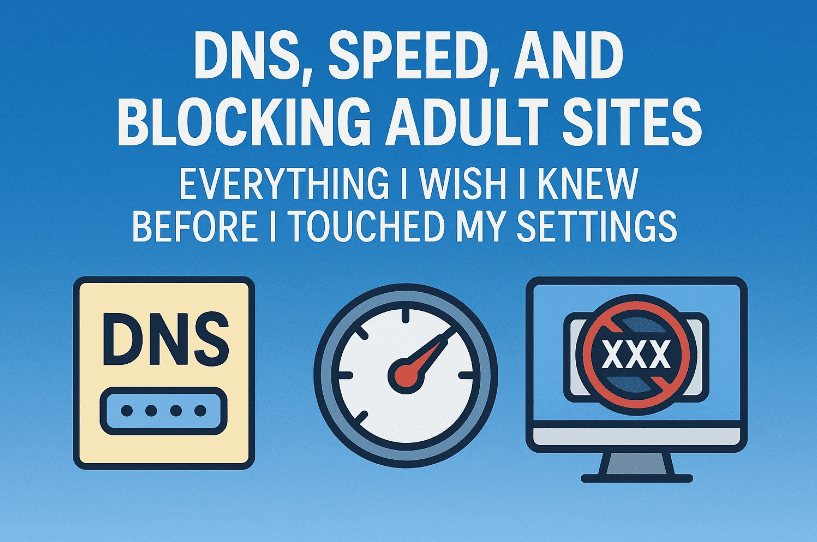
If you’ve ever typed youtube.com and wondered what secret handshake makes that page appear in your browser, the answer is a quiet hero called DNS—the Domain Name System. You use it every day on your PC, laptop, and phone, yet most of us only notice it when something breaks. In this article, we’ll strip the jargon, explain what DNS actually does (with simple examples), show you how to make web browsing feel faster, and teach you two reliable ways to block specific sites or entire categories (think social media, gambling, adult content) on your devices or home network.
We’ll go step-by-step, with screenshots you can imagine and commands you can copy—no shortcuts, no magic. And when there’s a better or safer alternative to something confusing (like editing a system file), I’ll say so.
Take a breath. We’ll start at the beginning and build up.
Table of Contents
1 DNS in Plain English: Why the Internet Needs an “Address Book”
2 What Happens When You Type a URL (The Life of a Lookup)
3 Try It Yourself: nslookup to See Real IPs
4 Faster Browsing with a Faster Resolver: What “Fast” Really Means
5 Choosing a DNS Provider (Google, Cloudflare, Quad9) and How to Compare
6 Change DNS on Windows (The Easy, Precise Walkthrough)
7 Bonus: Change DNS on macOS, Android, and iOS
8 Flush the DNS Cache (When Changes Don’t Seem to Work)
9 Block Individual Websites with the Hosts File (Method 1)
10 Block Sites or Whole Categories with OpenDNS (Method 2)
11 Router-Level vs Device-Level: What to Change Where
12 Privacy & Security Notes (DoH/DoT, Logs, and Bypasses)
13 Troubleshooting: “Page Won’t Load,” “Filter Didn’t Apply,” and More
14 FAQ
15 Quick Start Checklist (Copy–Paste Friendly)
1 DNS in Plain English: Why the Internet Needs an “Address Book”
Let’s keep the analogy simple. Imagine I invite you to my home. If I only say, “Come to Techno Uplift,” you’ll smile and ask, “Great, but what’s the address?” You need the city, street, and flat/house number to actually get there.
Domain names (like youtube.com or amazon.in) are the friendly names we remember. IP addresses (like 142.250.184.206) are the real, machine-readable addresses. DNS is the internet’s address book—it translates names into numbers so your device can reach the correct server.
No DNS, no page. It’s that fundamental.
2 What Happens When You Type a URL (The Life of a Lookup)
Here’s the behind-the-scenes story, told in human terms:
- You type youtube.com and hit Enter.
- Your device asks a DNS resolver (often your router or your ISP’s DNS) “What’s the IP for youtube.com?”
- The resolver finds the answer (from cache or by asking authoritative DNS servers) and replies with the IP address.
- Your browser now knows where to go and connects to that IP—that’s YouTube loading on your screen.
This happens for every site, often for every subdomain on that site. A fast, reliable DNS resolver means these lookups don’t slow you down.
3 Try It Yourself: nslookup to See Real IPs
It’s always nice to see the truth with your own eyes. On Windows:
- Open Command Prompt.
- Type:
nslookup youtube.com - You’ll see two key pieces of info:
- The server your PC asked (your current DNS)
- The Address returned for
youtube.com
Repeat with other domains to watch it in action. This is the same translation your browser depends on—only now you’re seeing the raw answer.





Note: You might see different IPs than your friend because large sites use CDNs and anycast—they route you to a nearby server for speed.
4 Faster Browsing with a Faster Resolver: What “Fast” Really Means
A “fast” DNS doesn’t speed up your download rate, but it does cut the delay between click and first byte. If your DNS resolver is sluggish, your browser waits longer to learn the IP—so pages feel slow to start loading.
A quick reality check:
- Latency (how quickly the resolver replies) matters.
- Caching (whether it already knows the answer) helps.
- Reliability (rare errors, consistent uptime) is crucial.
Using a strong resolver is like upgrading from a sleepy receptionist to a sharp one who always picks up and remembers where everything is.
5 Choosing a DNS Provider (Google, Cloudflare, Quad9) and How to Compare
Let’s look at popular, reputable options. You can test them and choose what feels best in your location.
- Google Public DNS —
8.8.8.8and8.8.4.4
Official page: https://developers.google.com/speed/public-dns - Cloudflare —
1.1.1.1and1.0.0.1
Official page: https://1.1.1.1/ - Quad9 (security-focused) —
9.9.9.9and149.112.112.112
Official page: https://www.quad9.net/
Simple test you can do right now (latency check):
Open Command Prompt and ping each resolver’s IP:
ping 8.8.8.8
ping 1.1.1.1
ping 9.9.9.9
Lower average time (ms) usually means snappier responses from your location. Keep in mind ping isn’t a full DNS benchmark, but it’s a quick sanity check.
A careful note: the “fastest ping” isn’t always the fastest resolver under every load, but for most home users it’s a practical way to pick a good provider quickly.
6 Change DNS on Windows (The Easy, Precise Walkthrough)
So far so good. Let’s move to the hands-on part and actually switch your DNS. There are a couple of paths on Windows; here’s the one that’s easiest to remember.
Method A — Classic Network Connections (works on Windows 10/11):
- Press Windows key and type:
ncpa.cpl
(Careful: it’s ncpa.cpl, not “ncpcl”.)
Hit Enter to open Network Connections. - Right-click your active connection (Wi-Fi or Ethernet) → Properties.
- Select Internet Protocol Version 4 (TCP/IPv4) → Properties.
- Choose Use the following DNS server addresses and enter your choice, for example:
- Preferred:
1.1.1.1 - Alternate:
1.0.0.1
(Or Google/Quad9 values if you prefer.)
- Preferred:
- Click OK, then Close.
Method B — Windows Settings (Windows 11 UI):
- Settings → Network & Internet → Wi-Fi (or Ethernet) → click your network → DNS server assignment → Edit.
- Switch Automatic (DHCP) to Manual.
- Enable IPv4, then fill DNS values (e.g., 1.1.1.1 and 1.0.0.1).
- Save.
Pro tip: After changing DNS, it can help to flush the DNS cache (see section 8) so you’re not using stale lookups from the old resolver.
7 Bonus: Change DNS on macOS, Android, and iOS
You asked for more than just Windows, so here’s the broader toolkit. Don’t worry—we’ll keep it concise.
macOS (Ventura/Sonoma):
- System Settings → Wi-Fi → click your network → Details.
- Go to DNS → click + to add servers (e.g.,
1.1.1.1,1.0.0.1). - OK → Apply.
Android (stock steps may vary by device):
- Settings → Network & Internet → Internet → your network → the pencil / edit icon.
- Expand Advanced → IP settings → switch DHCP to Static or look for Private DNS.
- If you see Private DNS, you can enter a provider hostname (e.g., for Cloudflare DoT:
one.one.one.one). - Otherwise, in Static mode, set DNS 1 and DNS 2 to your chosen IPs.
- If you see Private DNS, you can enter a provider hostname (e.g., for Cloudflare DoT:
- Save and reconnect.
iOS/iPadOS:
- Settings → Wi-Fi → tap the i next to your network.
- Configure DNS → Manual → Add Server (e.g.,
1.1.1.1,1.0.0.1). - Save.
If you prefer network-wide control (one change for everyone at home), you can set DNS on your router instead—see section 11.
8 Flush the DNS Cache (When Changes Don’t Seem to Work)
Sometimes your device or browser clings to old DNS answers. Clearing the cache is like refreshing the address book.
- Windows (Command Prompt as Admin):
ipconfig /flushdnsYou should see “Successfully flushed the DNS Resolver Cache.” - macOS (Terminal):
sudo dscacheutil -flushcache; sudo killall -HUP mDNSResponder(You won’t see a success message; it just returns to prompt.) - Android/iOS:
Toggle Airplane mode on/off or reboot the device. - Browser-only DoH:
If you use Secure DNS in the browser (Chrome/Firefox), close/reopen the browser after changes.
So far, we’ve tuned for speed. Next up—control.
9 Block Individual Websites with the Hosts File (Method 1)
If you only need to block a few domains on a single Windows PC, editing the hosts file is the fast, local approach. It’s old-school, but it works.
Important upfront notes:
- You need administrator rights.
- This affects only this device (not other phones/laptops on your network).
- It doesn’t easily block every subdomain (e.g.,
m.facebook.com,static.facebook.com) unless you add each one. - Some apps use hard-coded DNS or encrypted DNS and may bypass hosts.
Step-by-step (Windows 10/11):
- Open File Explorer → go to
C:\Windows\System32\drivers\etc\. - You’ll see a file named hosts (no extension).
- Copy the file to your Desktop (so you can edit it).
- Right-click the desktop copy → Open with → Notepad (or Notepad++).
- Add entries using the loopback IP
127.0.0.1, like this:127.0.0.1 www.facebook.com 127.0.0.1 facebook.com 127.0.0.1 www.amazon.com 127.0.0.1 amazon.comTip: add both with and withoutwww. For some sites you may need obvious subdomains too. - File → Save.
- Copy the edited hosts from the Desktop back to
C:\Windows\System32\drivers\etc\and choose Replace (you’ll need admin permission). - Flush DNS (section 8) and test.
If the block worked, the site should show “site can’t be reached” or similar.
When is this method perfect?
- Quick, device-only blocks.
- Temporary changes (easy to undo by removing lines).
When to avoid it?
- You need home-wide filters across all devices.
- You want entire categories (e.g., gambling) blocked automatically.
- You don’t want to maintain a long list or chase new subdomains.
In those cases, go with OpenDNS next.
10 Block Sites or Whole Categories with OpenDNS (Method 2)
If you want filtering that applies to every device on your home network without touching each phone and laptop, OpenDNS is a great, free place to start.
- OpenDNS Home: https://www.opendns.com/home-internet-security/
Here’s the flow—all it takes is an account, adding your network, choosing categories, and pointing your DNS at OpenDNS.
A) Create your free account
- Go to the link above → choose OpenDNS Home (Free) → Sign Up.
- Verify your email and log in to the dashboard.
B) Add your network
- In the dashboard, click Add a network.
- Open a new tab and search “what is my IP” to see your public IP (not the private
192.168.x.xfromipconfig). - Confirm the IP matches what OpenDNS detected → Add This Network.
- Give it a friendly name (e.g., Home). If your ISP changes your public IP periodically, you can set up an OpenDNS updater later, but start with manual.
C) Choose your filtering level
- None — allows all (useful for testing).
- Low — blocks pornography.
- Moderate — blocks adult-related & illegal activity.
- High — adds social networks, video-sharing, and common time-wasters.
D) Customize categories or block specific domains
- Click Custom to select exactly what you want (e.g., Gambling, Games, Adult Themes, Politics/Portals—choose what fits your home).
- To block specific domains, scroll to Manage Individual Domains → set the dropdown to Always block → add domains (e.g.,
facebook.com,instagram.com) → Add Domain.
E) Point your devices—or better, your router—to OpenDNS
- The OpenDNS resolver IPs you’ll need:
- 208.67.222.222
- 208.67.220.220
Device-level (Windows): Follow section 6 and use those two IPs.
Router-level (recommended): Log into your router → find Internet/Network → DNS → replace your ISP DNS with 208.67.222.222 and 208.67.220.220 → Save/Reboot.
F) Apply & wait
- Back in OpenDNS, click Apply. It typically takes a few minutes (their UI often says ~3 minutes) for settings to propagate.
- Visit a blocked site; you should see a block page or a browser error.
Verification tip: Open https://welcome.opendns.com. If it says you’re using OpenDNS, you’re set.
Why OpenDNS over hosts edits?
- One change covers every device (if set on router).
- Category filtering means less manual work.
- Block/allow lists are managed from a dashboard, not a system file.
11 Router-Level vs Device-Level: What to Change Where
Before we wrap, a quick strategy chat. You’ve got two levers:
- Device-level DNS:
- Great for testing and per-user rules.
- Doesn’t affect other devices.
- Router-level DNS:
- Great for family-wide rules—every device that connects inherits them.
- Make sure your router doesn’t allow clients to override DNS (some do). If it does, consider firewall rules to force DNS through your chosen resolver.
Extra curveball: modern browsers and OSs can use DNS over HTTPS (DoH), which may bypass router DNS settings by encrypting DNS inside browser traffic. If you rely on router-level filtering, consider disabling DoH on devices or enforce DNS at the network level.
12 Privacy & Security Notes (DoH/DoT, Logs, and Bypasses)
Let’s be responsible about this:
- Resolvers log queries. Public DNS providers often keep some telemetry. Read their privacy pages before choosing.
- DNS over HTTPS/TLS encrypts lookups between you and the resolver (good for privacy), but can bypass filters that rely on seeing DNS. Decide what you value more—privacy or centralized filtering—and configure accordingly.
- Hosts file is simple but not bulletproof. Apps with hard-coded resolvers or their own DoH clients can ignore it.
- OpenDNS filtering is strong, but not perfect. Determined users can use VPNs or custom DoH providers to bypass it.
- Follow the law and your local policies (work/school networks often have rules and managed security controls).
13 Troubleshooting: “Page Won’t Load,” “Filter Didn’t Apply,” and More
A few quick fixes before you tear your hair out:
- You changed DNS but nothing changed
- Flush DNS cache (section 8).
- Restart your device and router.
- Check ipconfig /all to confirm which DNS your adapter is actually using.
- Hosts file edits didn’t work
- Did you save and replace the file in
…\drivers\etc\as Administrator? - Did you add both
www.domain.comanddomain.com? - Flush DNS and try again.
- Did you save and replace the file in
- OpenDNS didn’t block the category
- Wait a few minutes for changes to propagate; then visit
https://welcome.opendns.com. - Ensure your router is truly using the OpenDNS IPs (some ISP routers override).
- If your browser uses DoH, it may be bypassing your router DNS—disable DoH or enforce DNS at the network.
- Wait a few minutes for changes to propagate; then visit
- I broke something and want to go back
- On Windows adapter settings, switch back to Obtain DNS server address automatically.
- Restore your hosts file backup (or remove the lines you added).
- Reboot and test with
nslookup.
14 FAQ
Does DNS actually make my internet “faster”?
It doesn’t increase bandwidth, but it can reduce the delay before pages start loading. Many small lookups add up to a smoother feel.
Is pinging 1.1.1.1 vs 8.8.8.8 a fair test?
It’s a good latency snapshot from your location. True DNS performance also depends on caching and resolver efficiency, but for home users ping is a practical pick-tool.
What about family-safe DNS options besides OpenDNS?
You can also look at Cloudflare Family (1.1.1.3, 1.0.0.3) and Quad9 (malware blocking). Each has different policies—read their docs and choose what matches your needs.
Can I block a site for one laptop but not the whole house?
Yes—set DNS only on that laptop (device-level) or edit its hosts file.
I added facebook.com to hosts, but m.facebook.com still opens. Why?
Hosts doesn’t support wildcards. You must add obvious subdomains individually (m.facebook.com, static.facebook.com, etc.) or use a DNS filter like OpenDNS.
How do I undo OpenDNS filtering quickly?
Change the device/router DNS back to Automatic/DHCP or to another provider (e.g., Cloudflare/Google). In a managed family setup, keep the router settings secured with a strong password.
15 Quick Start Checklist (Copy–Paste Friendly)
Before we call it a day, here’s a fast plan you can follow this evening:
- Confirm how DNS works on your device with:
nslookup youtube.com - Pick a resolver to test:
- Cloudflare:
1.1.1.1,1.0.0.1— https://1.1.1.1/ - Google:
8.8.8.8,8.8.4.4— https://developers.google.com/speed/public-dns - Quad9:
9.9.9.9,149.112.112.112— https://www.quad9.net/
- Cloudflare:
- Change DNS on Windows via ncpa.cpl → adapter Properties → IPv4 → set servers.
- Run:
ipconfig /flushdns - Test a few sites—do they feel snappier to start?
- If you need blocks on one PC, add to hosts:
127.0.0.1 facebook.com 127.0.0.1 www.facebook.comSave → replace → flush DNS. - If you need home-wide filters, create an OpenDNS Home account → add your public IP → choose categories → point your router DNS at:
208.67.222.222 208.67.220.220Wait a few minutes → verify atwelcome.opendns.com.
You’re done. That was a lot, but you’ve just taken control of something most people never touch.
Disclaimer
- Editing networking settings can affect connectivity. If you’re on a managed or corporate network, follow your organization’s policy.
- DNS filters improve control but are not perfect. Determined users may bypass them using VPNs, custom resolvers, or encrypted DNS.
- Public DNS providers may collect some telemetry. Review each provider’s privacy policy before adopting it.
- Hosts-file blocking is local and limited; use provider-level or router-level controls for broader coverage.
Official Links (for tools/services mentioned)
- Google Public DNS: https://developers.google.com/speed/public-dns
- Cloudflare DNS (1.1.1.1): https://1.1.1.1/
- Quad9: https://www.quad9.net/
- OpenDNS Home: https://www.opendns.com/home-internet-security/
Tags
dns, domain name system, dns speed, change dns windows, nslookup, hosts file, block websites, opendns, cloudflare dns, google public dns, quad9, dns over https, parental controls, router dns, flush dns
Hashtags
#DNS #Networking #InternetSpeed #Privacy #ParentalControls #OpenDNS #Cloudflare #GooglePublicDNS #Quad9 #WindowsTips