There was a time when flashing a custom ROM felt like a rite of passage. You’d unbox a phone, sigh at the bloat, unlock the bootloader, and by the end of the night your device looked and behaved exactly the way you wanted. If you’ve been around since the early Android days—LG, Sony, HTC, Micromax, those early Samsung and Google Nexus models—you’ll remember the thrill.
Fast-forward to today, and the landscape is very different. Bootloaders are harder (sometimes impossible) to unlock, kernel sources often arrive late, and even Google’s open-source rhythm has shifted. Banking and UPI apps frequently refuse to run on unlocked or modified devices, and many of the features that once made custom ROMs essential have trickled into stock Android and OEM skins.
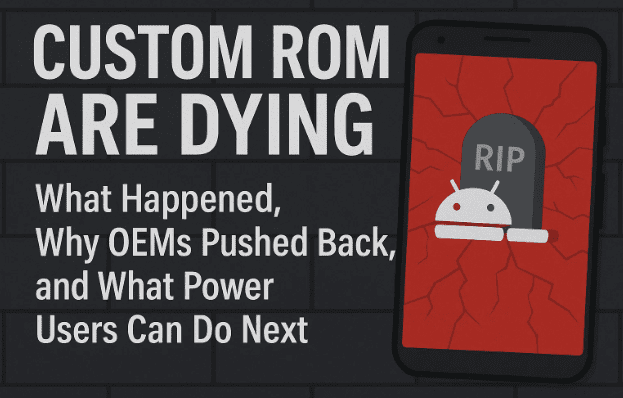
In this article, we’ll unpack the story—where custom ROMs came from, why OEMs and platforms started to resist them, and how you can still retain control over your device in a world that’s steadily closing doors. Along the way we’ll share practical, step-by-step options (from safer stock tweaks to advanced ROM paths), answer common questions, and add a few reality checks. Let’s take our time; there’s a lot to cover.
So far we’ve set the scene. Let’s move to the first chapter and see how we got here.
A Short History: Why Custom ROMs Boomed in the First Place
Back around 2010—give or take—Android was exciting but rough around the edges. OTA updates were infrequent; feature sets felt limited; and OEM skins could be clunky. Community developers stepped in with custom ROMs: community-built versions of Android that gave you speed, battery tweaks, new features, and timely updates. You weren’t stuck waiting for your manufacturer—you could flash what you liked, when you liked.
A few important milestones and names from that era:
- CyanogenMod (the forerunner to LineageOS) made custom Android accessible to the masses. Eventually CyanogenMod wound down and was succeeded by LineageOS (https://lineageos.org).
- MIUI began life as a custom ROM before Xiaomi turned it into the flagship skin for its phones (https://www.miui.com/).
- Other future OEM skins had “custom-ROM energy” too: ColorOS (Oppo, https://www.coloros.com/), FuntouchOS (vivo, https://www.vivo.com/).
- OnePlus famously partnered with Cyanogen for certain markets in the early days, reinforcing how central the custom scene was to Android’s identity.
- AOSP—the Android Open Source Project (https://source.android.com)—was the backbone. OEMs and ROM developers alike pulled from it to build their systems.
Back then, flashing a custom ROM was often the only way to get newer Android versions quickly, remove bloat, or try features like granular permissions, theme engines, and advanced power controls.
But the ground started to shift.
Why OEMs Turned Against Custom ROMs
There isn’t one single cause; it’s a stew of incentives and genuine concerns. Before we list them, here’s a quick gut-check: many users today are content with stock Android plus Google’s frequent Play system updates. OEM skins ship with more features. The “gap” custom ROMs used to fill has shrunk. Now, let’s break down what pushed OEMs—and even platform stewards—away from enthusiast modding.
We’ve covered the big-picture feelings. Now, before rattling off reasons, here’s a short bridge: remember that OEMs are businesses. Beyond the one-time device sale, they’re also trying to build recurring software revenue and lower support risk. With that worldview in mind, the following points make (uncomfortable) sense.
1) Security and Privacy Liability
OEMs argue—sometimes rightly—that they can’t guarantee security on a device that’s been unlocked and flashed. The moment a bootloader is unlocked, Verified Boot assurances are weakened. If a modified device is compromised, who’s responsible?







- Unlocked devices can be harder to wipe-securely if stolen.
- If sensitive apps (banking, UPI, wallets, enterprise apps) run on modified firmware, the risk model changes.
- As a result, many financial apps now rely on integrity checks and refuse to run on rooted/unlocked phones.
2) Monetization and “Services”
Modern phone businesses aren’t just about hardware margins. OEMs add services, preloads, and ad-supported experiences in certain regions. A custom ROM cleanly removes those revenue lines. Unsurprisingly, some OEMs ratcheted up friction:
- Delayed kernel source releases (which slows ROM development).
- Region-specific lock-downs where unlocking is not possible—or requires hoops.
- App bundles and telemetry that are core to the OEM’s service business.
3) Bootloader Lockdowns and Policy Drift
Bootloader unlocking used to be straightforward on many devices. Today:
- Some brands make it nearly impossible to unlock (or force a long waiting period).
- Others allow it but void warranties or break key features.
- Carrier variants can be stricter than unlocked retail models.
- Even brands historically friendly to modding have added more steps, region gates, or time locks.
The net effect: fewer devices are truly “ROM-friendly.”
4) AOSP’s Changing Cadence
The Android Open Source Project remains open, but the timing and breadth of feature drops have evolved. Google prioritizes internal branches and partner schedules; big features may show up in AOSP later. Meanwhile, Google has moved many components to Play services or Mainline modules, letting it update lots of parts without full Android upgrades.
For custom ROMs, this means:
- It’s harder to ship “day-zero” feature parity.
- You rely more on closed components to match user expectations.
- Project Treble and GKI (Generic Kernel Image) helped modularity, but they also change how deep ROMs can go without vendor support.
(Reference: AOSP docs at https://source.android.com/.)
5) Banking/UPI and Corporate Apps
Security policies for financial and enterprise apps became stricter. Many check for rooted status, unlocked bootloaders, or tampered environments. If a ROM fails Play Integrity API (formerly SafetyNet-adjacent checks), those apps may simply refuse to run.
- Developers of those apps are measured on risk reduction, not modder happiness.
- As more daily life moves through these apps, the practical cost of running a ROM rises.
Are Custom ROMs “Over”? A Reality Check
Let’s not over-dramatize: custom ROMs still exist. For many users, they still offer real value—especially on devices with excellent community support and clean unlock paths. But the overall trend is unmistakable:
- Fewer truly ROM-friendly models each year.
- Longer delays in kernel sources.
- More app ecosystems relying on integrity signals.
- Stock Android and OEM skins now include many features that ROMs pioneered.
If you loved flashing “something new every weekend,” today’s ecosystem will feel tighter. If you just want a fast, private, bloat-free phone with reliable banking and passes, you now have to plan more carefully.
So far we’ve covered the why. Next, let’s talk about what you can actually do—both if you don’t want to flash and if you still want to.
If You Don’t Want to Flash: Practical Steps to Reclaim Your Phone
A lot of readers tell me, “I miss the control, but I also need my banking apps. What can I do without going full custom?” Good question. You can regain 80% of the experience with careful stock tuning. Let’s map it out.
We’ve reached the hands-on part. Take a breath, grab your device, and let’s move to the steps.
Step 1 — Start with the Right Device (If You’re Shopping)
Not all phones are equal for “power user” life—even if you never flash:
- Prefer brands with clean, long updates and unbloated skins.
- Google’s Pixel line is predictable on updates; Samsung ships long support windows (though bootloader policy varies by region).
- Check community chatter before buying—“pain now or peace later” is often visible up front.
Step 2 — Tame Preloads and Notifications
- Uninstall what you can.
- Disable what you can’t (Settings → Apps).
- Revoke notification and overlay privileges for noisy preloads.
- Turn off ad toggles in OEM settings where available.
Step 3 — Use ADB Debloating (No Root)
You can remove system apps for the current user via ADB without root:
- Enable Developer options (tap Build number seven times).
- Enable USB debugging.
- On a PC with ADB installed, run
adb shell pm uninstall --user 0 package.name.
Document what you remove; some preloads are interconnected.
Step 4 — Harden Privacy and Permissions
- Use per-mission controls (one-time/while-in-use).
- Disable background access for apps that don’t need it.
- Consider DNS-over-HTTPS or private DNS in system settings.
- Use work profiles to isolate apps (e.g., Shelter, a free app that creates a separate profile).
Step 5 — Browser and Tracker Hygiene
- Use a modern browser with per-site permissions, containers, or profiles.
- Trim web-to-app handoffs that leak data between apps and the web.
Step 6 — Keep Updates On
Stock Android and Play services now ship lots of features and security fixes independent of OEM OTAs. Take the free wins—update promptly.
If You Still Want a Custom ROM: A Careful, Modern Playbook
Some of you are saying, “I hear you—but I still want a ROM.” Fair. In that case, approach it like a project. The rules of thumb that worked in 2014 won’t cut it in 2025.
We’ve done enough cautioning. If you’re determined and careful, here’s a plan that avoids common traps.
Step 1 — Choose the Right Device on Purpose
- Confirm the bootloader unlock policy for your exact model and region.
- Prefer devices with strong ROM communities (actively maintained device trees, recent kernels, available recoveries).
- Pixels remain the reference choice for projects like GrapheneOS (https://grapheneos.org) and LineageOS (https://lineageos.org).
Step 2 — Research the ROM and Recovery
- LineageOS: stable, close to AOSP, rich device support.
- GrapheneOS: security-hardening focused, for Pixel only.
- CalyxOS: privacy-oriented (https://calyxos.org), also Pixel-centric.
- Recovery options like TWRP (https://twrp.me) may or may not be available; some devices use fastbootd and adb sideload in stock recovery instead.
Step 3 — Understand the Tradeoffs Clearly
- Banking/UPI apps or passes may fail integrity checks.
- Some functions (Widevine L1, contactless payments) can degrade or break.
- OTA and firmware updates become your responsibility.
- You must be comfortable with fastboot, adb, and reading logs.
Step 4 — Back Up Like You Mean It
- Back up photos, messages, 2FA seeds, app data (where possible).
- Understand that unlocking usually wipes the phone.
- Keep a second device handy for 2FA while you set up the new ROM.
Step 5 — Follow the Maintainer’s Recipe, Not a Random Guide
Every device/ROM combo has a canonical set of steps. Follow the official docs:
- Unlock bootloader (OEM procedure; often via
fastboot flashing unlock). - Flash vendor-required firmware (if any).
- Flash recovery/boot images as instructed.
- Wipe and flash the ROM package.
- Boot once, then add extras (GApps, Magisk) only if you truly need them.
Step 6 — Keep the System Healthy
- Track your firmware version vs. the ROM’s required base.
- Apply ROM weeklies/monthlies on schedule.
- Audit the app list periodically; ROMs can accumulate cruft just like stock.
The AOSP Question: Does “Open Source Android” Still Matter?
Yes—AOSP matters. It’s just not the whole story anymore. Large slices of user-visible behavior live in closed components (Google Play services, OEM frameworks, proprietary HALs). The upshot is:
- Custom ROMs building purely from AOSP can’t replicate everything users expect without blobs and vendor partitions.
- When Google focuses feature work on internal branches and rolls updates through Play or Mainline, AOSP sees changes later.
- For end users, this means even a “pure” ROM pulls in proprietary bits to be usable on modern hardware.
If your priority is auditable and hardened Android, projects like GrapheneOS set a high bar (on supported Pixels). If your goal is customization and device longevity, LineageOS still carries the torch across many devices—just be honest about the tradeoffs.
Why Features “Don’t Differentiate” Like Before
One quiet reason the ROM scene calmed down: today’s Android has already absorbed many of the features custom ROMs pioneered.
- Granular permissions, per-app language, smoother theming, better privacy dashboards—these exist in stock now.
- OEM skins ship with abundant toggles: battery modes, display tweaks, launcher options.
- Google’s Feature Drops add capability between full Android versions.
The delta of “what you gain by flashing” is smaller, while the delta of “what you risk losing” (integrity, payments, certain DRM) is larger. That doesn’t make ROMs pointless—it just changes who they’re for.
What About Kernel Sources and GPL?
Android uses the Linux kernel, which is licensed under GPLv2. OEMs are obligated to release kernel sources for devices they ship. In practice:
- Some OEMs release sources late or in incomplete form, which slows ROM development.
- Timely source releases empower community maintainers to keep devices alive far beyond official support.
- If you care about long-term openness, reward brands with good source hygiene.
You can usually find official sources on the OEM’s GitHub or developer portals; ROM maintainers will know whether a particular device is “friendly.”
A Note on Legality, Warranty, and Ethics
A few responsible reminders:
- Warranty: Unlocking bootloaders can void warranties depending on region and policy.
- Legality: Modding your own device is typically lawful, but bypassing app protections, scraping at scale, or breaking DRM may violate terms of service or local law.
- Security: If you store sensitive data (finance, health, enterprise), treat unlocked devices as higher-risk and harden accordingly.
Disclaimer: This article is for informational purposes. You assume all risk for unlocking, flashing, or modifying your device. Follow your local laws, respect service terms, and understand that you can brick a device if you deviate from instructions.
FAQ
Q1: Are custom ROMs dead?
Not dead—smaller. Options exist, especially on Pixels and a handful of community-loved models. But the friction is higher and the benefits vs. stock are narrower than a decade ago.
Q2: Will my banking or UPI apps work on a custom ROM?
Not guaranteed. Many enforce integrity checks and refuse to run on unlocked or modified devices. Workarounds come and go; plan for breakage.
Q3: Does unlocking the bootloader always wipe the phone?
On modern devices, yes—by design. It protects data at rest. Back up thoroughly.
Q4: Will unlocking brick my phone?
Not if you follow the official process. Flashing the wrong images or ignoring pre-requisites can brick it. Follow the maintainer’s guide for your exact device.
Q5: Is root (Magisk) required for a custom ROM?
No. Many ROMs run fine without root. Root is optional and increases your attack surface.
Q6: Can I relock the bootloader after flashing a ROM?
Sometimes. Only do this if the ROM supports it and matches the device’s expected vbmeta/signing. Relocking on unsupported firmware can hard-brick.
Q7: What’s the best ROM today?
Depends on your goals: LineageOS for broad device coverage; GrapheneOS for security-hardening on Pixels; CalyxOS for a privacy-friendly daily driver. Always check device-specific forums and wikis.
Q8: Why can’t OEMs just let me do what I want?
Some still do (to a degree). But most optimize for business models and support costs, not enthusiast use. That’s the honest answer.
Q9: Is there any point flashing on a phone that already gets 5–7 years of updates?
Maybe not—for casual users. For tinkerers who value control, debloating, or special features, it can still be worth it—on the right device.
A Practical Checklist for 2025 and Beyond
We’ve done a lot of reflection; let’s finish with something concrete you can use whether you flash or not.
Before the final checklist, one last nudge: be intentional. The difference between a joyful project and a frustrating weekend is usually research and backups. You’ve done well to read this far—let’s wrap with a plan.
If You’re Staying Stock
- Pick devices with long, clean update policies.
- Debloat via ADB; disable noisy services.
- Tighten permissions and use a work profile (e.g., Shelter) for isolation.
- Keep Play services and system updates current.
- Use a strong screen lock and hardware-backed 2FA.
If You’re Flashing
- Choose a device that’s truly ROM-friendly (bootloader policy, recovery availability, sources).
- Read the maintainer’s instructions twice; download all files before you start.
- Back up everything, including 2FA.
- Expect that some apps and DRM may not work—and have alternatives.
- Update regularly; treat yourself like the “IT admin” of your own phone.
Final Thoughts
Custom ROMs shaped Android’s DNA—no question. Many of the features we take for granted in today’s stock builds were pioneered by modders who refused to wait for OEMs. But the center of gravity has moved. Security models are stricter, services are stickier, and stock Android is simply better than it used to be.
Is the era over? Not entirely. It’s just more specialized. If you still love the freedom to tinker, there are viable paths—especially on thoughtfully chosen hardware. If you prefer the easy life, stock Android plus a few careful tweaks can be excellent.
Either way, the spirit of control—your device, your rules—still matters. It just requires a little more planning than it did in 2012.
Tags
custom roms, android bootloader unlock, aosp, lineageos, grapheneos, calyxos, project treble, gki, play integrity, adb debloat, twrp, banking apps on custom rom, android privacy, oem skins, kernel source gpl
Hashtags
#Android #CustomROM #Bootloader #AOSP #LineageOS #GrapheneOS #CalyxOS #Privacy #PlayIntegrity #ADB #TWRP #MobileSecurity #Smartphones