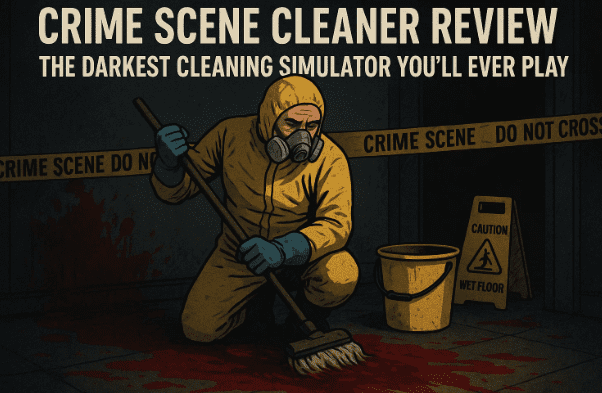
When you first hear about Crime Scene Cleaner, you might think it’s just another entry in the ever-growing “simulator” genre — something between PowerWash Simulator and Viscera Cleanup Detail. But this one dares to go darker.
Instead of scrubbing away mud or graffiti, you’re erasing the aftermath of serious crimes — covering up evidence, cleaning blood, and hauling bodies, all while balancing the moral and emotional weight of your actions. It’s a macabre concept, yet surprisingly well executed.
In this article, we’ll take a deep dive into Crime Scene Cleaner: its gameplay mechanics, story, sound design, visuals, and overall experience — including what works beautifully and what needs polishing.
So, grab a cup of coffee and let’s step into one of the grittiest cleaning jobs you’ll ever take on.
1. The Premise – Cleaning with a Criminal Twist
Let’s start with what makes this game stand out.
At its core, Crime Scene Cleaner is about doing dirty work for dangerous people. You play as a desperate father whose daughter is seriously ill. Facing crushing medical bills and an uncaring healthcare system, you strike a deal with a local crime boss. The job? Clean up the evidence after his operations — no questions asked.
That’s how you end up elbow-deep in stains, dragging bodies out of restaurants, and turning horrific murder scenes into spotless rooms that look like nothing ever happened. It’s dark, morally ambiguous, and surprisingly grounded for a simulator.
Between missions, you return to your small apartment. Here, you can answer phone calls from your employer, explore your surroundings, and piece together fragments of your character’s backstory. The storytelling isn’t groundbreaking, but it provides enough motivation to justify why you’re risking everything for money — and why you can’t just walk away.
2. The Gameplay Loop – Cleaning Has Never Been This Intense
At first glance, you might assume Crime Scene Cleaner plays like PowerWash Simulator — hose down, rinse, repeat. But while it shares the cleaning DNA, it introduces a darker tone and additional layers of interactivity.
Each mission starts at a crime scene — a restaurant, an apartment, an alleyway — where something terrible has happened. Your goal: make it all disappear.
Here’s what that typically involves:










- Removing bodies and evidence. You’ll need to drag or carry victims to your truck for disposal. It’s grim work, but it’s your job.
- Scrubbing away stains. Using your mop, sponge, and cleaning products, you remove blood and grime until every trace of wrongdoing is gone.
- Organizing the environment. Furniture, objects, and décor often need repositioning to restore the scene to its “before” state.
- Disposing of trash. Bottles, papers, and debris can be bagged and carried out to make the space look spotless again.
It sounds simple, but when you’re juggling multiple tasks, limited cleaning supplies, and time-consuming stains, things get chaotic fast. The game rewards precision and efficiency — the cleaner your finish, the higher your score and payout.
3. Tools of the Trade – From Mops to UV Lamps
So far, so good. But let’s move to what makes Crime Scene Cleaner engaging moment to moment — its tool system.
You start each level with basic equipment, but as you progress, you unlock new tools and upgrades through a skill tree system. Here’s a quick breakdown:
- 🧹 The Mop – Your primary cleaning tool. It handles most stains, but you must rinse it frequently in a bucket. Leave it too long, and it starts spreading grime instead of cleaning.
- 🪣 Buckets – Filled with water to wash your mop. The water eventually becomes dirty and needs replacing. Spill the bucket, and congratulations — you’ve just made another mess.
- 🧴 Detergents & Cleaners – Consumable liquids that make cleaning faster or keep your water fresh longer. Managing them efficiently is key.
- 🧽 Sponge – Useful for smaller surfaces or delicate items, helping you avoid breaking fragile objects.
- 💡 Lamps & UV Lights – Light up dark corners and reveal hidden stains. The UV lamp is especially satisfying, showing which blood spots are still uncleaned.
- 🔧 Power Washer – For large or stubborn stains that refuse to come off easily.
- 🪓 Axe – For breaking furniture or obstacles blocking your way.
Each tool feels functional rather than gimmicky, and the progression system keeps things interesting. You can upgrade cleaning speed, water efficiency, and visibility as you earn more experience points.
So far, we’ve got the basics covered — now let’s talk about the cleaning process itself.
4. The Cleaning System – Precision Meets Pressure
Cleaning in Crime Scene Cleaner feels methodical and satisfying when done right. You hit Q to activate “inspection mode,” which highlights dirty areas or hidden messes. Once you start scrubbing, the percentage meter climbs, rewarding you as each room reaches 100%.
However, it’s not all smooth sailing:
- Overusing the mop creates streaks rather than clean surfaces.
- Buckets fill up fast, forcing you to replace water regularly.
- Some blood patterns are trickier than others, requiring multiple passes or detergents.
Compared to PowerWash Simulator, the mechanics here are more forgiving — you don’t have to scrub every inch of a railing or crevice. Instead, Crime Scene Cleaner focuses on rhythm and flow, letting you move quickly between rooms.
Personally, I appreciate this balance. It keeps the satisfaction of cleaning without turning it into a tedious pixel hunt.
5. The Missions – Variety and Unease
Now that we’ve done a good job understanding the mechanics, let’s look at what really makes or breaks the experience: mission design.
There are around ten missions in total, each taking anywhere from 30 minutes to an hour. That might not sound like much, but considering the game only costs around $20 on Steam, it’s a fair amount of content.
Each location tells a small story of its own. One moment you’re cleaning a cozy suburban living room gone wrong; the next, you’re restoring order in a pizzeria that’s seen an unspeakable act. The variety keeps the gameplay fresh.
While there are flashes of dark humor, the game doesn’t trivialize what you’re cleaning up. In fact, it can get unnervingly realistic — a reminder that these scenes, though fictional, mimic the aftermath of human cruelty.
This uneasy tension is part of the charm. It’s not horror, but it definitely creeps under your skin.
6. Visuals – Gritty Realism Done Right
Graphically, Crime Scene Cleaner impresses more than you might expect from a small studio project.
The blood effects look disturbingly authentic (but not excessively gory), and surfaces respond dynamically to your cleaning efforts. You’ll notice smears, shine, and subtle texture changes as areas become spotless.
Lighting plays a big role too. Using your lamps to illuminate dark rooms creates a moody, cinematic feel — almost noir-like.
Each environment feels lived in: messy kitchens, cluttered bedrooms, rundown alleys. Unlike some simulators that use copy-pasted assets, Crime Scene Cleaner’s maps feel hand-crafted.
Sure, there are occasional visual hiccups — repeated props like identical chairs or toys, and an occasional glitch when moving large items — but overall, the presentation is strong.
For a game built on Unity, it manages to avoid the “cheap plastic” look that plagues many indie titles. The attention to material realism — from glossy tiles to reflective puddles — goes a long way.
7. Sound and Voice Acting – Better Than Expected
Sound design is one of the game’s unexpected strengths.
Each mission features cassette tapes scattered around, playing atmospheric classical or jazz-inspired tunes. These pieces set the mood beautifully — evoking the brooding unease of movies like Seven or Zodiac.
Then there’s the ambient sound: the squeak of your mop, the slosh of water, distant city noises. They all combine to make you feel truly present in each environment.
Voice acting, while not Hollywood-grade, adds personality. The protagonist’s dry, weary tone fits his world-weary character perfectly. Supporting characters — mainly your gangster employer and a few phone calls — keep the story grounded.
It’s rare for a simulator to have fully voiced dialogue, and it’s a welcome addition. It gives the game more narrative depth than most titles in this genre even attempt.
8. The Story and Its Shortcomings
Let’s move to the weaker side of the experience.
While the setup is solid — a father forced into dark work to save his child — the story doesn’t always dig as deep as it could. The protagonist occasionally cracks one-liners in situations that would realistically cause trauma, breaking immersion.
We also never find out what happens to the bodies after you load them into your truck. The game sidesteps that question, perhaps intentionally, but it leaves some narrative gaps.
A few more consequences or moral choices could’ve made the story more memorable. Imagine if neighbors got suspicious of your late-night activity, or if certain jobs affected your mental stability. Those small details could’ve elevated Crime Scene Cleaner from “unique simulator” to “psychological experience.”
Still, for what’s here, the story keeps you motivated and curious about the next job.
9. Controls and Quality of Life
Controls can be hit-and-miss.
Interaction uses a mix of E and left mouse button for different actions, which feels inconsistent. Dragging bodies or furniture occasionally bugs out, causing objects to get stuck.
The developers could tighten these interactions and improve physics — especially the water simulation, which doesn’t behave realistically. (Fans of PowerWash Simulator will relate — water physics are notoriously tricky in Unity.)
However, the addition of upgradeable skills like faster mopping, bigger buckets, and improved lighting shows the devs are thinking about quality-of-life improvements, not just core gameplay.
10. Performance and Technical Details
On the technical side, Crime Scene Cleaner performs admirably for a Unity title.
- It runs smoothly on mid-range PCs with modest specs.
- Load times are short, and levels stream seamlessly.
- Occasional bugs aside (like bodies clipping into walls), the experience remains stable.
GPU and CPU usage stay reasonable, suggesting the developers have optimized the environments well.
11. Comparisons – PowerWash Simulator’s Dark Cousin
If PowerWash Simulator is a cozy weekend chore, Crime Scene Cleaner is its gritty crime-thriller cousin.
Both games scratch the same itch: cleaning, order, and the satisfaction of turning chaos into calm. But while PowerWash feels relaxing, Crime Scene Cleaner keeps you uneasy, aware of what you’re erasing.
| Feature | PowerWash Simulator | Crime Scene Cleaner |
|---|---|---|
| Theme | Wholesome chores | Criminal cleanup |
| Tone | Lighthearted & relaxing | Dark & suspenseful |
| Multiplayer | Yes | No |
| Tools | Washers & nozzles | Mops, lamps, detergents, axes |
| Story | Minimal | Narrative-driven |
| Graphics | Bright & clean | Moody & realistic |
Both have their audience — it’s just a matter of what kind of “clean” you’re looking for.
12. FAQ – Common Questions About Crime Scene Cleaner
Q1. Is this game too graphic or disturbing?
While Crime Scene Cleaner contains violent implications and mature themes, it doesn’t rely on gore. The tone is serious, but the game focuses more on cleaning and atmosphere than shock value.
Q2. Does it support controllers?
Currently, the best experience is with mouse and keyboard. Controller support exists but feels limited in precision.
Q3. How long is the game?
Around 8–10 hours, depending on how thoroughly you clean and explore.
Q4. Are there upgrades or replay value?
Yes. Completing jobs perfectly earns skill points that unlock better tools and faster cleaning abilities.
Q5. Is it worth $20?
Absolutely, if you enjoy simulators with a unique narrative twist. It’s a fair price for the amount of content and polish on display.
13. Final Verdict – Clean, Clever, and Uncomfortably Compelling
Crime Scene Cleaner isn’t your typical simulator. It takes a niche idea — cleaning up after crimes — and turns it into something strangely compelling.
The gameplay is satisfying, the visuals are solid, and the soundtrack sets the perfect tone. The narrative could use a bit more emotional depth, and controls occasionally frustrate, but the overall package works remarkably well.
If you loved PowerWash Simulator but crave a darker edge and a proper storyline, Crime Scene Cleaner is well worth your time.
Pros
- Engaging cleaning mechanics with strong feedback loop
- Atmospheric visuals and lighting
- Excellent ambient music and sound design
- Story provides real motivation
- Fair price for solid content
Cons
- Occasional control quirks and physics bugs
- Story doesn’t explore its emotional depth fully
- Some repetitive assets and simplified mechanics
Verdict: ★★★★☆ (4 out of 5)
A surprisingly deep and atmospheric take on the cleaning simulator genre. Dark, unsettling, and strangely satisfying.
Official Store Link:
🎮 Crime Scene Cleaner on Steam
Tags: Crime Scene Cleaner, simulator games, PowerWash Simulator, indie game review, cleaning games, PC gaming, narrative simulation, Steam games, Unity engine
Hashtags: #CrimeSceneCleaner #SimulationGame #IndieGaming #GameReview #PowerWashSimulator #SteamGame