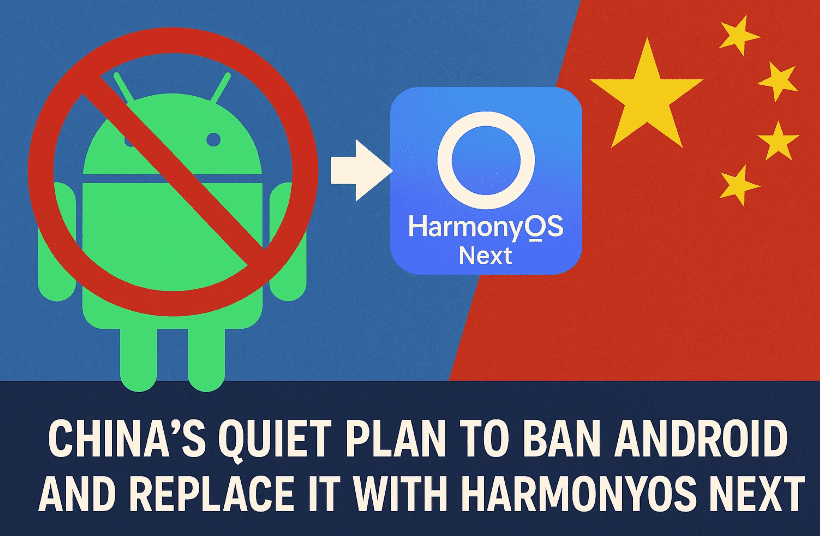
For over a decade, Android has reigned supreme in the smartphone market — dominating over 70% of devices worldwide. But deep inside China, the winds are shifting. What started as a tech survival strategy after U.S. sanctions on Huawei has now evolved into a state-backed movement to push Android out entirely and replace it with a fully homegrown operating system: HarmonyOS Next.
This isn’t speculation. It’s a coordinated, government-supported transition that’s already in motion — a move that could see Android vanish from Chinese-made smartphones within just a few years. The implications are massive: a fundamental split in the global mobile ecosystem, with China building its own digital world from the ground up.
1. From Reliance to Rejection: Why Android’s Days in China May Be Numbered
Let’s rewind to 2019 — the year the U.S. placed Huawei on the Entity List, cutting it off from Google Mobile Services (GMS). For most users outside China, Android without Google’s apps is almost unusable.
At first, Huawei’s response was HarmonyOS 1.0, a modified fork of Android built from the Android Open Source Project (AOSP). It kept compatibility with Android apps, giving Huawei breathing room to survive in the market.
But this wasn’t just about patching a problem — it was the spark for something much bigger.
For years, China’s leadership has openly spoken about digital sovereignty — the ability to control its own critical technology stack without depending on foreign systems like Android, iOS, or Windows. The Huawei sanctions simply accelerated a plan that was already on the books.
2. The Government Push: From Local Directives to National Mandates
Fast forward to today, and the scale of the HarmonyOS push is staggering. Local governments, especially tech hubs like Shenzhen, have rolled out aggressive action plans to supercharge native HarmonyOS development:
- Industrial parks dedicated to HarmonyOS software companies
- Financial incentives for developers building native apps
- Certification programs for over 1,000 companies to join the HarmonyOS ecosystem
- A national goal of 500,000+ trained HarmonyOS developers
This is not just encouragement — in some sectors, it’s effectively a mandate.
In the government and enterprise world, this push is even stronger. The State-owned Assets Supervision and Administration Commission (SASAC) has instructed central enterprises to upgrade compliance systems in 2025 — a move widely seen as a stepping stone toward fully adopting HarmonyOS-powered devices in government, healthcare, finance, and industrial infrastructure.
3. HarmonyOS Next: The “Pure-Blood” OS That Breaks Away from Android
The most important turning point came in 2024 with the launch of HarmonyOS Next — dubbed “Pure-Blood HarmonyOS” in Chinese media.
Unlike earlier versions, HarmonyOS Next has:










- No Android Open Source Project (AOSP) code
- No Linux kernel
- A fully in-house Huawei kernel
- A proprietary programming language called ArkTS
This means no compatibility with Android apps unless developers rewrite them for HarmonyOS. On the surface, that sounds risky — but with over 8 million developers already in the ecosystem and 30,000+ apps available (including 5,000 core apps being ported over), China is making the transition as smooth as possible.
4. Why This Could Amount to an Android “Ban” in Practice
Technically, China hasn’t announced a legal ban on Android. But in practice, government procurement rules, enterprise requirements, and state-backed developer programs are creating an environment where Android is simply being squeezed out.
Here’s how it could happen step-by-step:
- Government Devices Transition First
- All government agencies and state-owned enterprises move to HarmonyOS-powered phones, tablets, and PCs.
- Enterprise Adoption Follows
- Industries tied to government contracts — healthcare, transport, finance — shift to HarmonyOS for compatibility and compliance.
- App Developers Prioritize HarmonyOS
- Native HarmonyOS apps become the default, while Android support fades.
- Consumer Phones Switch by Default
- Major Chinese brands begin shipping HarmonyOS-only phones in China.
By the time this process plays out, Android may remain only as a secondary OS for export models, making it irrelevant in the domestic Chinese market.
5. Strategic Motivations: It’s Not Just About Phones
This shift is about much more than mobile handsets. HarmonyOS is designed as a distributed operating system — meaning it can power everything from smartphones to smart TVs, industrial machines, smart city infrastructure, and electric power grids.
Its microkernel architecture and distributed Soft Bus technology allow multiple devices to act as a “super device,” sharing resources and data seamlessly.
For China’s leadership, this has three main advantages:
- Security — A hardware-based Trusted Execution Environment (TEE) for sensitive data
- Interoperability — Seamless communication across device types
- Independence — No risk of foreign control or forced updates from outside companies
6. The Global Impact: A Fractured Internet
If China fully phases out Android domestically, the global mobile ecosystem will split in two:
- Android/iOS world — led by the U.S., Europe, and most of Asia
- HarmonyOS world — covering China’s 1.4 billion people and potentially other allied nations
Developers will face a tough choice:
- Build for both ecosystems (more work, more cost)
- Or pick a side based on market potential
This could also impact chipset makers, app stores, payment systems, and cloud services, forcing companies to maintain separate product lines for China and the rest of the world.
7. Questions People Are Asking
Q1: Will Android be officially banned in China?
Not in a legal sense — but government mandates and procurement rules could make Android devices impractical or non-compliant in many industries.
Q2: Will HarmonyOS be available outside China?
Huawei has hinted at global expansion, but app ecosystem challenges mean it’s still focused on the domestic market for now.
Q3: What happens to Chinese Android phone brands like Xiaomi or Oppo?
They may continue to use Android for export models, but could be pressured to ship HarmonyOS domestically.
Q4: How does this affect Google?
Google’s influence in China was already limited, but a full HarmonyOS shift means losing any remaining indirect foothold in the market.
8. The Road Ahead
If China follows through with this plan, by the end of the decade, Android may be virtually non-existent in the domestic Chinese market. HarmonyOS Next isn’t just a technological shift — it’s a political and economic statement about control, sovereignty, and independence in the digital era.
Whether you see it as a bold step toward self-reliance or a dangerous move toward a fractured internet, one thing is clear:
This is the beginning of a new chapter in the global tech war.
Disclaimer
This article is based on publicly available information from Chinese government directives, Huawei announcements, and developer ecosystem reports. While no official “ban” on Android has been declared, the trends and mandates described indicate a clear strategic direction toward replacing Android with HarmonyOS in China.
Tags: harmonyos, china bans android, huawei os, pure blood harmonyos, harmonyos next, chinese government technology, android alternatives, mobile operating system trends, global tech war, distributed operating system
Hashtags: #HarmonyOS #Huawei #AndroidBan #TechNews #ChinaTech #MobileOS #DigitalSovereignty #GlobalTechShift