For decades, Microsoft Windows has been the undisputed ruler of the PC operating system world. From government institutions to corporate offices, it has been the go-to platform for work, communication, and administration.
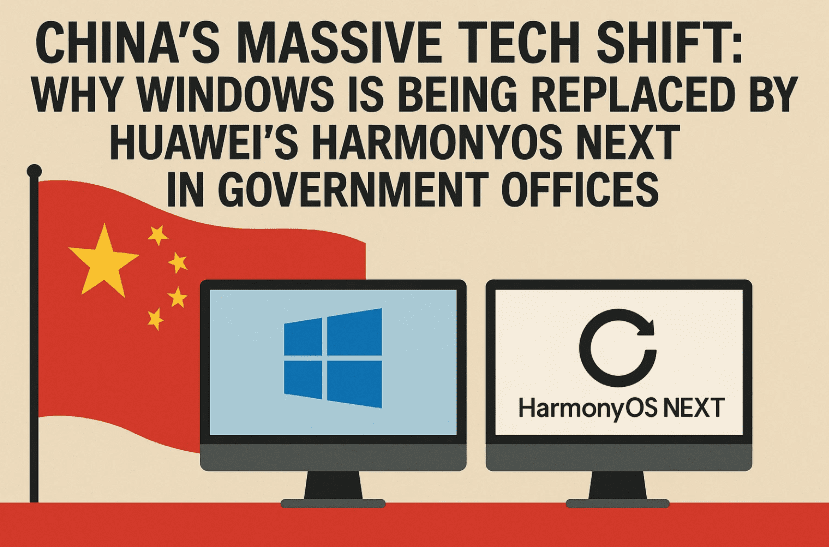
But now, something unprecedented is happening in China’s tech landscape — and it’s making headlines globally. The Chinese government is rapidly phasing out Microsoft Windows from government offices and state-owned enterprises, replacing it with Huawei’s HarmonyOS NEXT — a homegrown operating system designed entirely in China.
This isn’t a small update or just a switch to another version of Windows. It’s a major geopolitical and technological shift, rooted in self-reliance and strategic independence from U.S.-based technologies.
In this detailed article, we’ll explore:
- What HarmonyOS NEXT actually is.
- Why China is making this move.
- How this rollout is being executed.
- The potential global implications for the tech industry.
- The challenges and opportunities this creates.
1. Why Is China Replacing Windows?
Let’s start with the “why” before the “how.”
There are two main reasons behind this move:
A. Technological Self-Reliance
China’s leadership has been pushing for independence from foreign technology, especially after repeated sanctions and restrictions from the United States. Huawei — once a leader in the global smartphone market — was placed under heavy trade restrictions, limiting access to U.S. hardware and software, including Google services.
By replacing Windows with HarmonyOS NEXT, China reduces dependency on an American product that could be restricted in the future.
B. Geopolitical Tensions
The U.S.-China tech rivalry is no secret. Restrictions on Huawei’s access to U.S. chipmakers and software providers have accelerated China’s efforts to develop domestic alternatives for both hardware and software.
HarmonyOS NEXT is not just about functionality — it’s a strategic statement:
“We can build and control our own digital infrastructure without relying on foreign suppliers.”






2. What Exactly Is HarmonyOS NEXT?
Huawei’s HarmonyOS NEXT is not just another skin over Android. In fact, it’s a completely new operating system built from the ground up.
Key Features:
- Microkernel Architecture
Instead of using the large Linux or Android kernel, HarmonyOS NEXT uses a small, lightweight, and highly secure microkernel. This makes it faster, safer, and more modular. - No Android Compatibility Layer
Unlike earlier versions of HarmonyOS, NEXT completely drops support for Android apps. This means apps must be natively developed for HarmonyOS NEXT. - Optimized for Huawei Hardware
Runs best on Huawei’s in-house chips like Kunpeng processors and Ascend AI chips. - Deep Integration with Chinese Cloud & AI Services
HarmonyOS NEXT is tightly integrated with China’s domestic cloud infrastructure, completely bypassing U.S. companies like Google Cloud and Amazon Web Services.
3. The App Ecosystem Challenge
One of the biggest challenges for any new operating system is the app ecosystem. Without apps, even the best OS fails to attract users.
Huawei has been addressing this aggressively:
- Major Chinese apps like WeChat, Alipay, and WPS Office already have HarmonyOS NEXT native versions.
- Huawei claims that over 4,000 apps have already been optimized for the platform.
- Developers are being provided with SDKs, development tools, and incentives to build native HarmonyOS apps.
This is a huge task — but with government backing and the dominance of Chinese app developers, Huawei is moving fast.
4. How Is the Transition Being Implemented?
Replacing the operating system in millions of devices isn’t a small task. It’s part of a government-led program called Xinchuang.
What Is Xinchuang?
Xinchuang stands for Information Technology Application Innovation. In simple words, it’s China’s national mission to replace foreign technology with domestic alternatives in critical sectors.
Rollout Timeline:
- Late 2024: Pilot projects started in provinces like Shandong and Sichuan.
- Mid 2025: Rollout to major cities like Beijing and Shanghai.
- By End of 2025: Target to have 50 million devices in government offices and state enterprises running HarmonyOS NEXT.
Which Devices Are Affected?
- Government desktops and laptops.
- Office PCs in state-owned enterprises.
- Eventually — schools, universities, banks, telecom companies, and infrastructure systems.
5. Hardware Shift Alongside Software
This transition isn’t just about replacing Windows with HarmonyOS NEXT. The hardware is changing too.
- No More Intel or AMD in Government PCs
Instead, Huawei is partnering with domestic manufacturers like Lenovo and Inspur to produce computers powered by Chinese-made processors such as Loongson and FeiTeng. - Reason for Hardware Shift
Using domestic processors ensures full supply chain control, free from U.S. export restrictions.
6. Impact on U.S. Tech Companies
This is where the move really stings for companies like Microsoft, Intel, and AMD.
Microsoft
- Losing access to millions of Windows license sales in China’s government and corporate sectors.
- Microsoft Office is being replaced by WPS Office.
- Azure Cloud is being replaced by Huawei Cloud.
Intel & AMD
- Domestic CPUs like Loongson and FeiTeng are being prioritized.
- Estimates suggest a 70% drop in foreign CPU demand in China’s government sector.
The financial impact is significant — billions in lost revenue and reduced market share.
7. A Sign of a Split Digital World?
This shift is about more than just operating systems and processors. It signals a possible fragmentation of the global tech ecosystem into two camps:
- U.S.-led technology stack
- China-led technology stack
If more countries follow China’s lead, we could see separate global standards for software, hardware, and digital infrastructure.
8. Challenges Ahead for HarmonyOS NEXT
While the government-led transition gives Huawei a massive head start, there are hurdles:
- Building a rich, fully native app ecosystem from scratch.
- Training IT staff in government offices to use and manage HarmonyOS NEXT.
- Ensuring compatibility with legacy systems.
- Overcoming potential security and reliability concerns during the early adoption phase.
9. Possible Global Reactions
- U.S. & Allies: Could tighten restrictions or develop their own strategies to keep influence in global tech.
- Emerging Markets: May see China’s approach as a blueprint for digital independence.
- Developers: Might have to choose which “ecosystem” to prioritize — U.S.-aligned or China-aligned.
Q&A Section: Understanding the Shift
Q1: Can HarmonyOS NEXT run Android apps?
No. HarmonyOS NEXT has completely removed the Android compatibility layer. Apps must be built specifically for it.
Q2: Will this affect personal computers in China?
Initially, no. The change is targeted at government and state-owned enterprises, but it may expand in the future.
Q3: Is this purely a political move?
It’s a mix of politics, economics, and technology. The goal is both self-reliance and security.
Q4: Could this lead to a global split in technology?
Yes. If more countries adopt similar policies, we could see two or more separate global tech ecosystems.
Disclaimer
This article is for informational purposes only. The details are based on publicly available reports and announcements. Any large-scale OS migration, especially in government environments, involves complex political, security, and technical considerations.
Conclusion
China’s replacement of Microsoft Windows with Huawei’s HarmonyOS NEXT in government offices is a historic shift — not just for China, but for the global tech industry.
It’s a move that combines strategic independence, technological innovation, and geopolitical maneuvering.
Whether this leads to a more diversified tech world or a fragmented one remains to be seen — but one thing is clear: the dominance of Windows in China’s official spaces is coming to an end, and a new chapter in operating system history is being written.
Tags: China OS replacement, HarmonyOS NEXT, Huawei operating system, Windows replacement China, Chinese government tech policy, Xinchuang initiative, Loongson processors, FeiTeng chips, Huawei Cloud, Microsoft China market
Hashtags: #HarmonyOS #Huawei #ChinaTech #WindowsReplacement #TechGeopolitics #Xinchuang #DigitalSovereignty #TechPolicy #OperatingSystems #ChinaVsUS