Introduction
So far, we’ve explored how to craft psychologically compelling scripts using powerful principles like the Dopamine Gap, Expectation vs. Reality, and the Five Psychological Triggers. These methods are proven to hook your audience in the first few seconds. But writing a brilliant script is only the first step. What truly decides whether your content performs or flops lies in how you execute that script.
Let’s be honest, we’ve all seen videos with killer titles and promising hooks that fail to deliver once the visuals kick in. That’s where editing, visual cues, emotional pacing, and thumbnails play a massive role. Let’s now move to the next level—the real execution layer of content creation that makes your story stick and spread.
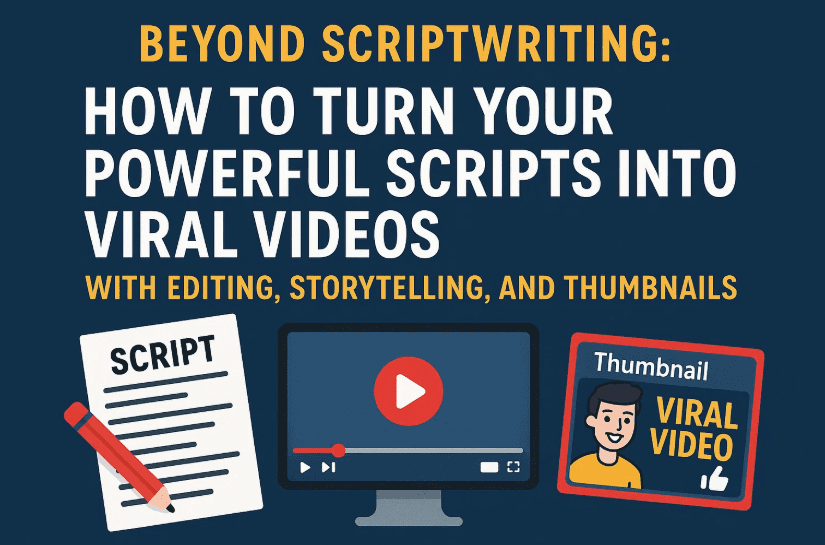
1. Storytelling Beyond the Script: Emotional Waves and Relatability
Just like in the previous blog, where we learned about structuring hooks and gaps, now it’s time to shape the emotional rhythm of your video. Humans respond to stories in waves—peaks and valleys of emotion.
Before we jump into visuals, ask yourself:
- Where is the emotional high point of your story?
- Where does the viewer feel conflict, empathy, or shock?
- How can you relate that to their daily life?
Pro Tip: Build emotional waves using contrast:
- Excitement vs. calm
- Victory vs. failure
- Dreams vs. reality
Use personal stories or social case studies to heighten this wave effect.
2. Editing for Retention: Visual Hooks and Viewer Flow
Alright, now that your story’s emotional arc is clear, let’s dive into the visuals. If your edit isn’t in sync with your narrative rhythm, your audience will feel lost or bored.
Here’s what to focus on:







- B-Roll Timing: Don’t just use B-roll for the sake of it. Place it exactly when the narration demands visualization.
- Jump Cuts & Zooms: Use subtle jump cuts for speed and zooms to emphasize emotional expressions.
- Reaction Cuts: Show audience reactions, meme inserts, or crowd engagement to mirror viewer emotion.
- Cut on Action: Always transition during a physical movement for seamless experience.
Example Tip: If your line says, “I lost everything in a second,” cut to a visual of a crashing hard drive, crying face, or a thrown paper.
3. Thumbnail Psychology: Designing Clickable Emotions
Think of your thumbnail as the door to your video. A strong script hidden behind a weak thumbnail is like a blockbuster movie hidden behind a blurry poster.
Here’s how to design better thumbnails:
- Use Emotions: Shock, awe, joy, fear—facial expressions work best when exaggerated.
- Include Conflict: Add tension with visual opposition. Example: fat vs. fit, poor vs. rich.
- Use Contrasting Colors: Bright backgrounds with bold text or cutouts help stand out in feeds.
- Don’t Reveal Everything: Curiosity beats information. Give a taste, not the whole picture.
Pro Tip: Use tools like Canva or Photoshop to test different compositions and even A/B test with YouTube tools.
4. Voice and Music Cues: Triggering Subconscious Engagement
Great creators use sound not just as filler, but as a psychological cue to retain attention. Let’s look at how to enhance that script:
- Background Music: Use soft ambient tones for emotional moments and upbeat music for actions.
- Sound FX: Whooshes, dings, and soft bass drops help guide attention and transition.
- Pause for Emphasis: Write in your pauses. A 1-second silence after a shocking line builds curiosity.
- Voice Tone: Match your vocal energy to the script’s mood—dramatic, playful, mysterious.
5. Consistency = Conversion: What the First 30 Seconds Must Do
Remember the 30-second rule? You have just half a minute to justify the viewer’s click. Here’s how to make it count:
- Show, Don’t Tell: Start with an unexpected visual event that matches the title promise.
- Keep the Dopamine Gap: Reveal just enough to create a cliffhanger, not the full story.
- Voice Call-to-Stay: Say something like “If you’ve ever felt X, this video is for you.”
Script Formula Tip: Combine Pattern Interrupt + Personal Stake + Curiosity Gap in first 20 seconds.
You might be intrested in these topics too!
- The Viral YouTube Video Formula That Works Every Time: 9 Proven Steps You Can Copy Today
- AI Music Copyright Nightmare: How AI Tracks Are Abusing Content ID and Threatening Creators
- Is it too late to start YouTube in 2025? Brutal Truths & Big Opportunities You Must Know
- How to Grow as a Small Streamer in 2025: The Proven Short-Form Content Strategy That Actually Works
- How YouTube Studio May Be Killing Your Motivation – And How to Take Back Control as a New Creator
Q&A Section
Q1: What happens if my dopamine hook doesn’t land?
A weak dopamine hook fails to create emotional curiosity. Rework your opening line or thumbnail to exaggerate the gap between expectation and reality.
Q2: Should the thumbnail reflect the actual climax or just hint at it?
Hint at it. Tease curiosity without giving away resolution. The brain wants to close loops—leave one open.
Q3: Can I use reverse storytelling for educational content?
Yes! Start with the final benefit or solution, and then walk backward through the journey. Viewers stay longer to understand how you got there.
Q4: Is it okay to use AI for thumbnails and voiceovers?
Absolutely, as long as the output feels authentic and not robotic. AI tools can speed up creativity but require human oversight.
The CVF Method: A Lasting Script-Execution Framework
This simple framework keeps you aligned with purpose:
- C: Context — Open with what the viewer is here for.
- V: Visual Cues — Reinforce your message with clear visual and audio signals.
- F: Framing — Explain why each part matters to the bigger story.
Use this formula as your execution bible when editing your script into a watchable, binge-worthy video.
Conclusion: Ready to Build the Viral Machine?
So far, we’ve mastered the script. Now, we’ve wrapped visuals, voice, emotions, and thumbnails around it. All that’s left is consistency and execution.
In our next article, we’ll build on this by creating a full Content Creation Workflow—covering ideation, planning, scripting, editing, publishing, analyzing, and improving. It’s time to build not just a great video, but a repeatable process for virality.
Until then, keep creating, keep testing, and keep triggering that beautiful dopamine gap.
Tags: script to video, editing for engagement, thumbnail psychology, emotional storytelling, dopamine gap videos, visual editing, youtube growth strategies, script retention, content pacing, storytelling for YouTube
Hashtags: #ScriptToVideo #VideoEditingTips #YouTubeThumbnails #EmotionalStorytelling #ContentRetention #DopamineGap #YouTubeGrowth #VisualHooks #ScriptwritingFramework