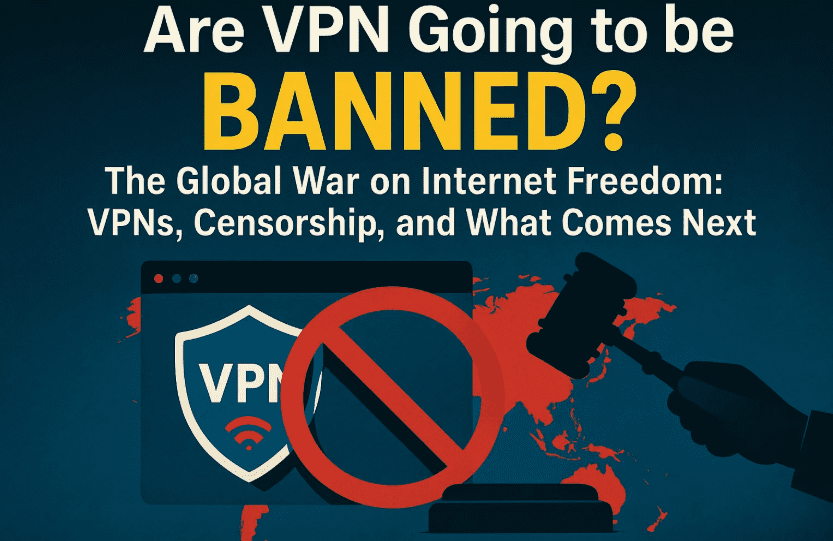
In the last few months, a worrying trend has emerged across the globe. Internet censorship is no longer just a tool of authoritarian regimes—democratic countries are increasingly introducing laws that tighten control over online spaces. From delisting games on Steam to pushing legislation that mandates ID verification, we are seeing a rapid erosion of digital freedom.
At the heart of this issue is one technology: VPNs.
Let’s break this down step-by-step, explore why governments are now targeting VPNs, what this means for you, and what tools still exist to maintain online privacy in an increasingly monitored world.
So What’s Happening Right Now?
Before diving into the technical side of things, let’s walk through the bigger picture.
Across the last few weeks:
- Steam has begun delisting mature games, even titles like Mouthwashing and Vile Exumed, citing mature content as justification.
- Xbox has added facial verification for age-restricted content.
- The UK passed the Online Safety Act, which will force social platforms and online services to aggressively moderate, monitor, and censor content.
- There’s increasing talk of targeting VPNs—the last line of defense for digital privacy.
What may look like isolated incidents are, in fact, part of a growing global pattern: Governments tightening their grip on the internet in the name of safety and morality.
The UK’s Online Safety Act: A Deep Dive
Let’s talk about what the UK has done recently, as it may soon be replicated elsewhere.
Key Features of the Act:
- Platforms are now responsible for removing “harmful content,” even if it’s not illegal.
- Websites and apps may soon require government-issued ID to access adult or sensitive material.
- Platforms can be fined or blocked if they don’t comply.
- Ofcom (the UK’s communication regulator) will enforce these rules.
At first glance, this may seem aimed at protecting kids and curbing misinformation—but critics argue it’s an attack on free speech and digital autonomy.
Why Are VPNs Suddenly Under Attack?
If you’re not familiar, let’s quickly define what a VPN is.
VPN (Virtual Private Network): A secure, encrypted tunnel that masks your IP address and location, allowing you to appear as though you’re accessing the internet from another region.
This tool has many legitimate uses:










- Accessing geo-restricted content
- Safeguarding against ISP or government surveillance
- Securing connections on public Wi-Fi
- Connecting to work or school networks remotely
So, why the heat?
UK Government’s Concern
A 2022 UK statement suggested that VPNs might “undermine the effectiveness of the Online Safety Bill.” Lawmakers are worried people will use VPNs to:
- Circumvent censorship
- View content that would otherwise require ID verification
- Access platforms not in compliance with UK law
The bill now includes a clause requiring a report on the impact of VPNs within 6 months of the bill’s passage.
The Real Panic: Surge in VPN Usage
Services like ProtonVPN reported a 1000% increase in new signups in the UK following the law’s passage. People are clearly trying to retain control over their browsing habits.
Can VPNs Actually Be Banned?
It may sound far-fetched, but some governments are actively considering restrictions on VPNs.
Let’s clear up a few myths and realities.
Myth: “VPNs can’t be banned.”
Reality: While it’s true that VPNs are essential for government and corporate operations (e.g., internal networks), consumer-grade VPNs can be targeted. Governments might:
- Ban VPN providers from operating in their jurisdiction.
- Block known VPN IP addresses at the ISP level.
- Force VPN providers to log user data, thus defeating their purpose.
This isn’t theoretical. Countries like China and Russia have already done it.
Reality: Business and Government VPNs Will Be Whitelisted
Governments will likely say:
“You can use VPNs for work—but not to bypass censorship.”
So, average users lose access, while government employees, banks, hospitals, and large corporations keep theirs.
Browser Fingerprinting: The Bigger Threat
Even if you’re using a VPN, websites can still identify you using browser fingerprinting.
Here’s how:
- Your timezone, browser type, screen resolution, and even installed fonts can be combined to uniquely identify you.
- This makes it possible for websites to say: “Hey, this person says they’re in LA, but their system clock is still in London.”
What You Can Do:
If you’re serious about privacy, you need more than just a VPN. Consider using:
- Mullvad Browser: A privacy-focused browser based on Firefox.
- Brave Browser: A Chrome-compatible privacy browser with built-in tracker blocking.
Both offer stronger privacy controls than mainstream browsers like Chrome or Safari.
Governments Using Scare Tactics: “Think of the Children”
Whenever governments push censorship laws, they often lead with child safety.
In UK Parliament, representatives argued that:
“We must protect children from websites promoting suicide or self-harm.”
No one disputes the importance of protecting vulnerable children. But here’s the issue:
- Platforms like Google, YouTube, and Instagram already show suicide helplines and support info if you search for sensitive terms.
- Governments use the “protect the children” argument to justify broader surveillance and censorship.
This approach creates a slippery slope. Once platforms can be forced to remove “harmful content,” who decides what’s harmful? Where do we draw the line?
The Global Spread: The US and Canada Are Next?
You might be wondering, “I don’t live in the UK—should I even care?”
Absolutely.
The United States has its own version brewing: KOSA (Kids Online Safety Act). Privacy experts like the Electronic Frontier Foundation (EFF) warn that it:
- Encourages platforms to over-censor in fear of liability.
- Endangers marginalized communities by silencing resources.
- Puts parental control above individual freedom.
Canada has also introduced several bills related to online regulation.
If the UK law succeeds in implementation, expect copycat laws in many democratic countries.
The Role of Tor: The Last Bastion?
When VPNs are attacked or blocked, there’s one tool that remains:
Tor (The Onion Router)
This decentralized network anonymizes internet traffic by bouncing it across multiple encrypted nodes.
- You can download the Tor Browser for free.
- It hides your IP, your identity, and encrypts your traffic.
Yes, it’s used for illegal activities. But Tor is also vital for journalists, whistleblowers, and activists in hostile countries.
If VPNs fall, Tor might be the last wall standing between individuals and government overreach.
Real-World Example: Running Your Own VPN
You don’t need to rely solely on companies. For advanced users, you can set up your own VPN tunnel using WireGuard.
Here’s how this could work:
- Host WireGuard on your home network (e.g., Raspberry Pi)
- Access it remotely from anywhere in the world
- Manage your home server, Pi-hole, or even self-hosted search engines like SearXNG
This setup gives you full control—but it does require technical know-how.
FAQs: Quick Answers to Big Questions
Q: Is using a VPN illegal?
A: No, in most countries, VPNs are still legal. But laws are changing rapidly.
Q: What’s the best free VPN?
A: ProtonVPN offers a decent free tier, but it comes with speed and usage limitations.
Q: Can VPNs truly hide everything?
A: No. Browser fingerprinting, time zones, DNS leaks, and poor settings can still expose you.
Q: Will using Tor slow down my browsing?
A: Yes, Tor is slower because it routes traffic through multiple nodes. It’s designed for anonymity, not speed.
Q: Are there alternatives to VPNs?
A: Yes. Smart DNS, Proxy services, or self-hosted solutions like WireGuard.
Final Thoughts: This Is About More Than VPNs
Let’s not sugarcoat it.
This isn’t just about streaming blocked Netflix shows or playing delisted games. It’s about who controls what you can see and say online.
The moment you give governments power to censor “bad” content, it won’t take long for that power to be used against dissenting views, activists, or even average citizens.
If VPNs fall, and censorship becomes the default—we lose the very essence of an open internet.
So stay informed. Stay curious. And most importantly, stay private.
Tags:
internet censorship, vpn ban, online safety act, digital rights, tor browser, privacy tools, vpn alternatives, uk internet law, protonvpn, browser fingerprinting, wireguard
Hashtags:
#InternetFreedom #OnlineSafetyAct #VPNBan #DigitalPrivacy #TorBrowser #ProtonVPN #WireGuard #StopCensorship #FreeInternet #PrivacyRights
Disclaimer:
This article is for educational purposes only. It does not encourage illegal activity or violation of regional laws. Always check local regulations before using VPNs or related tools.