In the modern digital world, messaging platforms have become the backbone of communication — not just for individuals but also for governments, media, and businesses. For years, India has relied almost entirely on American-owned apps such as WhatsApp, Twitter (now X), Facebook, and Instagram for social connectivity.
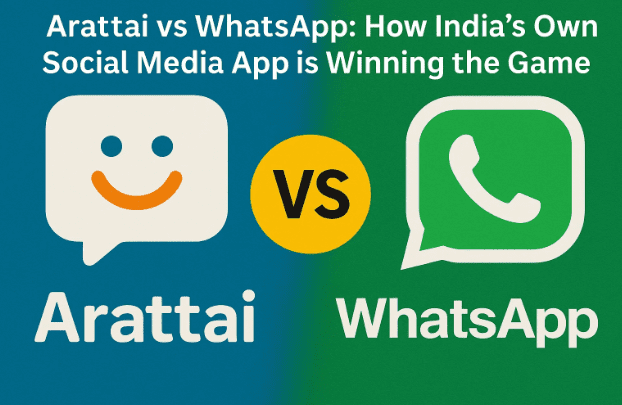
But a silent revolution is underway. A new homegrown messaging app named Arattai, developed by Zoho Corporation, is challenging this dependency and sparking conversations about data sovereignty and digital self-reliance.
This article explores how Arattai came into existence, how it compares with WhatsApp on a technical and strategic level, and what its rise means for India’s app ecosystem.
1. The Background: India’s Over-Dependence on American Apps
Over the past decade, India has become one of the largest digital markets in the world. With over 1.4 billion people and hundreds of millions of smartphone users, India is an app-driven society. But here’s the paradox — while Indians develop world-class software and dominate IT services globally, the country itself depends heavily on foreign-owned communication platforms.
From WhatsApp messages to official government announcements on Twitter/X, and from YouTube education to Facebook campaigns — the backbone of India’s digital life lies in the hands of American corporations. This dependency became visible when global trade tensions between India and the United States grew. Many began wondering: what if the U.S. simply decided to restrict access?
It’s not an unrealistic thought. After all, India once banned 59 Chinese apps overnight due to security concerns. That decision barely affected daily life because dependency on Chinese platforms was minimal. But doing the same with American apps would practically pause India’s digital communication ecosystem.
This realization sparked a movement: if India can build a Unified Payments Interface (UPI) to dominate global fintech, why not a messaging system rooted in Indian infrastructure?
2. How Arattai Was Born: The Zoho Connection
Let’s trace where this all began.
Arattai — meaning “chat” in Tamil — was developed by Zoho Corporation, one of India’s most respected software companies headquartered in Chennai, Tamil Nadu. Founded by Sridhar Vembu, Zoho is already famous worldwide for its enterprise software suite that competes with Microsoft Office 365 and Google Workspace.
Zoho’s business philosophy has always been simple yet profound:
“Build in India, host in India, and protect user data with full privacy.”
Arattai was initially launched quietly in 2021, available on both the Google Play Store and Apple App Store. At that time, it went largely unnoticed because the market was saturated with WhatsApp and Telegram. However, when political events and trade discussions highlighted India’s tech dependency, users started searching for a native alternative — and that’s when Arattai resurfaced in public consciousness.
3. The UPI Moment of Indian Messaging
India’s digital history has seen several turning points — one of the biggest being the creation of UPI (Unified Payments Interface). It disrupted global payment giants like PayPal by offering an open, free, and fast payment method integrated across banks. Apps like PhonePe, Paytm, and BHIM became everyday essentials, showing how a government-backed open system could outperform private international players.









Arattai is being compared to that “UPI moment,” but for messaging.
It’s a product born out of necessity and patriotism but driven by technical competence.
Just like UPI allowed Indian fintech startups to flourish, Arattai is seen as a foundation for India’s independent communication layer — an ecosystem not reliant on Silicon Valley.
4. Arattai’s Sudden Popularity Surge
When Arattai gained public attention again in late 2024 and early 2025, it wasn’t because of heavy marketing or government endorsement. Instead, it spread organically — a grassroots digital movement.
Social media began trending with phrases like #SwadeshiApp and #UseIndianApp, as ministers and influencers started mentioning Zoho’s initiative.
According to user data shared in early 2025:
- The app crossed 5 million downloads.
- It achieved a stellar 4.8-star rating on Play Store.
- At its peak, Arattai was adding 350,000+ new users per day.
This growth was so rapid that Zoho’s servers faced OTP delays because verification systems were overwhelmed. Arattai’s developers even admitted they had underestimated the initial surge, planning for a gradual rollout rather than a viral adoption wave.
5. WhatsApp vs Arattai – A Detailed Feature Comparison
To truly understand how serious this competition is, we need to look at the numbers, features, and architecture side-by-side.
Here’s a comprehensive comparison:
| Feature | Arattai (Zoho) | WhatsApp (Meta) |
|---|---|---|
| Origin & Ownership | Developed by Zoho Corporation, India | Owned by Meta Platforms, USA |
| Launch Year | 2021 | 2009 |
| App Size | ~65 MB | ~90 MB |
| Active Downloads | 5+ million | 5+ billion |
| Average Rating | 4.8★ | 4.2★ |
| Server Location | India (Chennai Data Centers) | Global – U.S. & other regions |
| End-to-End Encryption | Yes (Zoho encryption layer) | Yes (Signal Protocol) |
| Data Monetization | None – user data not sold | Ads, business API monetization |
| Video & Audio Calls | Supported | Supported |
| Group Video Calls | Up to 100 participants (Android TV supported) | Up to 32 participants |
| Broadcast Lists | Available | Available |
| Channel Feature | Yes (public/private channels) | Yes (Meta Channels) |
| Media Sharing | Documents, photos, videos, links | Documents, photos, videos, links |
| Live Location Sharing | “Till I reach” mode (auto stops on arrival) | 15 min / 1 hr / 8 hr limits |
| File Sharing Limit | 2 GB | 2 GB |
| Status / Stories | Yes | Yes |
| Cross-Device Sync | Available (mobile + TV + tablet) | Available (multi-device beta) |
| Cloud Backup | Indian cloud (Zoho servers) | Google Drive / iCloud |
| Business Model | Free for individuals; Zoho may integrate business tools later | Ad-based and API licensing |
| Data Center Jurisdiction | Indian IT laws (local compliance) | U.S. and global jurisdiction |
| Privacy Concern History | None reported | Multiple controversies (data leaks, metadata sharing) |
As the table shows, Arattai’s biggest strength lies not in innovation but in trust, transparency, and local data hosting. It promises that user data — messages, contacts, and files — never leave Indian soil.
6. Why Data Privacy Became India’s Central Concern
To appreciate why Arattai’s privacy-first model matters, one must look at WhatsApp’s journey.
When WhatsApp introduced its updated privacy policy in 2021, it required users to share metadata with Facebook for “business improvement.” Many saw this as a breach of trust, especially when alternative apps like Signal and Telegram were promoting stricter privacy standards.
Since then, WhatsApp has become part of Meta’s larger data ecosystem — cross-linked with Instagram, Facebook, and other advertising platforms.
While messages remain end-to-end encrypted, metadata (like contact lists, time stamps, and behavioral patterns) can still be analyzed for commercial insights.
Arattai, on the other hand, publicly declares:
“Your data belongs to you. We do not and will never sell user data for profit.”
Furthermore, Zoho has a strong global reputation for self-hosting all its services — it doesn’t rely on Amazon AWS, Google Cloud, or Microsoft Azure. This independence makes its privacy claim far more credible.
You can learn more about Zoho’s privacy philosophy at Zoho.com.
7. How Arattai Handles Data and Monetization Differently
A common question arises: if Arattai doesn’t sell ads or user data, how does it make money?
Here’s the answer — Zoho’s ecosystem strategy.
Arattai is part of a broader set of Zoho products, including Zoho Workplace, Cliq, Mail, and Meeting. For regular users, Arattai will remain free. But for enterprises using Zoho’s cloud suite, Arattai could integrate into paid collaboration tools like Zoho One or Zoho Connect.
In short:
- Individuals get a free, privacy-protected messenger.
- Businesses can pay for advanced collaboration using the same underlying tech.
It’s a sustainable model similar to how Slack or Microsoft Teams operate — but without the surveillance capitalism.
8. Challenges Ahead for Arattai
Despite its success story, Arattai faces several real challenges before it can truly rival WhatsApp.
Let’s discuss a few key ones:
- Network Effect Problem
People use messaging apps where their friends already are. Even with superior features, Arattai needs millions of users to make communication seamless. - Infrastructure Scalability
Handling millions of simultaneous calls and messages requires massive backend infrastructure. Sudden spikes (like OTP overloads) reveal that the system must scale dynamically. - Feature Parity with WhatsApp
While Arattai covers most features, small conveniences — such as advanced media compression, stickers, payments integration, and desktop syncing — still need polish. - Marketing and Brand Trust
Unlike Meta, Zoho doesn’t rely on aggressive marketing. Its growth depends on user trust and government endorsement, which takes time. - Competition from Indian Rivals
Other “Swadeshi” apps like Sandes (government-built) and Namaste Bharat are also in development. This fragmentation could divide the user base unless interoperability is encouraged.
However, what makes Arattai promising is its engineering-first mindset. Zoho is known for quietly refining its products over years — prioritizing performance over hype.
9. Can Arattai Realistically Beat WhatsApp? – Expert Perspective
Let’s analyze this question from both technical and market angles.
Market Reality
WhatsApp has a head start of over 15 years and nearly 500 million active users in India alone. Beating that isn’t a sprint — it’s a marathon.
Yet, as seen in the mobile phone industry, giants can fall. Nokia once dominated India’s market before Android and Samsung took over.
If Arattai maintains:
- Feature parity with WhatsApp
- Consistent app performance
- And transparent privacy policies
…it can capture a niche of privacy-conscious and business users first, and then expand gradually.
Technical Reality
Arattai is built on Zoho’s existing secure communication stack, which powers enterprise software for Fortune 500 companies. This means its backend is far more robust and scalable than a typical startup app.
Integration with Zoho Mail, Docs, or Cliq can also give it a productivity edge — something WhatsApp Business lacks beyond basic chat automation.
In short, while WhatsApp will remain dominant for personal use, Arattai could emerge as India’s Slack-meets-WhatsApp hybrid, especially for professionals, educators, and government users.
10. FAQs
Q1. Who owns Arattai?
Arattai is developed and owned by Zoho Corporation, an Indian company headquartered in Chennai. Its founder is Sridhar Vembu, known for promoting self-reliant technology development.
Q2. Is Arattai safe and private?
Yes. Arattai uses end-to-end encryption and stores all data within India. Zoho does not sell or share user data for ads or analytics.
Q3. Can I use Arattai on my smart TV?
Yes! Arattai uniquely supports Android TV integration, allowing users to join group meetings and calls directly from their television.
Q4. What does “Till I Reach” location feature mean?
Unlike WhatsApp’s fixed time-based live location (15 minutes, 1 hour, 8 hours), Arattai automatically stops sharing your live location once you reach the destination.
Q5. Does Arattai have payments or UPI integration?
Not yet. However, integration with Zoho’s business ecosystem or UPI is possible in future updates.
Q6. What makes Arattai different from Signal or Telegram?
Arattai’s distinction is local data hosting and integration potential with Zoho’s productivity tools — it’s both a messenger and a collaboration hub.
11. Final Thoughts
India’s journey toward digital independence isn’t about nationalism — it’s about technological security and control. The Arattai story proves that world-class apps can be developed and maintained within India’s borders, respecting local laws and privacy values.
While WhatsApp will remain a communication giant for years, Arattai’s emergence represents a paradigm shift — from dependency to self-reliance, from surveillance capitalism to ethical innovation.
If Zoho continues to iterate, expand cloud infrastructure, and partner with public institutions, India could soon boast not just UPI as its global model, but also Arattai as its flagship communication platform.
Official Website: https://www.arattai.in/
Disclaimer:
This article is for informational purposes only. The comparisons made here are based on publicly available information as of October 2025. Users should verify current app features and privacy policies before installation.
Tags: Arattai, WhatsApp Alternative, Indian Apps, Zoho, Messaging App Comparison, Data Privacy, Digital India, End-to-End Encryption, Indian Software, Arattai vs WhatsApp
Hashtags: #Arattai #WhatsAppAlternative #Zoho #DigitalIndia #DataPrivacy #MadeInIndia #MessagingApp