India’s tech ecosystem is no longer just catching up — it’s beginning to lead.
A few years ago, the idea that an Indian company could challenge global tech giants like Google, Meta, or Microsoft seemed ambitious. Today, it feels inevitable.
And at the forefront of this revolution stands Zoho Corporation, the Chennai-based software powerhouse that has quietly built over 55 global SaaS products — all made in India, for the world.
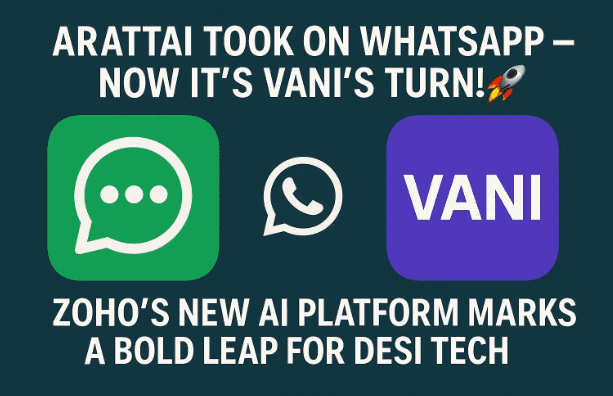
After the massive success of its privacy-focused messaging app Arattai, which directly challenged WhatsApp, Zoho has now launched Vani — an AI-powered workplace collaboration platform that could redefine how Indian businesses communicate and operate.
But that’s not all. This week’s major updates from India also include:
- The launch of Zoho Vani, India’s AI workplace platform.
- US dollar printing spree and its impact on India’s economy.
- New visa opportunities for Indian professionals as the US tightens H-1B rules.
- Global financial warnings from analysts about inflation and currency stability.
Let’s unpack each of these developments in detail — because together, they reveal how India is positioning itself for a powerful decade ahead.
🌐 The Rise of Zoho — From Arattai to Vani
Before we dive into the new AI platform, let’s quickly recap Zoho’s journey.
In 2021, when WhatsApp faced backlash over privacy concerns, Zoho quietly released Arattai, a Made-in-India chat app focused on data security and independence. Within months, it became one of the most downloaded communication apps on Indian app stores, backed by praise from leaders like Anand Mahindra and massive support from the government’s Atmanirbhar Bharat initiative.
That was just the beginning.
💬 Arattai: The Desi Alternative to WhatsApp
Arattai was designed to offer everything WhatsApp did — and more — but without sending user data to foreign servers. It included:
- End-to-end encrypted messaging.
- Support for Indian languages to reach rural users.
- Voice and video calls optimized for low bandwidth.
- Private chats, disappearing messages, and group tools.
The app wasn’t built for hype — it was built for independence. For a country where millions rely on messaging daily for business and family communication, Arattai proved that India could build its own social infrastructure without relying on Silicon Valley.
However, Zoho didn’t stop there. With its roots deep in enterprise software, the company set its sights on something even bigger: AI collaboration for Indian businesses.









🤖 Introducing Zoho Vani — India’s AI Workplace Collaboration Platform
Zoho has now officially launched Vani, an AI-based workplace communication and project management platform aimed at helping teams plan, collaborate, and execute their goals seamlessly — all within an Indian-made ecosystem.
Unlike chat apps, Vani is not just for messages — it’s an entire virtual office. Think of it as India’s answer to Microsoft Teams, Slack, or Google Workspace, but powered by AI and designed for SMBs and startups.
Let’s break down what makes Vani special.
⚙️ Key Features of Zoho Vani
Before getting into the detailed benefits, here’s an overview of the features that define this new platform:
- AI-Powered Collaboration: Teams can share ideas, brainstorm visually, and execute projects with smart recommendations generated by built-in AI.
- Infinite Whiteboarding: Users can draw, sketch, plan mind maps, and create flowcharts in real-time — all accessible from the cloud.
- Smart Monitoring & Management: Team leaders can monitor productivity, assign tasks, and visualize progress on interactive dashboards.
- Content Creation Tools: AI-assisted writing and ideation tools allow users to generate business reports, summaries, or campaign ideas directly within Vani.
- Data Security and Local Hosting: Unlike global competitors, all data remains hosted on Indian servers, aligning with national data protection laws.
💡 What Makes Vani Different From Global Tools
It’s not enough to just replicate Slack or Teams — Indian businesses need tools that understand Indian workflows.
Here’s where Vani stands out:
- Designed for Indian SMBs
Most small companies in India can’t afford high-cost enterprise tools with USD pricing. Vani’s pricing is in INR, starting around ₹399/month, making it far more accessible. - Regional Language Support
Vani supports multiple Indian languages, bridging communication barriers for hybrid teams across different states. - Low Data Dependency
Optimized for India’s inconsistent network conditions, it can work efficiently even in limited bandwidth areas. - Integrated AI for Real Work
From summarizing discussions to generating reports, Vani isn’t just adding “AI” for buzzwords — it’s practically useful. - Privacy First
Zoho’s founder, Sridhar Vembu, has repeatedly emphasized independence from foreign surveillance-driven tech ecosystems. Vani continues this principle — your data stays yours.
🧠 How Businesses Can Use Vani
For startups and SMEs, Vani could become the backbone of digital operations. Here are a few use cases:
- Remote Team Collaboration – Conduct brainstorming sessions using the infinite whiteboard.
- Project Planning – Use AI to create visual flowcharts and assign tasks.
- Internal Communication – Replace scattered email threads with focused discussions.
- Training and Documentation – Use AI to generate summaries and onboarding materials for new employees.
So far, we’ve understood what Vani brings to the table. Let’s now explore why this launch matters in the broader Indian and global context.
🇮🇳 Desi Tech vs Silicon Valley: India’s Big Moment
Zoho’s strategy represents a larger movement — India’s push toward self-reliant technology ecosystems.
While the West still dominates global digital infrastructure, Indian companies like Zoho, Infosys, and TCS are rewriting that narrative. India’s tech startups now build products for the world, not just for outsourcing contracts.
But success also depends on public trust and adoption. Earlier, local platforms like Koo (Twitter alternative) and Hike Messenger saw early success but eventually faded due to limited user support.
That’s the key difference now — today’s Indian companies are backed by real infrastructure, investor maturity, and government policies encouraging “Digital Swaraj.”
If users continue supporting indigenous tech, India could easily emerge as a global alternative hub in the next five years.
💵 U.S. Dollar Printing and Its Global Impact
Switching gears — while India is innovating in tech, global financial shifts could reshape how economies interact.
Recent reports suggest that the United States has restarted large-scale dollar printing to stabilize its slowing economy. Analysts warn that this could fuel inflation worldwide and destabilize emerging markets like India.
According to finance expert Akshat Srivastava, over 60% of all existing U.S. dollars have been printed in the last five years.
Yet, strangely, the dollar remains strong — even as countries like India face currency depreciation.
🧩 Why Is This Happening?
- Excess Dollar Supply: The more money that’s printed, the less valuable it becomes globally.
- Shift to Gold and Alternative Currencies: Nations are increasingly storing reserves in gold or diversifying into stable regional currencies.
- Geopolitical Pressure: Tariffs and trade policies under former U.S. administrations weakened global confidence in the dollar.
India, being a rapidly growing economy, feels the ripple effects of every U.S. monetary shift. When the dollar’s value fluctuates, import costs rise, and the rupee weakens, affecting inflation and essential commodity prices.
Experts predict that continuous U.S. money printing could eventually cause a global rebalancing — with Asian economies like India, China, and Indonesia taking a stronger role in world trade.
🌍 The H-1B Visa Problem — and the New Opportunities
For decades, Indian professionals have been the backbone of U.S. tech companies. But rising H-1B visa costs — now reaching nearly $8,800 — are changing that.
While this move aims to protect American jobs, it’s indirectly driving Indian talent to other countries.
Nations like Finland, Taiwan, Germany, South Korea, the U.K., and Canada have stepped in, actively inviting Indian professionals and students.
🎓 Why These Countries Want Indian Talent
- Skill Shortages in AI, IT, and Semiconductors
Countries like Taiwan and Germany are facing massive skill gaps in chip manufacturing, AI research, and digital engineering. India’s workforce fills that gap perfectly. - University Collaborations
Over 15 top Taiwanese universities have already announced partnerships to recruit Indian students directly from IITs and NITs. - Easy Family Visas
Unlike the restrictive H-1B, these programs allow professionals to bring families at minimal cost. - No Lottery System
Many of these countries offer direct campus selections or fast-track work permits — something the U.S. visa system never managed to simplify.
This shift could significantly weaken the U.S. tech monopoly while strengthening India’s global influence as a “human capital powerhouse.”
📈 Global Power Shift — From West to East
When you connect all these dots — Zoho’s innovation, currency dynamics, and global talent migration — a clear pattern emerges.
The center of global tech and economic gravity is moving eastward, and India is a key player in this transition.
From Digital India to Make in India to AI in India, the nation is no longer content being a service provider. It’s becoming a creator of technology.
Zoho’s Vani isn’t just a product launch — it’s a symbolic statement:
“India can build world-class platforms, powered by Indian minds, hosted on Indian servers, serving global users.”
And that message is resonating louder than ever.
❓ Frequently Asked Questions (FAQ)
Q1. What is Zoho Vani used for?
Zoho Vani is an AI-powered workplace collaboration platform for teams to communicate, plan projects, and visualize workflows through AI-driven tools like infinite whiteboards and smart content assistants.
Q2. How is Vani different from Microsoft Teams or Slack?
Unlike global competitors, Vani focuses on Indian SMBs with regional language support, data privacy under Indian jurisdiction, and affordable INR pricing. It’s optimized for India’s infrastructure and compliance needs.
Q3. Is Vani free to use?
Vani isn’t fully free. It’s available under a subscription plan starting around ₹399/month, offering all AI and collaboration features for teams and small businesses.
Q4. What’s the connection between Arattai and Vani?
Both are Zoho products — Arattai focuses on personal and private messaging, while Vani focuses on team collaboration and business productivity.
Q5. What’s the future of Indian-made tech like this?
If users adopt platforms like Arattai and Vani in large numbers, India could achieve digital independence similar to how the U.S. built its own internet ecosystem decades ago. It’s the next big step toward “Digital Swaraj.”
🧭 Final Thoughts — India’s Technological Awakening
The story of Zoho, Arattai, and now Vani is not just about apps — it’s about confidence. It’s proof that India can compete in areas once monopolized by the West.
At the same time, global developments — from dollar inflation to shifting visa policies — are forcing the world to recognize India not just as a labor market, but as an innovation hub.
The challenge now lies with us — the users.
Will we support Indian platforms like Zoho’s Vani the same way we once adopted WhatsApp and Google?
Because if we do, the next global tech giant may not come from California — it might come from Chennai.
⚠️ Disclaimer
This article is for educational and informational purposes only. All statistics, opinions, and financial observations are based on publicly available data as of October 2025. Readers should verify details and check official websites for the latest updates before making business or investment decisions.
Tags:
Zoho, Arattai, Vani, Zoho Vani, Indian AI platforms, Made in India, WhatsApp Alternative, Digital India, Atmanirbhar Bharat, Desi Tech, Indian Startup Ecosystem, Global Economy, US Dollar, H1B Visa, Indian Professionals
Hashtags:
#Zoho #Arattai #Vani #MadeInIndia #DesiTech #DigitalIndia #AIBusiness #IndianStartups #H1BVisa #IndianEconomy #SridharVembu