Finally, Airtel has rolled out its own cloud service in India after a long wait — and it comes with a few surprises. For Airtel users and for the larger tech ecosystem, this move raises questions: What benefits will it bring? Who is it aimed at? Why partner with a legacy provider like IBM? And what is Airtel’s long-term strategy?
In this article, I’ll walk you step by step through what we know so far: the structure of the service, its intended sectors, its technology backbone, its limitations, and how it compares to existing cloud options. As we go, I’ll add extra insights and raise questions where the public information is thin. At the end, there’s a Q&A section and a summary you can use to decide whether Airtel Cloud is relevant for you or your organization.
So far, we’ve set the stage. Let’s move into the details of Airtel Cloud’s launch and architecture.
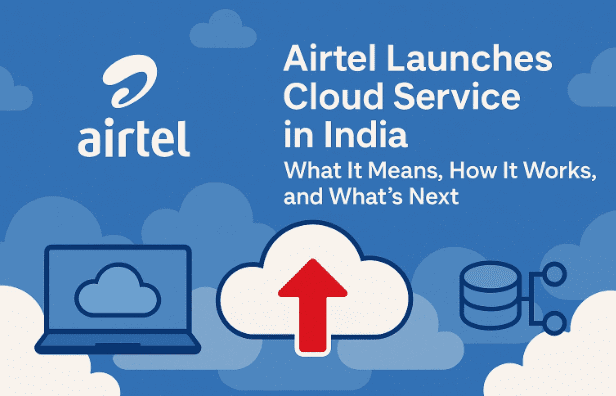
What Is Airtel Cloud — The Launch & Concept
Before dissecting how it works, let’s understand what Airtel says it is and how they’ve positioned it.
- Airtel has announced a new cloud service in India through its digital unit (Xtelify).
- They have entered a partnership with IBM to provide hybrid cloud and edge infrastructure in India.
- The target sectors are enterprises in regulated domains: banking, healthcare, government — not (for now) retail or consumer cloud storage.
- Airtel’s approach is to not build everything from scratch immediately, but to leverage the IBM partnership for core cloud capabilities while gradually assessing the market.
In short: this appears to be an enterprise-first cloud service for India, not a consumer-focused Dropbox alternative. It’s about regulated industries, data residency, and hybrid cloud rather than competing directly with global hyperscalers in all domains.
Why Does Airtel Do This Now? The Strategic Drivers
Understanding the “why” gives clarity to the design. Here are the key drivers:
- Data Residency & Sovereignty
Many Indian laws and upcoming regulation (or national policy) push for data to stay within India. Airtel + IBM aim to offer “India-resident” cloud services to comply with those rules. - Regulated Industries’ Demand
Sectors like banking, healthcare, and government have stricter rules about data, privacy, and latency. Those customers are more willing to adopt a locally controlled cloud. - Edge / Hybrid Capability & Latency Sensitivity
With 5G, IoT, real-time AI, and edge use cases, cloud solutions that are physically closer to users (edge) or hybrid (mix on-premises + cloud) matter. IBM + Airtel are building that architecture. - Market Experimentation before Heavy Investment
As the original text suggests, Airtel seems to be testing market acceptance before fully building its own cloud infrastructure footprint. This allows them to understand demand, costs, risks. - Telecom + Cloud Synergy
As a telecom operator, Airtel already has network assets, infrastructure, data centers (Nxtra), and connectivity that are natural complements to a cloud business.
So this is not just about “enter cloud business” for the sake of it — it’s a logical extension of Airtel’s infrastructure and a bet on India’s growing demand for sovereign cloud services.
How Airtel Cloud Is Structured — Architecture, Partnerships & Models
Let’s go deeper into how Airtel is building this service, using what’s publicly disclosed, and fill in gaps with reasonable inferences.
Key Technology Components & Partners
- Partnership with IBM
- Airtel is using IBM’s hybrid cloud technologies, including IBM Cloud Satellite and Red Hat OpenShift, to host and manage workloads across data centers, cloud, and edge.
- IBM brings cloud management, orchestration, tools, and experience in enterprise workloads.
- Airtel contributes its network, data center reach (through Nxtra), connectivity, and local operations.
- Edge / Distributed Data Centers
- Airtel and IBM plan to use existing Nxtra data centers (120 data centers across ~20 cities) to bring cloud/edge closer to enterprises.
- These distributed centers reduce latency, data transit, and help with regional compliance.
- Hybrid Cloud Model
- Not all workloads will move to cloud. Many enterprises will maintain on-premises infrastructure for sensitive systems, with Airtel’s cloud as extension.
- A hybrid architecture allows seamless orchestration and data flow between on-premises and cloud or edge.
- Performance Hardware & AI Workloads
- The service is set to support AI, inference, and performance-sensitive tasks. Reports mention Airtel aiming to host powerful servers for AI workloads.
- That suggests they will include GPU, TPU, or AI-optimized hardware in their offering.
- Sector Focus & Selective Rollout
- Rather than open to all, Airtel is starting with a narrower vertical focus (finance, healthcare, government) where data sensitivity is high and customers may prefer a local cloud.
- Over time, they may expand to more sectors or consumer cloud services.
The Airtel Cloud Service Model: What It Means in Practice
Here’s how the model is likely to work, based on descriptions and industry practice:
- Airtel offers a “power as a service” model, meaning customers rent compute, storage, network, managed services, etc., instead of building their own.
- The IBM component will provide the cloud control plane, orchestration, APIs, hybrid management, and enterprise features (security, monitoring, automation).
- Airtel manages or co-manages the infrastructure, data center ops, network connectivity, and support.
- Over time, Airtel may incubate its own modules or replace some IBM components, but initially relying on IBM reduces time to market.
- Airtel can test adoption in controlled verticals, evaluate what customers truly prioritize (latency, cost, compliance), before scaling further.
What Airtel Cloud Enables — Benefits & Use Cases
Let’s explore the benefits that Airtel claims or implies, plus real use cases where this cloud model can shine.
Key Benefits
- Data Sovereignty & Compliance: Enterprises in regulated sectors can keep data within India, a major compliance requirement in banking, healthcare, government.
- Lower Latency / Edge Advantage: By using distributed data centers, workloads like AI inferencing, IoT, real-time analytics benefit from smaller latency.
- Hybrid Flexibility: Enterprises can extend on-prem systems to cloud without full migration, which avoids risk.
- High Performance for AI & Critical Apps: With appropriate hardware and architecture, Airtel aims to support demanding applications.
- Integrated Connectivity & Cloud: Airtel’s network can optimize paths, private links, traffic prioritization, benefiting enterprise WAN + cloud integration.
- Controlled Investment & Scalability: Customers can adopt services incrementally rather than investing in large data centers themselves.
Use Case Examples
Here are plausible and some already-public use cases:









- Quality Inspection / Smart Manufacturing
Aerospace or automobile plants may run visual inspection models (camera + AI) locally at the edge, feeding results to cloud. Indeed, Maruti Suzuki is cited as a use case in Airtel-IBM’s announcements. - Healthcare & Telemedicine
Hospitals could keep patient data on-prem and run analytics or backup storage in Airtel Cloud with compliance. - Government / Smart City Applications
Local smart city sensors, traffic management, public surveillance — processing near source but aggregating in cloud. - Banking / Financial Services
Sensitive workloads (KYC, fraud detection) can run in suites that meet Indian regulatory standards. - Multi-Branch Enterprises
A business with many branches across the country can centralize data or share resources via Airtel Cloud, reducing duplicative server infrastructure.
Known Limitations, Risks & Open Questions
So far, Airtel Cloud sounds promising. But there are several caveats and unknowns. Let’s list them, and where possible propose suggestions or questions.
Limitations & Risks
- Initial Focus Excludes Consumers / Small Businesses
As the original text hinted, Airtel cloud is not (yet) targeted at individual users. It’s enterprise-first. If you’re a small user, this may not help you. - Dependency on IBM & Hybrid Over Time
Because many core functions rely on IBM’s technologies initially, changes in partnership or strategy could pose risks or lock-in. - Infrastructure Build-Out Costs
Scaling to match AWS, Azure, GCP is capital intensive. Airtel must balance expansion pace carefully. - Competition from Hyperscalers
Even though Airtel is local, global players like AWS, Azure, Google have entrenched presence, mature platforms, and ecosystems. Airtel must offer strong differentiators (latency, compliance, cost structure). - Customer Trust & Adoption Resistance
Some enterprises may hesitate to trust a telecom for critical workloads — cloud providers have built trust over many years. - Regulatory Uncertainties & Policy Changes
India’s laws on data, privacy, cross-border transfer etc. are evolving. Airtel needs to ensure compliance amid shifting rules. - Unknown Consumer Benefit (Yet)
The original text suggests “no direct benefit for Airtel consumers yet.” That may change, but currently individual users might not see improvements.
Open Questions
- Will Airtel eventually expand cloud to consumers (storage, media, backups)?
- How much control will Airtel have over core cloud functions vs. IBM’s platform?
- What pricing models will they offer vs established cloud providers?
- How fast will they rollout infrastructure in Tier-2 and Tier-3 cities?
- How will Airtel ensure interoperability and migration paths (e.g., for AWS, Azure users)?
- Can Airtel build its own AI modules and offerings over time, or will they always depend on IBM?
It’s possible some of these will be clarified in future announcements.
Step-by-Step: How Airtel Could Roll Out & Adoption Phases
I’ll now sketch a hypothetical rollout path (based on what we see in cloud industry and what the original text suggested). This helps you see how Airtel’s cloud might evolve.
Phase 1: Pilot / Limited Launch
- Target a few verticals (e.g., enterprise banking, healthcare, state gov).
- Use IBM infrastructure modules initially; limited regions.
- Gather feedback, refine service levels, SLA, pricing, support.
Phase 2: Expand Region & Workload Support
- Expand to more cities, deploy more data centers (Nxtra).
- Add more hardware capabilities (GPU, AI acceleration).
- Add support for more workloads, move beyond core verticals.
Phase 3: Compete Broadly & Consumer Tier
- Add consumer / SMB offerings (storage, backup, media).
- Build proprietary modules, reduce dependency on IBM where feasible.
- Strengthen ecosystem: partner developers, ISVs, consulting firms.
Phase 4: Mature Cloud Player
- Complete feature parity (or better) vs global cloud platforms in Indian context.
- Provide seamless interoperability, global fallback, hybrid/multi-cloud.
- Achieve economies of scale, competitive pricing, trusted brand.
Throughout these phases, Airtel can monitor adoption metrics, churn, competition, cost-per-user, and optimize investment accordingly.
Q&A — Common Questions About Airtel’s Cloud Move
Q: Does this service benefit regular Airtel consumers (mobile/home users)?
A: Not immediately. The focus is on enterprise / regulated sectors. Over time, Airtel may introduce consumer cloud features (backups, storage) but we do not have confirmation yet.
Q: Why use IBM instead of building from scratch?
A: Leveraging IBM’s proven cloud backbone, orchestration, tools, and enterprise credibility accelerates time to market, reduces initial risk, and allows Airtel to focus on connectivity, operations, support.
Q: How does Airtel’s network help?
A: As a telecom operator, Airtel’s network can offer optimized data paths, private connectivity, low-latency links between clients and nearest data centers. That’s a competitive advantage few cloud-only players have.
Q: Is Airtel’s cloud better than AWS/Azure in India?
A: “Better” depends on your priorities. Airtel may offer advantages in latency, compliance, cost structure for Indian workloads. But global players still may have strengths in ecosystem, global reach, mature tooling, integration.
Q: What does “hybrid cloud + edge” mean here?
A: It means workloads may run partly on-premises, partly on cloud, or close to where data is generated (edge). The system should enable seamless integration, data flow and management across these layers.
Q: How will they price services?
A: Pricing is not public yet. Likely competitive with global cloud rates, perhaps with incentives for Indian workloads or lower interconnect charges for Airtel network users.
Summary & Takeaways
Here’s a quick recap and what to watch going forward:
- Airtel has entered the cloud market in India, with a strategic partnership with IBM.
- The focused sectors are enterprise and regulated domains (banking, healthcare, government).
- The architecture is hybrid + edge, leveraging distributed data centers (Nxtra) and IBM’s cloud platform.
- Potential benefits include data sovereignty, latency improvements, cloud + network synergy, and hybrid flexibility.
- But there are risks: dependency, infrastructure cost, competition, and adoption challenges.
- Over time, Airtel may expand offerings, build more of its own capabilities, and possibly serve consumers.
If you’re in enterprise IT, especially in regulated sectors, Airtel Cloud is one to watch. If you’re a developer or consultant, you may begin exploring integration possibilities down the line.
Disclaimer
This article is based on publicly available announcements, news reports, and informed inference. Airtel’s plans, service features, or timeline may change, and not all details are officially confirmed. The article does not constitute technical or business advice; please verify details with official Airtel / IBM documentation or announcements before making decisions.
#AirtelCloud #HybridCloud #EdgeComputing #DataSovereignty #IBM #TelecomCloud #CloudIndia #EnterpriseTech