In today’s hyper-digital world, artificial intelligence has unlocked incredible creative potential—but it’s also opening up legal and ethical minefields. One of the most troubling developments on the horizon? AI-generated music and the chaotic copyright war it’s brewing, particularly for musicians, YouTubers, and content creators.
What started as an exciting promise of royalty-free AI music has now spiraled into a dystopian twist: people are generating AI tracks, uploading them to YouTube’s Content ID system, and claiming videos for music the AI itself technically doesn’t even own.
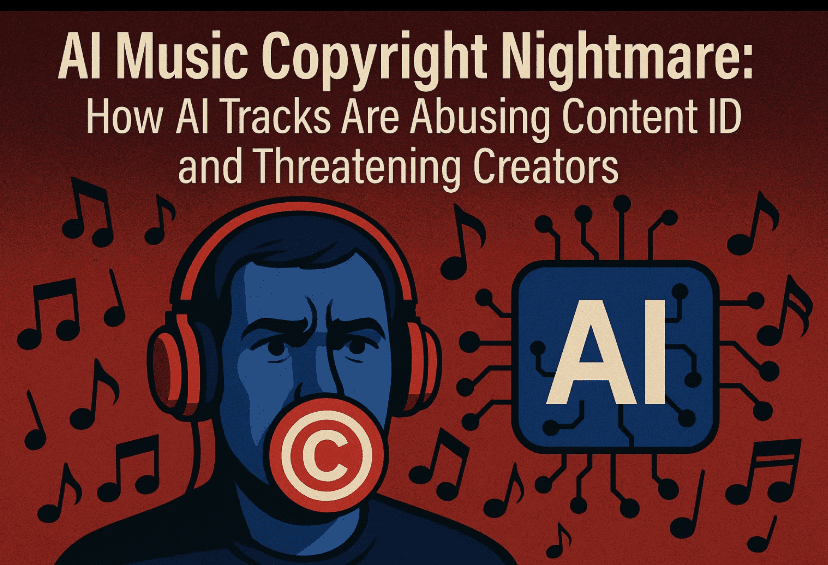
In this article, we’ll break down how it’s happening, what it means for the future of creativity, and why you need to protect yourself—even if you’ve never used AI-generated content in your life.
🎵 Let’s Start With the Core Problem: Who Owns AI-Generated Music?
Before diving into the deep mess that is Content ID abuse, let’s answer a foundational question:
Who owns the copyright to music generated by AI?
You might assume:
- The person who clicked “Generate”
- The AI platform
- No one
- The copyright holders of the music that trained the AI
Well… none of those answers are quite right. Or they’re all partially right. And that’s where the danger starts.
⚖️ Copyright Laws and AI: A Legal Grey Zone
In 2023, the U.S. Copyright Office issued guidelines stating that AI-generated content is not eligible for copyright protection unless there is “sufficient human authorship.”
But what does “sufficient” mean?
Nobody knows.
It hasn’t been challenged in court yet, and until then, platforms are operating in a gray area, allowing just about anyone to check a box saying, “Yes, this is original,” and then upload the content to YouTube’s Content ID system or digital distributors.









There is no verification, no vetting, no enforcement.
💡 Real-Life Example: Claiming Yourself for $30
Here’s how easy it is to abuse the system:
- Go to an AI music platform (like Suno or Udio).
- Generate a track for free.
- Download it.
- Upload that track to YouTube under an alternate account.
- Use a distribution platform to upload the same track to Content ID.
- Pay the small fee (roughly $30).
- Voilà—you’ve just claimed yourself for copyright.
The platform doesn’t verify whether it’s truly your original work. You just click the right boxes and go.
🎛️ How Content ID Works (And How It’s Being Weaponized)
Let’s take a brief detour to understand Content ID.
Content ID is YouTube’s fingerprinting system for protecting copyrighted works. It scans uploads for matches to its database, flags them, and either:
- Monetizes the video and redirects the revenue to the claimant
- Mutes the audio
- Blocks the video entirely
While originally built to help protect creators from theft, it has ironically become a weapon—especially when paired with AI.
If an AI-generated song sounds even remotely like another, it can trigger a match. Worse, if someone purposefully uploads a generic-sounding AI track to Content ID, it can match your video and you might lose the revenue for your original work.
🎼 Why This Matters to Musicians and YouTubers
Even if you:
- Don’t use AI music
- Only use royalty-free tracks
- Compose everything yourself
…you’re still at risk.
Because someone else could generate an AI track that resembles your style, or even train it on your public music, and upload that to Content ID.
If YouTube’s system finds a “match,” you’re the one who gets flagged—not them.
Here’s where things get really frustrating:
- Disputing a claim is risky. You could get a copyright strike or lose your channel.
- YouTube admits it can’t enforce or judge what’s valid. They leave it up to you and the claimant.
- Taking legal action? Be ready for a long, expensive court case.
🎧 AI Music Isn’t As Original As It Seems
Let’s zoom out. How do AI platforms generate music?
Most use massive datasets scraped from the internet—public music, old songs, YouTube clips, SoundCloud tracks, and more. Some companies admit this openly.
For instance, in 2024, a co-founder of Suno admitted they used “open internet” sources for training data—meaning your music, my music, and everyone else’s could be in there.
This training data forms the backbone of generated music. So if an AI model creates a song that sounds like yours—it may not be a coincidence.
🧠 A Thought Experiment: The Chinese Room Problem
To illustrate why this is dangerous, let’s consider a concept from philosophy called the Chinese Room Experiment.
Imagine someone locked in a room. They don’t speak Chinese, but they have a guidebook. When you slide a Chinese message under the door, they use the guidebook to write a response.
From the outside, it looks like they understand Chinese—but they’re just following rules.
That’s AI.
It doesn’t understand the music. It just references patterns from its training data to generate similar outputs.
If it generates something that sounds like your music, it wasn’t intentional—but the consequences can still be very real.
🧪 Testing the Limits: Music That Sounds Like Me
The author of this case study tested the system by prompting Suno to generate tracks in a style “similar to themselves.”
Even with platform protections in place, a little prompt engineering yielded music that closely resembled their own original compositions.
They then uploaded that track to Content ID and claimed it—proving how easy it is to weaponize AI music.
🤖 What About AI Voice and Audio Cloning?
Things get worse.
Some platforms now allow reference audio input—you can upload a clip of real music, and the AI will generate something based on it.
This creates a terrifying scenario:
Let’s say a film studio wants to use your song in a trailer but doesn’t want to pay for the license. They upload your track into an AI generator and tweak it slightly.
Now it’s legally “different,” and they owe you nothing.
Worse still, if they copyright their version, you could be infringing on your own original work in the future.
🛠️ How Easy Is It to Start Abusing Content ID?
Let’s walk through the chilling process again:
- Generate Music
Use a free AI platform like Suno or Udio. - Download the Track
Export the audio to your device. - Upload It to YouTube
Post the music as part of a normal video. - Use a Distributor
Register on any Content ID music distribution service (e.g., DistroKid, RouteNote). - Tick the Right Boxes
Agree to the terms, even if you’re lying. No one checks. - Pay the Small Fee
Around $30. - Start Claiming Videos
Anyone using music that sounds remotely similar gets flagged.
You might be intrested in these topics too!
- AI Music Copyright Nightmare: How AI Tracks Are Abusing Content ID and Threatening Creators
- How I Revived 3 Dead YouTube Channels Using Brand Account Switching (Complete Step-by-Step Guide)
- Your YouTube Video is Live – Now What? The First 60 Minutes That Make or Break Your Video in 2025
- YouTube Launches A/B Title Testing – Here’s Everything Creators Need to Know (First Look & Tips)
- The Viral YouTube Video Formula That Works Every Time: 9 Proven Steps You Can Copy Today
❓ FAQ: Common Questions About AI Music Copyright
Q1. Is AI-generated music copyrightable?
No, unless there is significant human input. But what qualifies as “significant” remains vague and untested legally.
Q2. Can someone claim my music if it sounds like their AI track?
Yes, unfortunately. Content ID isn’t smart enough to know who created what. It just looks for matches.
Q3. Can YouTube resolve these issues?
No. YouTube does not investigate claim validity. It leaves disputes between users.
Q4. What happens if I dispute a claim and lose?
You could get a copyright strike. Three strikes = channel termination.
Q5. Should I stop making music or using AI?
Absolutely not. But you must stay informed and cautious.
🛡️ What Can You Do to Protect Yourself?
While the system is flawed, here are some tips to safeguard your work:
1. Avoid AI Music Unless Necessary
Only use AI tracks from reputable platforms with clear licensing terms and explicitly allow commercial use.
2. Keep Proof of Ownership
Maintain timestamps, source project files (DAWs), and drafts of your music as proof of authorship.
3. Register Copyrights Where Possible
Even if it’s tedious, official copyright registration in your country offers legal protection.
4. Use Human-Composed Royalty-Free Music
If you outsource music or use stock tracks, ensure they’re not AI-generated unless backed by a known company.
5. Regularly Monitor Claims on Your Videos
Use YouTube Studio’s copyright section to keep an eye on false claims.
💬 Final Thoughts: A Broken System in a Fast-Moving World
This entire situation reflects a terrifying truth: technology has moved faster than the law.
Creators who spend hours crafting original content are at risk of losing their income and credibility to AI-generated junk. And worst of all, no one seems capable of enforcing fairness.
While platforms like YouTube, Suno, and Udio continue profiting, creators are left fending for themselves—fighting copyright claims over music no human ever truly made.
So what should you do?
Keep creating. Keep documenting. Stay informed. Don’t let AI stop your art.
📌 Tags and Hashtags
Tags: AI music copyright, YouTube Content ID abuse, Suno AI, Udio AI, AI generated music, musician rights, copyright protection, digital distribution, YouTube copyright strike, fair use, AI audio generation, legal issues in AI music
Hashtags:
#AIMusic #CopyrightAbuse #ContentID #YouTubeStrike #MusicIndustry #MusicianRights #AIvsHumans #DigitalDistribution #SunoAI #UdioAI #CreatorsBeware #MusicCopyright #AIArtEthics