As the modern workplace continues to embrace remote and hybrid work models, securely managing devices across various platforms has become more critical than ever. Whether you’re an IT admin managing hundreds of devices or a tech-savvy professional aiming to understand Intune better, this guide walks you through every device enrollment method available in Microsoft Intune for Windows, Android, iOS/iPadOS, and macOS.
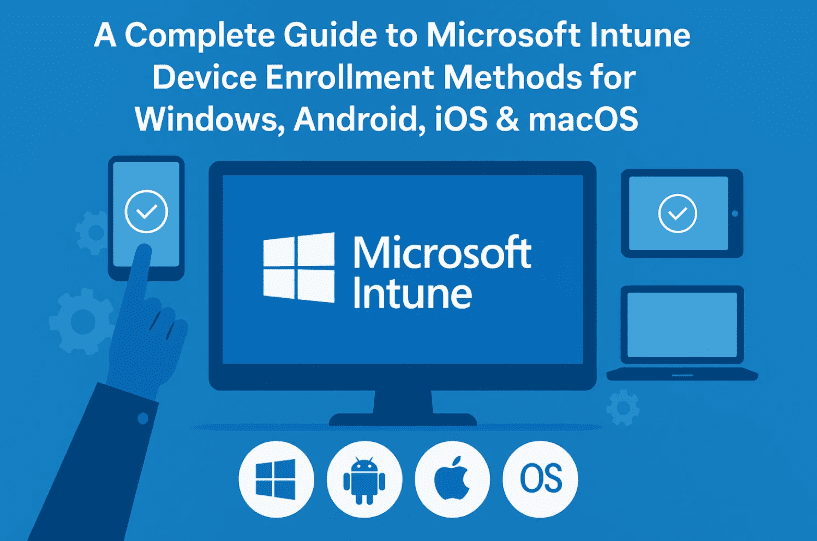
Let’s break it all down in a human-friendly way — no jargon overload, just practical insights and detailed steps.
📌 What is Device Enrollment in Intune?
Before we get into the specifics for each operating system, let’s understand the concept.
Device enrollment is the process of registering a device with Microsoft Intune so it can be managed, secured, and configured according to your organization’s policies. Intune offers various enrollment methods, each suited for specific platforms, device ownership types (corporate or personal), and use-case scenarios.
Now that we’ve got that out of the way, let’s dive into the platform-specific options, starting with Windows.
💻 Windows Enrollment Methods in Intune
Windows is still the most common OS in corporate environments, so it offers the most diverse enrollment methods.
So far, so good — let’s explore each method in more detail:
1. Azure AD Join
- ✅ Use Case: Corporate-owned devices
- 🌐 Environment: Cloud-first or hybrid
- 📋 Benefits: Full management and policy enforcement via Intune
- 🔒 Devices are joined to Azure Active Directory and automatically enrolled in Intune
2. Azure AD Registration (Workplace Join)
- ✅ Use Case: Personal/BYOD (Bring Your Own Device)
- ⚙️ Function: Offers limited management
- 👀 Mainly used to enforce compliance and grant conditional access without full device control
3. Windows Autopilot
- ✅ Use Case: Provisioning new Windows 10/11 devices out of the box
- 📦 Ideal for large enterprises
- ⚙️ Devices are automatically enrolled into Intune and configured based on admin-defined policies
- 🎯 Reduces IT burden by skipping manual setup
4. Bulk Enrollment with Provisioning Packages
- ✅ Use Case: Shared devices or mass deployment
- 🛠 Admins create
.ppkg(Provisioning Package) using Windows Configuration Designer - 👤 No user interaction needed — ideal for labs, kiosks, or education environments
5. Hybrid Azure AD Join
- ✅ Use Case: Organizations with on-premises Active Directory
- 🔗 Devices are joined to both On-Prem AD and Azure AD
- 🧩 Suitable during cloud migration phases
📱 iOS/iPadOS Enrollment Methods in Intune
Apple’s ecosystem provides both corporate and BYOD options. Here’s how it works:
1. Automated Device Enrollment (ADE)
- ✅ Use Case: Corporate-owned iPhones and iPads
- 🔁 Works via Apple Business Manager (ABM) or Apple School Manager (ASM)
- ⚙️ Devices are enrolled in Intune right after activation
- 🚫 Users can’t remove management without admin approval
2. User Enrollment
- ✅ Use Case: BYOD devices
- 🎯 Provides a lightweight management experience
- 🔐 Focused on protecting organizational data without full control of the device
3. Apple Configurator
- ✅ Use Case: Devices not purchased through ABM/ASM
- 💻 Admins can manually enroll devices by connecting to a Mac with Apple Configurator
- 🛠 Good fallback for smaller deployments
4. Company Portal App Enrollment (BYOD)
- ✅ Use Case: Employees using personal iOS/iPadOS devices
- 🔑 Users install the Company Portal App and register their device
🤖 Android Enrollment Methods in Intune
Android offers a wide variety of enrollment methods depending on whether the device is personal or corporate-owned.
Ready? Let’s break it down:
1. Android Enterprise Work Profile
- ✅ Use Case: BYOD
- 🔒 Separates personal and work data
- 📦 Corporate apps live inside a secure container; personal data remains untouched
2. Android Enterprise Fully Managed
- ✅ Use Case: Corporate-owned, single-user
- 🛡 Full device control by IT
- 📵 Can restrict settings, apps, and functionalities as needed
3. Android Enterprise Dedicated Devices (Kiosk Mode)
- ✅ Use Case: Single-purpose corporate devices (e.g., digital signage)
- 🔄 Locked-down configuration for shared or task-based usage
4. Corporate-Owned Personally Enabled (COPE)
- ✅ Use Case: Company device used for both work and personal tasks
- 🔁 Two partitions: One for personal, one for work
- 🔐 Combines full control with employee flexibility
5. Samsung Knox Mobile Enrollment (KME)
- ✅ Use Case: Samsung-specific corporate-owned devices
- 🔗 Integrates with Samsung Knox for security enhancements
- 🧠 Streamlined setup and remote management
🍏 macOS Enrollment Methods in Intune
MacBooks are increasingly popular in workspaces, and Intune has strong support here too.



Let’s go over your options:
1. Apple Automated Device Enrollment (ADE)
- ✅ Use Case: Corporate-owned macOS devices
- 🔁 Works with Apple Business Manager
- 💻 Devices are enrolled as soon as they’re turned on and connected to Wi-Fi
- 🔐 Ensures immediate policy enforcement
2. User-Driven Enrollment (BYOD)
- ✅ Use Case: Personal MacBooks
- 🧰 Users manually install the Company Portal App to begin enrollment
- 🤝 Lighter control, ideal for flexible work environments
3. Apple Configurator
- ✅ Use Case: MacBooks not purchased through ABM
- 🛠 Admins use Apple Configurator to prepare and enroll devices manually
- 🔐 Ideal for smaller batches or special-use Macs
🧠 How to Choose the Right Enrollment Method?
Choosing the best enrollment strategy depends on several factors. Let’s simplify it:
So far we’ve looked at each platform. Now here are some general guidelines to help you decide what’s best for your organization.
Key Decision Factors:
- Device Ownership
- Corporate-owned: Use ADE, Fully Managed, or Autopilot
- BYOD: Use Work Profile (Android) or User Enrollment (Apple)
- User Experience
- Want less user involvement? Go with Autopilot or KME
- Want to allow user choice? Use Company Portal
- Security Needs
- High-security orgs: Fully Managed or Hybrid AD Join
- Lightweight control: Work Profiles or Registration
- Platform Compatibility
- Some features are platform-specific. For example:
- Autopilot = Windows
- KME = Samsung
- ADE = Apple
- Some features are platform-specific. For example:
❓FAQs
Q: Can I enroll personal phones into Intune?
A: Yes. You can use Work Profile for Android or User Enrollment for iOS/iPadOS. These methods separate personal and work data.
Q: What happens if a user removes the Company Portal app?
A: The device will be unenrolled, and corporate access and data will be revoked.
Q: Is Apple Configurator available for Windows?
A: No. It’s a macOS-only application. You need a Mac to use Apple Configurator for enrollment.
⚠️ Disclaimer
This article is intended for educational purposes. Always ensure your organization follows internal IT policies and consults with your compliance/security team before applying device enrollment strategies.
🔗 Useful Resources
- Microsoft Intune Official Site
- Apple Business Manager
- Samsung Knox Mobile Enrollment
- Windows Autopilot Docs
✅ Final Thoughts
Device enrollment is the foundation of modern device management. With Microsoft Intune, organizations can choose from a variety of flexible, scalable, and secure options tailored to their specific needs.
By understanding the different enrollment methods — whether for Windows laptops, Android phones, iPads, or MacBooks — you can build a strategy that improves security, boosts productivity, and enhances the end-user experience.
Keep learning, stay secure, and make tech management seamless!
Tags: Microsoft Intune, device enrollment, Windows Autopilot, iOS management, Android enterprise, macOS, mobile device management, BYOD, corporate device security
Hashtags:
#Intune #DeviceEnrollment #Microsoft365 #Autopilot #AndroidEnterprise #AppleADE #BYOD #MDM #MacOSManagement #Windows11 #TechForITAdmins