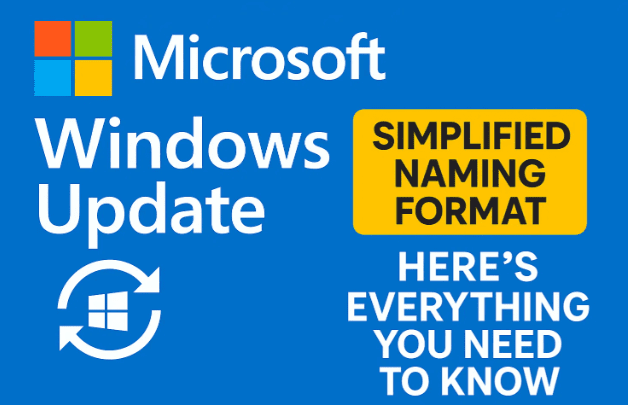
If you’ve recently checked for updates on your Windows 11 PC and noticed that the update titles look shorter and clearer than before — you’re not imagining things. Microsoft has officially introduced a new simplified naming format for Windows updates, starting with versions 24H2 and 25H2.
This change marks one of the most significant adjustments to the Windows Update naming system in years, and it’s designed to make update information easier to read, understand, and manage — not just for home users, but also for IT administrators and OEM partners who rely on consistent naming patterns.
Let’s take a deep dive into what’s new, how this affects different types of updates, and why Microsoft made this change in the first place.
1. Understanding the Change
Before we explore the reasoning, let’s clearly understand what’s actually changed.
In the past, update titles in Windows Update, Settings → Update History, and the Windows Release Health Dashboard used to contain long, complex names filled with technical identifiers, platform architecture, and date prefixes.
For example, an older update title might have looked something like this:
“2024-09 Cumulative Update for Windows 11 Version 23H2 for x64-based Systems (KB5039874)”
With the new naming policy, the same update will now appear more simply as:
“Windows 11 Update — September 2024 (KB5039874)”
This may seem like a small cosmetic change, but the simplification is part of a much larger effort by Microsoft to reduce confusion, improve readability, and ensure consistency across every part of the Windows ecosystem.
2. Why Microsoft Decided to Simplify Update Names
Now let’s move to the reasoning behind this change.




According to Microsoft’s official announcement, this update naming reform is aimed at making update information:
- Easier to understand for everyday users.
- More consistent across all update categories.
- Simpler for IT administrators who manage deployments at scale.
- Predictable for OEMs and partners, who depend on stable update formats for testing and integration.
Microsoft admitted that the old format was often cluttered with unnecessary data — such as internal architecture labels (x86, x64, ARM64) and repetitive version identifiers — which confused many non-technical users.
The new structure, therefore, “drops unnecessary technical details and focuses on readability.”
In short, the goal is to make it immediately clear what kind of update is being installed and why — without making users decode a long title filled with version numbers.
3. Which Updates Are Affected
So far, we’ve discussed the reasoning. Let’s now move to the actual scope of this rollout.
The simplified naming format applies to several major update categories, including:
- Monthly Security Updates (Patch Tuesday updates)
- These are the core updates that fix vulnerabilities and improve overall system stability.
- Out-of-Band Security Updates
- Released outside the normal schedule to fix urgent or high-risk vulnerabilities.
- Non-Security (Preview) Updates
- Typically released towards the end of the month for testing new features or performance enhancements.
- .NET Framework Updates
- Includes both security and non-security releases related to the .NET Framework runtime.
- Driver Updates
- Cover updates distributed through Windows Update for device drivers from manufacturers.
- AI Component Updates
- With Windows 11 integrating AI-powered features (like Copilot and Recall), these updates get their own simplified names for clarity.
- Visual Studio Updates
- Simplified titles for development tools that ship via the Windows Update channel.
So essentially, whether it’s a security patch, a framework update, or even an AI model enhancement — all of these updates will now follow a cleaner, shorter naming convention.
4. Where You’ll See the New Names
Let’s move to the next part — where these new update titles will appear.
You’ll notice the simplified names in:
- Windows Settings → Windows Update
- Update History page
- Windows Release Health Dashboard (Microsoft’s official update tracking portal)
- Microsoft Learn and documentation pages
However, there’s one important detail:
If you use Windows Update Catalog or Windows Server Update Services (WSUS) — the backend tools used by IT admins — the older, more detailed naming convention will remain in place for now.
Microsoft explained that these services still rely on extended metadata and classification identifiers that the simplified names don’t include.
In other words, consumer-facing platforms will show the short names, while enterprise-facing tools will keep the detailed titles for technical accuracy.
5. Real Examples of the New Format
So far, we’ve understood what changed and where you’ll see it. Now let’s look at what these updates look like in practice.
Here are a few examples shared by Microsoft:
- Monthly Security Update:
Windows 11 Update — October 2025 (KB5067036) - Monthly Preview (Non-Security):
Windows 11 Preview Update — October 2025 (KB5067052) - .NET Framework Security Update:
.NET Framework Security Update for Windows 11 — October 2025 (KB5067060) - Driver Update:
Intel Display Driver Update for Windows 11 - AI Component Update:
Windows AI Update — Copilot Enhancements (October 2025)
By looking at these examples, you can see that Microsoft is emphasizing clarity over complexity — using consistent phrasing that instantly communicates the update’s type and purpose.
6. Benefits for Users and IT Administrators
Let’s take a moment to talk about the real-world advantages of this new format.
For regular users:
- Easier to recognize whether an update is a security fix, a feature update, or an AI component.
- No need to interpret long version codes or architecture tags.
- More accessible titles for those with visual or cognitive difficulties, aligning with Microsoft’s broader accessibility goals.
For IT administrators and OEMs:
- Predictable naming conventions simplify documentation, deployment scripts, and update management.
- Reduces errors during bulk rollouts by providing consistent formatting.
- Helps OEMs and partners better track versioning and compatibility.
In essence, this change benefits both ends of the Windows ecosystem — from home users who just want clarity to system administrators managing thousands of endpoints.
7. The Broader Context: AI, Copilot, and a Simplified Future
Now let’s step back and see the bigger picture.
This renaming effort isn’t just about aesthetics. It’s part of Microsoft’s ongoing modernization of Windows 11, especially as it integrates AI features like Copilot, Recall, and system-generated suggestions.
AI-related updates are now being released independently, outside traditional Patch Tuesday schedules. The simplified naming helps these new update types stand out clearly so users know when something major is being added to their system.
Microsoft’s statement even mentioned that “AI component releases” are now part of the unified naming model — showing how deeply integrated AI is becoming within the Windows update process itself.
This is also in line with Microsoft’s push toward greater transparency and predictable communication. In short, it’s no longer just about system patches — it’s about modular updates for different Windows experiences.
8. Are There Any Downsides?
Let’s talk about possible drawbacks, because every major change has some.
- Some advanced users and IT professionals may miss the technical precision of old update names, which contained architecture details (x64, ARM, etc.) and date stamps.
- For power users relying on the Windows Update Catalog, having two different naming styles (simplified vs. detailed) could cause minor inconsistencies when cross-referencing updates.
- Legacy automation scripts that scrape update titles might need adjustments if they rely on old formatting patterns.
However, these are relatively small trade-offs compared to the clarity and accessibility the new system provides.
9. Frequently Asked Questions (FAQ)
Q1. Will this affect the actual update installation process?
No, the underlying update mechanism remains unchanged. Only the visible naming structure is being simplified.
Q2. Will updates in Windows 10 also get the new naming format?
For now, Microsoft has confirmed the rollout for Windows 11 (24H2 and 25H2). However, it’s likely that similar conventions will extend to future Windows 10 LTS builds later.
Q3. Will WSUS and Update Catalog names change too?
No, these enterprise tools will retain the detailed names for backward compatibility and administrative use.
Q4. Does this mean update KB numbers are going away?
No, the familiar KB identifiers (like KB5067036) will remain. They continue to serve as unique references for tracking and documentation.
Q5. Is this linked to the upcoming Windows 12?
Indirectly, yes. Microsoft’s simplification efforts often serve as groundwork for broader transitions — so it’s reasonable to expect similar formatting in Windows 12 or future unified platforms.
10. Final Thoughts
So far, we’ve seen that this isn’t just a minor aesthetic change — it’s a part of Microsoft’s larger goal to make Windows more user-friendly, consistent, and accessible.
For years, update names were written mainly for engineers and IT specialists. Now, Microsoft wants every user to understand what’s being installed without needing to decode technical jargon.
From a usability perspective, this makes perfect sense. Clearer naming builds confidence, especially at a time when Windows updates are integrating not just system patches but also AI features and cloud-driven components.
For most people, it means less confusion and a cleaner interface. For developers and administrators, it means a more predictable structure going forward.
The old naming system served its purpose for decades — but as Windows evolves into an AI-connected platform, this simplification is a natural and necessary step forward.
Official Source:
You can read Microsoft’s official announcement on their Windows Release Health page:
🔗 https://learn.microsoft.com/windows/release-health/
Disclaimer:
This article is for informational and educational purposes only. Microsoft’s naming changes apply gradually across versions and may differ based on your regional or enterprise update channels.
#Windows11 #MicrosoftUpdate #WindowsUpdate #PatchTuesday #Windows24H2 #Windows25H2 #AIComponents #dtptips