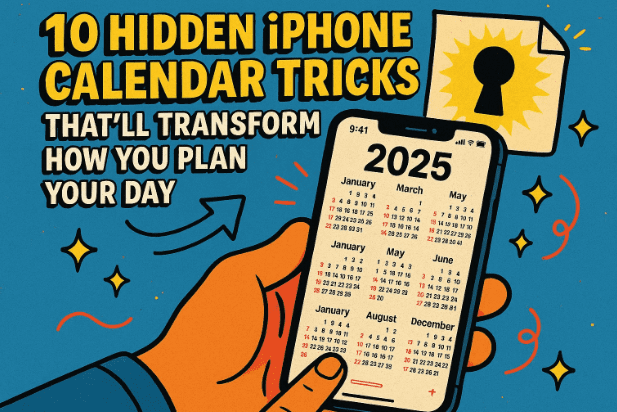
It’s surprising how many iPhone users underestimate one of the most powerful tools sitting right on their home screen — the Calendar app. For most of us, it’s just a place to set reminders for birthdays, meetings, or a dentist appointment. But under the surface, Apple has packed in features that can completely reshape how you organize your time, balance work and life, and even coordinate travel and events seamlessly.
In this article, we’ll explore 10 hidden iPhone Calendar tricks that can make your daily routine smarter, more organized, and far less stressful. Whether you’re new to the app or already using it, these tips will help you unlock its full potential.
So, let’s start with something simple but surprisingly powerful.
1. Add and Manage Multiple Calendar Accounts
The first step to mastering the Calendar app is to bring all your schedules under one roof — but without mixing them up.
You can add multiple accounts — say, your Google Workspace for office meetings, iCloud for personal events, and maybe even Outlook for client appointments — and manage them independently.
Here’s how to do it:
- Go to Settings → Calendar → Accounts → Add Account.
- Choose the type of account (Google, Outlook, iCloud, etc.) and log in.
- Once added, open the Calendar app and tap “Calendars” at the bottom.
- You’ll now see all your calendars listed by account — simply toggle each one on or off to control what appears in your view.
This makes it easy to keep work meetings separate from personal plans while still seeing everything in one place when needed.
Pro Tip: Assign unique colors to each calendar. For example, blue for work, red for personal, green for family. Just tap the small “i” next to the calendar name, pick a color, and tap Done. It’s a small change that makes a big difference — a quick glance at your week view, and you’ll instantly know what’s work and what’s play.
2. Integrate Apple Reminders with Calendar
Let’s move to something that takes your productivity to the next level. Did you know you can sync your Apple Reminders directly with Calendar?
This allows your tasks and events to appear together in one timeline, helping you plan your day hour-by-hour without switching between apps.
Here’s how it works:









- Open the Calendar app and create a new event.
- Select “Add Reminder” and choose the list it belongs to.
- Tap Details to add options like location-based reminders (e.g., notify me when I arrive at office) or when messaging a specific person.
- You can even attach an image if needed.
Once done, your reminders will appear both in the Reminders app and your Calendar — and you can mark them complete from either one. Perfect for those who plan tightly scheduled days with meetings, errands, and follow-ups all in one place.
3. Use Time Zone Override for Travelers
If you travel frequently or work with international teams, you’ll love this feature. By default, your calendar events adjust automatically to your phone’s local time zone — but that can cause confusion when traveling.
To fix that, turn on Time Zone Override:
- Go to Settings → Calendar → Time Zone Override.
- Enable it and select your home city’s time zone.
This ensures your events remain locked to a specific time zone, so you won’t accidentally show up early or late after landing somewhere new.
It’s a small tweak that saves big headaches — especially for global professionals and frequent flyers.
4. Display Alternate Calendars and Week Numbers
Apple quietly added an option to view alternate cultural calendars right inside your Calendar app — for example, Tamil, Chinese, or Korean calendars.
Go to Settings → Calendar → Alternate Calendars and choose one that’s relevant to your region or traditions.
It’s a wonderful addition if you celebrate regional holidays or track cultural events alongside your regular calendar.
While you’re there, also turn on “Show Week Numbers.” This feature displays which week of the year you’re currently in — useful for project planning, academic scheduling, or syncing with clients who use week codes like “Week 42.”
5. Set a Default Calendar for Siri and Quick Events
Sometimes we forget to specify which account an event should go to — and that can lead to clutter.
To avoid that, set your most-used calendar as default:
- Go to Settings → Calendar → Default Calendar.
- Choose your preferred one (e.g., your work calendar).
Now, any new event created through Siri, Mail, or Messages will automatically save there — keeping your schedules organized without extra steps.
For example, if you say:
“Hey Siri, add a meeting with Mark tomorrow at 3 p.m.”
It’ll automatically land in your default calendar.
6. Add Events with Natural Language Input
So far, we’ve talked about structure. Now let’s talk about speed.
Instead of filling multiple fields manually, just type (or say) your event in plain English:
“Brunch with friends on Sunday at 11 a.m. at The Cottage Bottle.”
The Calendar app will instantly recognize your intent — date, time, and location — and create the event automatically.
You can even set recurring events the same way:
“Yoga every Tuesday at 6 a.m.”
No menus, no taps — just type or dictate. It’s like having a smart personal assistant who actually listens.
7. Add Travel Time and Get “Leave Now” Alerts
Here’s a feature that makes your Calendar smarter than ever. When you add a location to your event, scroll down and tap Travel Time.
You can choose your preferred mode of transport (car, walk, public transit). The Calendar app then uses real-time traffic data to alert you when it’s time to leave — ensuring you never miss an appointment again.
Imagine having a meeting downtown at 3:00 p.m. — if traffic is bad, your iPhone will automatically notify you earlier with a “Leave Now” alert.
This turns your Calendar into a true travel assistant, seamlessly connecting Maps and time management.
8. Use Siri to Add, Move, and Review Events
Apple’s voice assistant can do much more than just tell jokes. Siri integrates beautifully with Calendar, allowing you to manage schedules hands-free.
Try commands like:
- “Add an event called grocery run tomorrow at 5 p.m.”
- “Move my 2 p.m. meeting to 3:30 p.m.”
- “What’s on my calendar for Friday?”
Whether you’re cooking, driving, or working out — you can add or adjust events without touching your screen. Once you start using Siri this way, it’s hard to go back.
9. Share Calendars with Family or Team Members
If you coordinate with family, a partner, or your work team, this is a must-use feature.
You can share entire calendars (not just individual events) through iCloud, allowing everyone to view updates in real time.
To do this:
- Open the Calendar app and tap Calendars at the bottom.
- Tap the “i” next to your iCloud calendar.
- Under Share With, add people’s Apple IDs or email addresses.
Now, whenever you add or edit events, everyone sees it instantly — no extra messages or reminders needed.
This is perfect for family schedules, school pickups, shared projects, or collaborative planning.
10. Set Multiple Alerts and Use Multi-Day View
Finally, let’s cover two simple but life-changing features — multiple alerts and multi-day views.
You can set more than one reminder for a single event — for example, one an hour before and another ten minutes before.
Here’s how:
- Open your event → Tap Edit → Alert → Custom → Add Another Alert.
This ensures you never forget those critical calls, flights, or appointments.
And if you often feel lost looking at your day one screen at a time, try the Multi-Day View.
From the monthly view, tap a date → then tap Multi-Day at the top. You can now see 2, 3, or 5 days side-by-side — a perfect bird’s-eye view for a busy week with overlapping commitments.
Once you try it, you’ll never want to go back to the single-day layout.
11. Invite People to Events
This feature deserves its own mention because it can save countless back-and-forth messages.
When creating or editing an event, scroll down and tap Invitees. You can then add people directly from Contacts or type their email addresses.
They’ll receive a calendar invitation (if they’re on iCloud, Gmail, or Outlook), and when they accept or decline, you’ll see their response right inside the event details.
You can even attach notes, meeting links, or shared alerts — everyone stays synced automatically. It’s like having Slack or Teams integrated into your personal calendar.
Why You Should Start Using iPhone Calendar More Seriously
The iPhone Calendar app isn’t just a digital planner — it’s an ecosystem that ties together your work, home, and personal life. With automation, smart alerts, voice control, and real-time sharing, it replaces several separate apps in one smooth experience.
And the best part? It’s already there on your phone — no downloads, no subscriptions, no clutter.
The moment you start using even half of these features, you’ll realize how much time you’ve been wasting juggling multiple apps and manual planning tools.
Frequently Asked Questions
Q: Can I use the Calendar app offline?
Yes, you can create, edit, and view events offline. The changes will sync automatically once your device reconnects to the internet.
Q: Does Apple Calendar work with Google or Outlook?
Absolutely. You can add multiple external accounts (Gmail, Outlook, Exchange, Yahoo) and manage them directly inside the app.
Q: What’s the best way to back up my calendar?
If you’re using iCloud, backups happen automatically. For Google or Outlook accounts, backups occur through their respective servers.
Q: Can I recover deleted events?
If your calendar is synced with iCloud, you can restore deleted calendars and events from iCloud.com → Account Settings → Advanced → Restore Calendars.
Final Thoughts
Apple’s Calendar app may not get flashy updates every year, but it remains one of the most reliable and thoughtfully designed productivity tools on iOS. It’s smart enough to handle modern multitasking yet simple enough for anyone to use daily.
Once you learn these hidden features — from color-coding and Siri shortcuts to natural language input and travel alerts — you’ll wonder how you ever planned your day without it.
So go ahead, open your iPhone Calendar, explore its settings, and start crafting the perfect daily routine. You might just find that time management becomes effortless when your schedule starts working for you instead of against you.
Disclaimer:
This article is intended for educational purposes. All features described here are part of Apple’s official iOS Calendar app available by default on iPhones. For more information or troubleshooting, visit Apple’s official support page at https://support.apple.com/iphone.
#iPhoneCalendar #iOSTips #AppleProductivity #TimeManagement #iCloud #iPhoneGuide #CalendarApp #iPhoneHacks #AppleTips #iOS2025