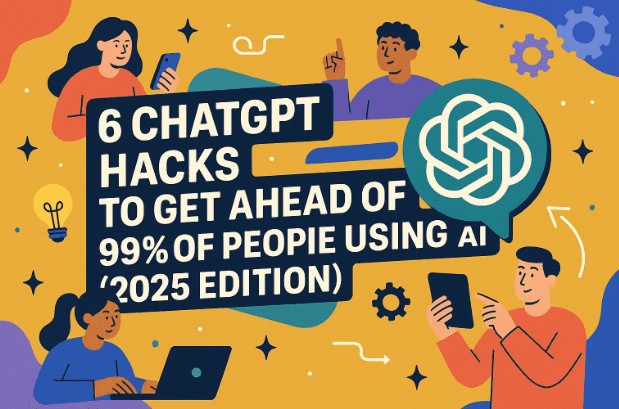
Artificial Intelligence isn’t just a buzzword anymore—it’s a superpower. The truth is, it’s surprisingly easy to get ahead of 99% of people simply by using AI the right way. Most people open ChatGPT, type a basic question, and stop there. But if you learn how to properly interact, instruct, and integrate AI tools into your workflow, you’ll multiply your speed, creativity, and decision-making overnight.
I’ve spent more than a decade working in technology—writing code, creating business solutions, and collaborating with industry leaders. Today, I use AI to accelerate all of it. In this article, we’ll explore six powerful ChatGPT hacks that will separate average users from power users.
And yes—Hack #6 is an absolute game-changer that most people don’t even know exists.
1. Why Using AI the Right Way Matters
Let’s start with a simple fact: AI won’t replace you—but the person using AI better than you will.
Most users barely scratch the surface of ChatGPT. They rely on free versions, ask vague questions, and expect magic. But the real power comes from giving context, clarity, and customization.
If you learn to set up ChatGPT with your preferences, tone, and goals, it becomes less like a chatbot and more like a personalized digital teammate.
Let’s begin with the very first (and simplest) upgrade that changes everything.
2. Hack #1 – Invest in ChatGPT Plus (and Why It’s Worth It)
Here’s the truth: if you’re serious about productivity, paying for ChatGPT Plus is one of the best investments you can make.
Most people hesitate because they see it as “just another subscription.” But think about it this way—ChatGPT Plus costs less than a single dinner out, and what it gives you back is hours of saved time, faster results, and smarter outputs.
Why the Plus Plan Matters
- You get access to GPT-4, which is smarter, more accurate, and better at complex reasoning.
- You can upload files, analyze data, and use integrated tools like image generation or document editing.
- You experience faster response times, even during peak hours.
Think of it as upgrading from a bicycle to a high-speed electric vehicle. Both move forward, but one saves enormous time.
Once you’re using ChatGPT Plus, the next step is setting it up to understand you deeply. That’s where Hack #2 comes in.











3. Hack #2 – Create a “Master Prompt” That Defines You
Now that you’ve got the powerful engine (GPT-4), it’s time to fine-tune it for you.
A Master Prompt is like your personal profile or résumé inside ChatGPT. It tells the AI who you are, what you do, how you like to communicate, and what your goals are—so you don’t need to repeat that context every time.
Let’s pause for a moment: imagine you’re working with a personal trainer. Before designing your fitness plan, the trainer asks about your diet, goals, schedule, and habits. That’s exactly what a Master Prompt does for ChatGPT—it helps it train on you.
How to Create a Master Prompt
- Ask ChatGPT to help you build one. Type this: “I want you to ask me detailed questions to create a personalized Master Prompt. The goal is to help you understand my work, goals, and communication style so you can respond accordingly.”
- ChatGPT will then ask questions such as:
- What’s your profession or area of focus?
- Who is your target audience or reader?
- What tone of communication do you prefer (formal, friendly, educational, persuasive)?
- What’s your primary goal (content creation, productivity, coding, marketing, etc.)?
- Answer these in detail. The more information you give, the smarter it becomes.
- Once you’ve answered everything, ask ChatGPT: “Now create my complete Master Prompt from all this information.”
- Save that result as a PDF file or copy it to your notes.
Next time you start a session, upload this file or paste your Master Prompt before working. ChatGPT will instantly recall your preferences and deliver more consistent, high-quality responses.
🧠 Pro Tip: You can even create different Master Prompts for different roles—like “Marketing Strategist,” “Technical Writer,” or “Startup Consultant.”
So far, we’ve taught ChatGPT who you are. Now let’s teach it how to think before responding.
4. Hack #3 – Build a System Prompt That Thinks Like You
While a Master Prompt tells ChatGPT who you are, a System Prompt tells it how to behave.
System Prompts are powerful meta-instructions that define ChatGPT’s internal mindset. You can use them to make it act as a teacher, editor, travel planner, developer, or researcher—without repeating those instructions each time.
Example 1: The Wrong Way
“Plan me a 5-day trip to Bali.”
This gives a generic itinerary that may not match your style or needs.
Example 2: The Right Way (System Prompt)
“You are my personal travel planner. I’m traveling from Dubai to Bali in December for 5 days on a modest budget. I enjoy beaches, cafés, and local culture. Recommend affordable hotels and hidden gems. Keep your suggestions practical and concise.”
Do you see the difference? The second prompt gives role, context, and instructions—resulting in a professional-quality travel plan.
Structure of a Good System Prompt
- Role: Who ChatGPT should act as (e.g., “You are a software consultant”).
- Context: What it needs to know about your task or goal.
- Instruction: What you want it to deliver and how (tone, format, constraints).
Once you understand this formula, you’ll never complain about “bad responses” again. ChatGPT doesn’t fail—prompts do.
5. Hack #4 – Use Canvas Mode to Edit and Iterate Seamlessly
We’ve all been there—you ask ChatGPT for something, it gives an almost perfect answer, but when you tweak your next prompt, the whole response changes completely.
That’s where Canvas comes in.
What Is Canvas Mode?
Canvas is like a built-in workspace or notepad inside ChatGPT. Instead of copying answers into Word or Google Docs, you can open them directly in a Canvas window and refine them there.
Here’s how it helps:
- You can ask ChatGPT to make specific edits (“Swap Day 3 and Day 1 activities in this itinerary”).
- You can chat directly with the document—tweaking paragraphs, shortening text, or checking grammar.
- All changes happen on the fly without losing context.
Example
Let’s say you’re editing a travel plan:
“Open the response in Canvas.”
Once the response opens in Canvas, you can type commands like:
“Swap Day 3 with Day 1 activities.”
The changes happen instantly.
This feature isn’t just for travel—it’s perfect for:
- Editing long articles or reports
- Rewriting paragraphs for clarity
- Performing quick grammar or tone adjustments
Canvas removes the endless copy-paste cycle and lets you collaborate with ChatGPT in real time.
So far, we’ve made ChatGPT smart and efficient. Now let’s make it private and secure.
6. Hack #5 – Control ChatGPT’s Memory and Private Chats
One underrated feature of ChatGPT is Memory—it allows the AI to remember things about you between sessions.
While this is powerful, there are times you want full privacy—for example, when preparing for a confidential project, job interview, or surprise event.
Thankfully, you have control.
How to Manage Memory Settings
- Click your profile name (bottom-left corner).
- Go to Settings → Personalization → Memory.
- You’ll see options for Saved Memories and Chat History.
You can either:
- Turn off Memory completely: ChatGPT forgets everything between sessions.
- Start a Temporary Chat: Keeps the memory feature enabled globally but disables saving for that specific conversation.
When to Use Temporary Chats
- Brainstorming new startup ideas
- Planning confidential business pitches
- Working on surprise gifts or personal projects
This ensures no digital trace of that chat remains once you close it.
🔐 Tip: Temporary chats are ideal when discussing sensitive data or clients.
Now, let’s move to the most powerful hack—one that transforms ChatGPT from a chat assistant into a complete digital command center.
7. Hack #6 – Connect ChatGPT to Your Apps (Email, Calendar, Files & More)
This final hack will blow your mind.
ChatGPT isn’t just a chatbot anymore—it’s becoming a central hub for your productivity. With its integration abilities (through official connectors), it can access your Google Drive, Gmail, Calendar, Box, or Slack, bringing everything into one place.
Imagine managing all your work from one interface—no tab-switching, no scattered apps.
What You Can Do
- Search emails in Gmail: “Find my latest invoice email from Stripe.”
- Check calendar events: “When is my meeting with David’s teacher?”
- Access files: “Summarize the document in my Drive called project-plan.docx.”
Example in Action
When you ask,
“When is my meeting with Ms. Davidson, my son’s teacher?”
ChatGPT instantly checks your Google Calendar and replies with the exact date, time, and location—without you ever opening the calendar app.
This feature saves hours every week and makes ChatGPT feel like your true executive assistant.
If your workflow involves multiple apps and projects, these integrations can declutter your digital life overnight.
8. Frequently Asked Questions (FAQs)
Q1. Is ChatGPT Plus really worth it for beginners?
Yes. Even if you’re new, GPT-4 gives cleaner answers, better reasoning, and new tools like file uploads and memory—making it ideal for learning and productivity.
Q2. What’s the difference between Master Prompt and System Prompt?
A Master Prompt defines who you are and what you need. A System Prompt defines how ChatGPT should behave and think before responding. Use both for best results.
Q3. How secure is Canvas mode?
Canvas is part of your ChatGPT session. It doesn’t share data externally—it’s just a better interface for editing your generated content.
Q4. Can I use connectors without ChatGPT Plus?
Some connectors (like Calendar or Drive) require Plus or enterprise access. Always enable them through official settings for safety.
Q5. What if I don’t want ChatGPT to store my information?
Use Temporary Chats or disable memory completely under Settings → Personalization → Memory.
9. Final Thoughts
We’ve covered a lot—from upgrading your plan to building smart prompts, editing in Canvas, securing chats, and integrating real apps.
So far, we’ve done a good job understanding that AI isn’t about replacing effort—it’s about amplifying your intelligence. Once you combine context (Master Prompt), structure (System Prompt), and productivity (Canvas + Integrations), you’ll truly operate in the top 1%.
Remember, you don’t need to master everything at once. Start small—create your Master Prompt today and experiment with Canvas tomorrow. Within a week, you’ll notice how much faster and sharper your workflow becomes.
AI is the greatest equalizer in history—but only for those who learn to use it right.
Disclaimer
This article is for educational purposes only. The methods and tools described here are based on publicly available ChatGPT features by OpenAI. Always respect privacy guidelines when using integrations or sharing sensitive data.
#ChatGPT #AIProductivity #AIPrompts #GPT4 #OpenAI #MasterPrompt #SystemPrompt #CanvasMode #ArtificialIntelligence #AIAutomation