The internet woke up recently to terrifying headlines claiming that 183 million Google accounts were hacked — a number large enough to make anyone panic. Social media buzzed, inboxes filled with warnings, and websites like Forbes splashed dramatic titles about a “massive Gmail data breach.”
But here’s the truth — no, Google was not hacked.
Yes, millions of credentials were leaked, but they didn’t come from Google’s servers. The real story is far more complex, and the real danger lies somewhere else entirely — in infostealer malware, fake “hacks,” and careless user behavior.
So in this article, let’s break everything down in detail. We’ll separate myth from fact, explore how data leaks actually happen, how hackers use simple tricks to steal passwords, and what practical steps you can take to keep your data secure.
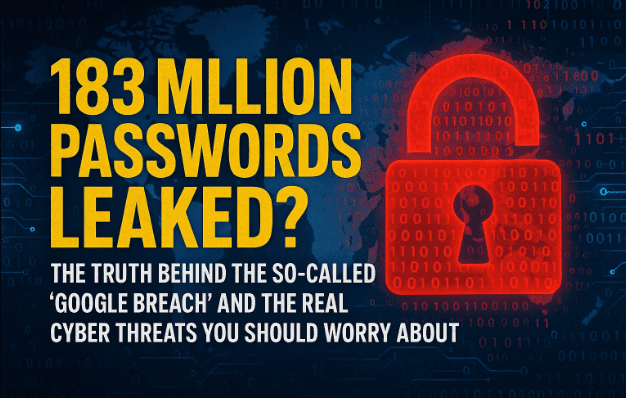
⚠️ The Viral Claim: “183 Million Gmail Accounts Leaked!”
A few days ago, several large websites claimed that Google suffered a major security breach affecting over 183 million Gmail accounts. The headlines were designed to cause panic — and they worked.
After all, 183 million users is nearly half the U.S. population. If true, it would be one of the largest hacks in history. But like many viral tech stories, this one mixed a small fact with a lot of exaggeration.
When cybersecurity experts looked deeper, they discovered that the so-called “Google breach” was nothing more than an aggregation of stolen credentials collected over many years — compiled from hundreds of unrelated leaks.
So, yes — 183 million accounts exist in that dataset. But they weren’t hacked from Google. They were stolen through malware infections, phishing, and third-party website breaches.
🔍 What Really Happened (And Why Google Wasn’t Hacked)
Let’s clear this up: Google’s servers remain secure. There’s no evidence that Gmail, YouTube, or Google Drive were breached.
Instead, cybersecurity researchers traced the data back to “infostealer malware dumps.”
These are massive archives of stolen login details collected from infected devices — not from Google’s systems.
In simple terms:
- Someone’s laptop or phone got infected by a password-stealing virus.
- That virus sent saved credentials (including Gmail logins) to a hacker’s server.
- Hackers later sold or shared those stolen logins in bulk.
- Someone merged those old leaks into one huge file — and called it a “Google breach.”
The result? A misleading headline that spreads panic and clicks but hides the real threat — the malware running silently on everyday computers.


💀 The Hidden Source of the Leak: Infostealer Databases
So what exactly are “infostealers”?
An infostealer is a type of malware designed to steal sensitive information — email credentials, credit cards, cookies, saved passwords, or tokens from browsers like Chrome or Edge.
Once infected, everything you type, save, or log in to may be silently recorded and uploaded to a hacker-controlled database.
Popular infostealers include:
- RedLine Stealer
- Lumma Stealer
- Vidar
- Raccoon Stealer
Hackers buy and sell these tools openly on forums and even on messaging platforms like Telegram. Some even rent them out for as little as $50–$100 per week.
Once the malware collects enough data, it sends it to a command and control (C2) server, where all stolen credentials are compiled — sometimes millions of them. Later, these dumps get combined and mislabeled as “Google,” “Netflix,” or “Facebook” leaks, depending on which domains appear most frequently.
🧠 Understanding How Credential Dumps Work
Let’s move to the next step — how these leaks actually appear online.
When you hear about “183 million leaked accounts,” it usually means a collection of credentials taken from multiple past hacks. These could include:
- Old gaming platforms
- Abandoned social media apps
- Small web forums
- Compromised corporate sites
Hackers merge these dumps into giant spreadsheets containing emails, usernames, passwords, and URLs.
Unfortunately, these files often include duplicates, invalid logins, or outdated data. Yet they still make great headlines — “biggest leak ever” — even if half the credentials no longer work.
So while the number is technically real, the threat depends on whether you’re reusing passwords.
🧩 How Hackers Actually Steal Passwords (With Real Examples)
It’s important to understand that data breaches aren’t the only way credentials get stolen. Most modern hacks happen through malware or social engineering.
Here’s how a typical attack unfolds:
- The lure: A user clicks on a suspicious email attachment, fake job offer PDF, or a cracked game download.
- The infection: A hidden
.exeor macro installs a small program — often disguised as something harmless. - The takeover: The malware quietly starts recording every keystroke, login, and session cookie.
- The upload: The stolen data is sent to the hacker’s remote server.
- The sale: These credentials are resold on underground forums or merged into public “breach” databases.
And it doesn’t stop there — some malware also activates webcams or screenshares, leading to extortion or blackmail attempts.
💻 Inside a Malware Attack: Remote Access Trojans Explained
Let’s move deeper into one of the most dangerous types of malware — the Remote Access Trojan (RAT).
A RAT allows hackers to remotely control a victim’s computer as if they were sitting in front of it.
It gives full access to:
- Files and folders
- Screenshots and webcams
- Saved credentials
- Browser sessions
- Even microphone input
Hackers use these tools to spy, steal, and sometimes extort users.
The most frightening part? Some RATs are as small as 1 MB, can disguise themselves inside compressed folders, and look like legitimate software.
🧪 Example: How It Works
Imagine a hacker sends a fake “Battlefield 6 Hack Tool.”
A gamer downloads it from a YouTube video or forum post.
The file appears harmless — small, neatly packaged, maybe even password-protected with “4545.”
Once opened, however, it executes a hidden script that connects to a hacker’s server. Within seconds, that device is compromised — its data stolen and webcam accessible.
That’s how millions of credentials end up in those so-called “Google” leaks.
🕸️ The YouTube “Ghost Network” Problem
One of the lesser-known but major problems today is what cybersecurity researchers call the YouTube Ghost Network.
It’s not supernatural — it’s a network of fake YouTube channels created solely to distribute malware disguised as software downloads.
Here’s how it works:
- Hackers upload tutorial videos for fake “game hacks,” “premium software,” or “cracked apps.”
- In the description, they include links to download “tools.”
- Those links lead to malicious ZIP or EXE files containing trojans or stealers.
Because these channels often have fake engagement, they appear legitimate — until thousands of users start getting infected.
These campaigns rely on curiosity and greed — the idea of getting something free. But in return, users unknowingly install software that steals everything from their browser cookies to Google login tokens.
🛡️ What Google Actually Said About the Breach
After panic spread across social media, Google publicly responded to clarify the situation.
Their statement read (paraphrased):
“Gmail defenses remain strong. We have found no evidence of an internal breach. The reports circulating online are based on info-stealer databases that collect stolen credentials from various unrelated sources.”
Google also reminded users to enable 2-Step Verification and Passkeys, which make stolen passwords useless without device authentication.
👉 You can learn more about official Google account security at:
https://myaccount.google.com/security
🔎 How to Check If Your Email Was Exposed
If you’re worried that your Gmail (or any email) might be part of a leak, you can easily check.
Visit the trusted site:
👉 https://haveibeenpwned.com
Enter your email address — the site will list any known data breaches involving that email.
If your address appears, don’t panic. Instead:
- Change your passwords immediately.
- Avoid reusing the same password across sites.
- Enable two-factor authentication wherever possible.
- Consider using a password manager to generate strong, unique passwords.
🧠 Five Crucial Steps to Protect Your Account
So far, we’ve understood where these leaks come from. Now, let’s focus on how to protect yourself.
You don’t need to be a cybersecurity expert — just consistent with good habits.
🟢 1. Use a Password Manager
A password manager generates and stores long, unique passwords for every account. Even if one site is breached, the others remain safe.
Free and reliable options include Bitwarden and KeePass.
🟢 2. Turn On Two-Factor Authentication (2FA)
Always enable 2FA or use Google Passkeys.
Even if your password leaks, hackers can’t log in without your phone or fingerprint.
🟢 3. Avoid Downloading Random Files
Don’t trust “cheat tools,” “cracked software,” or unofficial installers — especially from YouTube or Telegram.
🟢 4. Regularly Scan for Malware
Use reputable antivirus tools and occasionally scan with VirusTotal.com for suspicious files.
🟢 5. Keep Your Software Updated
Operating system and browser updates often patch known security holes. Delaying updates gives hackers a window of opportunity.
❓ FAQs — Common Questions About Data Leaks
Q1: Was Google actually hacked?
No. The leaked data came from previously stolen credentials compiled from multiple sources, not from Google’s servers.
Q2: Are Gmail passwords safe?
Yes, if you’ve enabled two-factor authentication and use a unique password. Google’s internal systems remain secure.
Q3: What is an “info-stealer”?
It’s a type of malware that collects passwords and browser data from infected devices, sending it to hackers’ servers.
Q4: Can I get hacked just by clicking a link?
Sometimes — if the link downloads or executes a malicious file. Always hover to check URLs before clicking.
Q5: Should I trust “Have I Been Pwned”?
Yes. It’s an industry-trusted project created by security researcher Troy Hunt, used by major companies to monitor data exposure.
🌍 Final Thoughts: The Real Cyber Threats in 2025
The real story behind the “183 million Gmail breach” isn’t about Google’s security — it’s about ours.
Hackers don’t need to break into massive companies anymore; they just infect individual users and collect passwords one by one. Over time, those small thefts create massive databases that get sold, reshared, and sensationalized.
The best defense isn’t fear — it’s awareness and good habits.
Update your devices, use a password manager, enable 2FA, and never download software from unverified sources.
In the end, cybersecurity isn’t about being 100% safe — it’s about being a harder target than the next person. Stay cautious, stay updated, and stay smart.
⚠️ Disclaimer
This article is for educational and informational purposes only. The malware demonstrations and tools discussed are explained purely to help readers understand digital security concepts. Do not attempt to download or execute any malware or hacking software. Always use sandboxed environments for security research and follow cyber laws in your country.
#GoogleBreach #GmailSecurity #DataLeak #CyberSecurity #PasswordManager #2FA #Malware #Phishing #OnlineSafety #TechAwareness