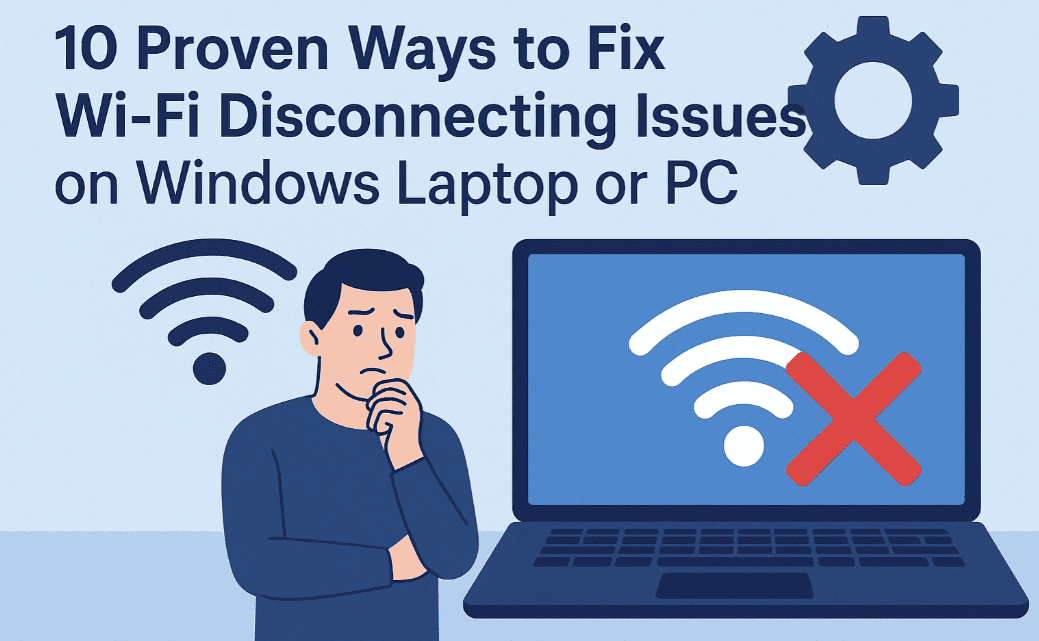
Is your Wi-Fi connection on your Windows laptop or PC constantly dropping? You’re not alone. Many users face this annoying issue where Wi-Fi keeps disconnecting unexpectedly. This article covers 10 detailed solutions to help you resolve this issue permanently.
🛠️ Method 1: Forget and Reconnect to Wi-Fi Network
- Right-click on the connected Wi-Fi icon in your system tray.
- Click on “Forget” to remove the current connection.
- Wait a few seconds, then click the Wi-Fi network name again.
- Enter your Wi-Fi password and reconnect.
- After connecting, click on “Properties”.
- Change the Network Profile from “Public” to “Private”.
This small setting can fix random disconnections in some cases.
🛠️ Method 2: Restart WLAN AutoConfig Service
- Press
Windows + S, type Services, and open it. - Scroll down and find WLAN AutoConfig.
- Right-click > Properties.
- Ensure Startup type is set to “Automatic”.
- If the service is running, click Stop, wait a few seconds, then click Start again.
- Click Apply and then OK.
This ensures the essential Wi-Fi service is always active.
🛠️ Method 3: Change DNS Settings
- Go to Settings > Network & Internet.
- Click on “Change adapter options.”
- Right-click on your Wi-Fi connection > Properties.
- Select Internet Protocol Version 4 (TCP/IPv4) > Properties.
- Choose “Use the following DNS server addresses”.
- Preferred:
8.8.8.8 - Alternate:
8.8.4.4(Google DNS)
- Preferred:
- Tick “Validate settings upon exit” and click OK.
DNS issues can often lead to unstable connections.
🛠️ Method 4: Reset Network Using Command Prompt
- Search for cmd, right-click, and choose Run as administrator.
- Execute the following commands one by one:
netsh winsock reset netsh int ip reset resetlog.txt - Restart your PC.
This will reset all network configurations and clear any corrupt network cache.
🛠️ Method 5: Adjust Wireless Adapter Power Settings
- Open Control Panel > Power Options.
- Click on Change plan settings next to your selected plan.
- Click on Change advanced power settings.
- Expand Wireless Adapter Settings > Power Saving Mode.
- Set it to Maximum Performance for both Battery and Plugged in.
- Click Apply > OK.
This prevents Windows from reducing Wi-Fi power to save battery.
🛠️ Method 6: Network Reset
- Go to Settings > Network & Internet.
- Scroll down and click Network Reset.
- Click Reset now.
Restart your PC when prompted. Your Wi-Fi will reset to default, so reconnect to your network afterward.
🛠️ Method 7: Change Wi-Fi Adapter Power Management
- Right-click on Start > Device Manager.
- Expand Network adapters.
- Right-click on your Wi-Fi adapter > Properties.
- Go to the Power Management tab.
- Uncheck: “Allow the computer to turn off this device to save power.”
- Click OK to save.
This ensures your device doesn’t disable Wi-Fi to conserve energy.
🛠️ Method 8: Update Wi-Fi Driver Automatically
- Open Device Manager.
- Right-click on your Wi-Fi adapter > Update Driver.
- Choose Search automatically for updated driver software.
Windows will check and install the latest driver automatically if available.
🛠️ Method 9: Roll Back or Reinstall Older Driver Version
- Again, right-click the Wi-Fi adapter > Update Driver.
- Click Browse my computer for drivers.
- Select Let me pick from a list of available drivers.
- Choose a previous version and click Next.
This can resolve issues caused by recent driver updates.
🛠️ Method 10: Uninstall and Reinstall the Wi-Fi Driver
- In Device Manager, right-click on your Wi-Fi adapter > Uninstall device.
- Confirm uninstallation.
- Restart your PC.
- Windows will auto-install the best compatible driver on boot.
Alternatively, visit your laptop/PC manufacturer’s website to download and install the latest Wi-Fi driver manually.




✅ Summary of All Fixes
| Method | Description |
|---|---|
| 1 | Forget and reconnect to Wi-Fi |
| 2 | Restart WLAN AutoConfig Service |
| 3 | Change DNS settings |
| 4 | Reset network settings via CMD |
| 5 | Modify wireless adapter power saving |
| 6 | Perform a full network reset |
| 7 | Disable Wi-Fi power management |
| 8 | Auto-update Wi-Fi drivers |
| 9 | Use previous stable driver |
| 10 | Uninstall and reinstall Wi-Fi driver |
❓FAQs
Q1: What if my Wi-Fi still disconnects after all these fixes?
You may be facing a hardware issue. Try connecting another device to the same Wi-Fi to verify.
Q2: Can antivirus or firewall cause this issue?
Yes, temporarily disable any third-party security software to check.
Q3: Is using Google DNS safe?
Absolutely. 8.8.8.8 and 8.8.4.4 are public DNS servers by Google and are secure for general use.
🔗 Recommended Wi-Fi Range Extenders (Affiliate Links)
✨ Support the blog by purchasing through these trusted picks. No promotions—just honest recommendations!
🅰️ Best Single Band Wi-Fi Range Extender
🔹 TP-Link TL-WA850RE – Budget King for small spaces
👉 Buy on Amazon
🅱️ Best Dual Band Wi-Fi Range Extender (Entry Level)
🔹 TP-Link AC750 – Ideal for 2BHK homes
👉 Buy on Amazon
🅱️ Best Dual Band Wi-Fi Range Extender (High Speed)
🔹 TP-Link AC1200 (RE305) – Great for gaming and 4K streaming
👉 Buy on Amazon
⚠️ Disclaimer:
These methods are intended for Windows 10/11 users and assume that your PC’s network hardware is functioning correctly. If none of the above solutions work, consult with a technician or check for motherboard/adapter issues.
Tags:
wifi disconnecting windows fix, wifi keeps dropping, laptop wifi issue, windows network troubleshoot, wifi reset windows 10, dns fix wifi disconnect, wlan autoconfig fix, device manager wifi driver, manual wifi driver install, network reset windows
Hashtags:
#WiFiDisconnect #WindowsFix #NetworkReset #WiFiDriver #WindowsTroubleshoot #LaptopWiFiIssue #WiFiNotWorking #WLANAutoConfig #Windows10 #Windows11