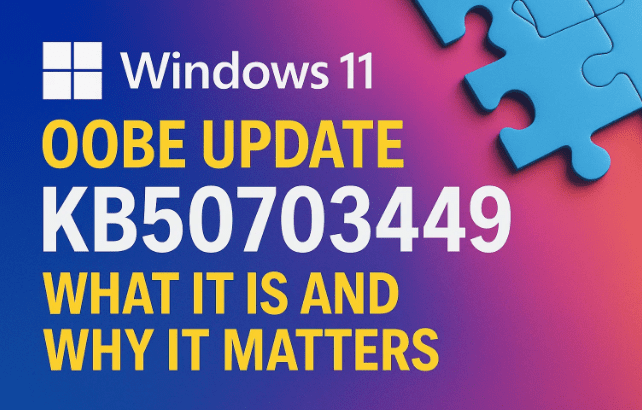
Microsoft continues refining how Windows 11 behaves during its installation and first boot process. In late 2025, the company introduced a new OOBE (Out-of-Box Experience) update — officially known as KB5070349 — designed to make sure that fresh Windows 11 installs (versions 24H2 and 25H2) start life with all the latest patches and drivers, right from day one.
At first glance, this might sound like just another background update. But this change quietly alters how future Windows installations work — particularly for IT professionals, system builders, and even home users who prefer clean installs.
So in this article, we’ll explore what the OOBE update does, how it works, why it’s important, and what potential pros and cons it introduces.
Let’s begin with the basics.
1️⃣ What Is the OOBE in Windows?
Before we go into the details of this new update, let’s make sure we understand what OOBE means.
OOBE stands for Out-Of-Box Experience.
It’s the setup process that runs right after Windows finishes installing — the part where you choose your language, sign in with (or skip) a Microsoft account, connect to Wi-Fi, set privacy preferences, and name your PC.
Essentially, OOBE is that “first-boot wizard” that welcomes you to Windows.
Historically, once the OOBE setup completed, you would land on your desktop — but your system might still lack certain critical fixes or hardware drivers until you ran Windows Update manually. Microsoft now wants to eliminate that delay completely.
2️⃣ Understanding the New KB5070349 Update
So far, we’ve got a good idea of what OOBE does. Now let’s see what KB5070349 brings to the table.
📦 What KB5070349 Is
According to Microsoft’s documentation, KB5070349 is a dedicated OOBE update aimed at enhancing the installation experience for:
- Windows 11 version 24H2
- Windows 11 version 25H2
- Windows Server 2025
The update is not something you’ll see under “Windows Update” in Settings. It’s not like your regular Patch Tuesday or cumulative update.
Instead, it’s applied only during a fresh or clean installation of these versions.
That means if you’re upgrading an existing Windows 11 PC, you won’t receive this patch separately — it activates automatically for new installations only.
3️⃣ Why Microsoft Released This Update
Let’s pause for a moment and understand the motivation behind this.
When you install Windows 11 from an ISO or bootable USB, you’re usually using installation media that was built weeks or even months ago. During that time, Microsoft may have released dozens of bug fixes, zero-day patches, or updated drivers.
Without this update, your freshly installed system might boot with outdated security components — leaving a small but real risk window before your first Windows Update completes.
To solve this, KB5070349 ensures your PC gets the latest fixes immediately after the OOBE process begins, even before you reach the desktop.
Microsoft explains it like this:
“This update enhances the installation phase that runs right after Windows setup completes. It ensures that critical components like drivers and zero-day patches are downloaded and applied automatically as soon as your PC connects to the internet.”
In simpler terms:
From now on, a clean Windows 11 installation will self-update itself during setup, making sure you start with the newest possible build.
4️⃣ How the OOBE Update Works
Now let’s look a little deeper into the technical flow.
During a clean install:
- You boot from Windows 11 installation media and complete the basic setup.
- As soon as Windows enters the OOBE phase (the language, Wi-Fi, and account setup screens), the system connects to Microsoft’s update servers.
- If OOBE updates are available — like KB5070349 — they are downloaded and applied in the background.
- Windows may also fetch newer drivers or zero-day patches relevant to your system’s hardware.
This all happens automatically, requiring no manual steps from the user.
According to Microsoft, this process ensures that by the time you reach your desktop for the first time, you’re already running a fully up-to-date and stable build — instead of spending hours fetching updates afterward.
5️⃣ Who Will Receive KB5070349
It’s important to note that this update only applies to new installations of:
- Windows 11 24H2
- Windows 11 25H2
- Windows Server 2025
If you already have Windows installed and regularly updated, you won’t see this patch in your update history. It is exclusive to the OOBE update phase — which means you’ll only encounter it when setting up Windows from scratch on a clean disk.
So if you reinstall Windows 11 tomorrow using the latest ISO and connect to Wi-Fi during setup, KB5070349 will be silently downloaded and applied before the installation finishes.
6️⃣ Is the Update Mandatory?
Yes — and this is a key point.
Microsoft calls this a “mandatory OOBE update.”
That means whenever your system reaches the OOBE stage and connects to the internet, the update will be automatically installed before you can complete the setup.
This ensures uniformity and reliability across all devices starting Windows for the first time.
However, depending on your perspective, this can be either a blessing or a frustration.
Let’s discuss both sides.
7️⃣ The Good Side — Why It’s Beneficial
Let’s move to the positives first, because this update does solve several long-standing installation issues.
✅ 1. Better Security from Day One
Fresh installs will immediately receive zero-day patches, driver updates, and security fixes that would otherwise take hours (or sometimes days) to apply. This greatly reduces your system’s exposure during the initial hours of use.
✅ 2. Improved Hardware Compatibility
By pulling updated drivers during setup, Windows 11 can avoid device-specific issues — like missing network drivers or display errors — that often plague older installation media.
✅ 3. Reduced Post-Install Work
Traditionally, the first thing you had to do after installing Windows was to run Windows Update multiple times. Now, much of that process happens automatically during setup, saving time and bandwidth later.
✅ 4. Fewer Setup Errors for New PCs
For OEMs or IT technicians deploying multiple systems, this change ensures every machine starts on the same baseline — no more dealing with slightly outdated installation images.
8️⃣ The Concerns — Why Some Users Dislike It
So far we’ve seen the benefits, but it’s also fair to look at the drawbacks.
⚠️ 1. Forced Internet Dependency
Because the OOBE update installs as soon as the system goes online, users who prefer offline setups or local-only installations might find this inconvenient. If you connect to Wi-Fi even briefly, the update will trigger automatically.
⚠️ 2. No Way to Skip It
There’s currently no setting or command to bypass KB5070349. For advanced users who want total control over their installation sequence, this may feel restrictive.
⚠️ 3. Potential Setup Delays
Since updates are fetched during installation, the total setup time could increase depending on your connection speed or update size.
⚠️ 4. Stability Risks from Day-One Patches
While Microsoft’s intention is to improve reliability, freshly deployed fixes sometimes introduce new bugs — meaning you could end up with issues that weren’t present on the original ISO.
In short, it’s a trade-off between freshness and control.
9️⃣ Will This Affect Existing Systems?
If your PC already runs Windows 11 24H2 or any earlier version, you won’t see KB5070349 in Windows Update.
This is strictly an installation-phase update. Once your system is running and patched through regular Windows Update, this OOBE update no longer applies to you.
It also doesn’t change your future cumulative update process — those will continue as usual.
🔧 10️⃣ How to Check If It Was Applied
If you’ve recently done a clean install of Windows 11 24H2 or 25H2, you might be curious whether this OOBE patch was installed automatically.
To check:
- Open Settings → Windows Update → Update History.
- Scroll to “Other Updates” or “Servicing Stack Updates.”
- If OOBE updates are logged, you may see KB5070349 listed there.
However, since this patch runs during setup, not every system will display it in the usual update history. You can also use the Command Prompt:
wmic qfe | find "KB5070349"
If it returns a result, that means the patch was applied during installation.
🔄 11️⃣ What Happens If a Newer Version Is Available
One subtle but important detail is that Microsoft says:
“If a newer Windows version is available during setup, it will also be updated automatically.”
That means, in some cases, your fresh installation might upgrade itself to a newer build mid-setup.
For example, if you install Windows 11 24H2 today but 25H2 has already been released, your setup could automatically fetch that newer version through this mechanism.
This is part of Microsoft’s broader effort to keep installation media evergreen, ensuring users always start with the most current build.
🧠 12️⃣ Impact on System Builders and IT Teams
Let’s move on to how this change affects professionals who frequently deploy Windows systems.
For system builders and enterprise admins, KB5070349 actually simplifies long-term maintenance. It means fewer post-install scripts or manual patching steps.
However, organizations that depend on custom offline images or controlled rollout environments may need to adjust their workflow. They might have to block OOBE internet access until system configuration completes, to avoid unintended updates.
For OEM partners, this update ensures every device shipped from the factory is pre-patched with the latest critical updates — a key improvement for security compliance.
💡 13️⃣ What This Means for Ordinary Users
For most home users, this update is mostly invisible — but helpful.
If you buy a new laptop, or reinstall Windows 11 from scratch, your system will now automatically download:
- The latest drivers for your hardware,
- Any security patches released after the ISO build date, and
- Essential stability fixes for your specific Windows version.
You’ll notice that once you reach the desktop, you’ll have fewer pending updates waiting in the queue — and your system will likely perform better out of the box.
🧩 14️⃣ Should You Worry About This Update?
The short answer: probably not.
While some users may dislike the loss of control, Microsoft’s goal here is to ensure consistency and reduce risks for everyone.
If you’re an advanced user who prefers to keep your PC offline during installation (perhaps for privacy or local account reasons), you can simply avoid connecting to Wi-Fi during OOBE.
The update only triggers once your PC goes online. After you finish setup, you can manually check for updates later.
💬 Frequently Asked Questions (FAQ)
Q1. What does OOBE stand for in Windows?
It means “Out-Of-Box Experience” — the setup stage that runs after Windows finishes installing.
Q2. What is KB5070349 exactly?
It’s a mandatory update for Windows 11 24H2, 25H2, and Windows Server 2025 that applies during the first-boot setup to install the latest patches and drivers automatically.
Q3. Will I see this update in my existing Windows installation?
No. It only applies to fresh installations, not systems already running and updated through Windows Update.
Q4. Can I skip or disable it?
Not directly. The update installs automatically once your PC connects to the internet during setup. Staying offline is the only way to avoid it.
Q5. Does it increase installation time?
It can slightly extend setup time since updates are downloaded before you reach the desktop. The trade-off is fewer updates afterward.
⚠️ Disclaimer
This article is based on official Microsoft documentation and verified rollout behavior of Windows 11 24H2/25H2 OOBE updates as of late 2025.
Microsoft may modify this process in future cumulative or feature updates.
Always create backups and ensure you’re using official installation media from Microsoft’s download page.
🧩 Final Thoughts
With KB5070349, Microsoft has quietly changed how Windows 11 installations behave — and in many ways, it’s a step toward smoother, safer setups.
From security patches to driver updates, everything now happens automatically as soon as the PC connects to the internet for the first time. While that adds a layer of convenience for most users, it also means the traditional “fully offline setup” era is slowly fading away.
For everyday users, the takeaway is simple:
If you reinstall Windows 11 or buy a new PC with version 24H2 or 25H2, your system will automatically start life fully updated and secure — no manual patching required.
For power users and IT admins, it’s worth knowing how this background mechanism works, so you can manage it appropriately in controlled environments.
Either way, the OOBE experience just got a quiet but significant upgrade.
#Windows11 #OOBE #KB5070349 #WindowsUpdate #Microsoft #WindowsSetup #24H2 #25H2 #TechNews #dtptips