Introduction — From War Machines to Household Helpers
By late 2025, robots stopped being military experiments and started becoming everyday appliances.
Just months after footage of robot dogs sprinting through combat drills, humanoid machines began serving coffee, cleaning floors, greeting shoppers, and even folding laundry.
This isn’t science fiction anymore — it’s the first wave of embodied AI, where artificial intelligence steps out of screens and into physical form.
While Part 1 of this series examined warfare, this chapter explores how those same technologies are transforming homes, factories, and cities.
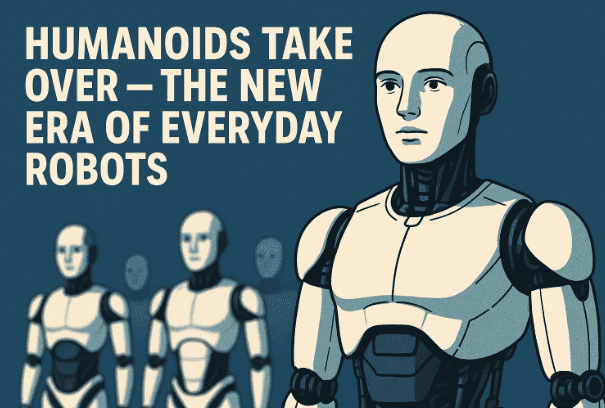
The Humanoid Boom — Why 2025 Changed Everything
Humanoid robotics used to be dominated by university labs like MIT or Tokyo’s Waseda University. Now, start-ups and consumer brands are leading.
Key breakthroughs drove this shift:
| Innovation | Impact on 2025 Market |
|---|---|
| Direct-drive actuators | Smoother movement & less maintenance |
| Solid-state batteries | Longer runtime, safer operation |
| Large Language Models (LLMs) | Conversational & adaptive behavior |
| Low-cost manufacturing in China | Mass production under $10 000 per unit |
| Reinforcement learning simulation | Robots train thousands of moves virtually before testing |
These advances converged at a new price threshold — robots now cost less than a used car.
That single economic fact flipped humanoids from curiosity to commodity.
Tesla Optimus vs Figure AI — The Battle for the Smartest Body
So far, Tesla and Figure AI represent two opposite approaches to humanoid design.
⚙️ Tesla Optimus
Elon Musk’s team has spent three years evolving the Optimus prototype from a stiff walker to a fully functional biped that can sort parts, carry boxes, and balance on one leg.
It runs Tesla’s self-developed AI stack originally built for Autopilot, allowing it to recognize objects and navigate dynamically.
Specs Summary (2025 Prototype)
| Height | Weight | Payload | Battery Life | AI Platform | Price Estimate |
|---|---|---|---|---|---|
| 1.73 m | 70 kg | 20 kg | ≈ 8 h | Tesla Autopilot + Dojo Training | $20 000–30 000 (target) |
Optimus is being tested in Tesla factories to handle repetitive assembly tasks. Musk claims that by 2026 it will enter commercial production.
🧠 Figure AI
Founded by Brett Adcock, Figure AI took a software-first path. Their humanoid uses Helix AI, a multimodal system combining vision, language, and action.
After cutting ties with OpenAI to build its own in-house models, Figure pivoted toward full autonomy and precision.
| Height | Weight | Runtime | Payload | Distinctive Feature |
|---|---|---|---|---|
| 1.68 m | 60 kg | 5 h | 20 kg | Palm cameras + tactile fingers for fine grip |
Figure robots already work in BMW’s South Carolina plant, showing that real-world deployment is no longer a demo.
| Tesla Optimus | Figure 03 | |
|---|---|---|
| Design Goal | Industrial labor at scale | General-purpose autonomy |
| AI Brain | Dojo + vision network | Helix multimodal LLM |
| Interface | Voice & vision only | Conversational memory |
| Safety | Soft covers & torque control | Embedded touch sensors |
| Production Target | 100 000 units by 2030 | 12 000 units per year (Phase 1) |
Together, they represent two philosophies: hardware dominance vs software intelligence.






Unitree R1 — The $5 900 Robot That Shocked the World
When Unitree unveiled the R1 in mid-2025, the industry gasped. A full-size humanoid priced below $6 000 sounded impossible — yet it was real and orderable online.
Standing 1.65 m tall and weighing 25 kg, the R1 runs on 26 degrees of freedom, executing handstands, cartwheels, and voice-driven tasks.
Its open SDK allows developers to write custom programs in Python or C++.
| Specification | Details |
|---|---|
| Height | 1.65 m (5 ft 5 in) |
| Weight | 25 kg |
| Battery Life | ≈ 1 h |
| Control System | AI + remote override |
| Development Access | Full SDK + ROS |
| Price | $5 900 |
The R1 is not a toy; it’s a developer platform with industrial-grade motors and AI stability algorithms. Schools and research labs quickly adopted it for experimentation in balance control and object recognition.
Boston Dynamics Atlas — The Gold Standard of Movement
If Unitree democratized humanoids, Boston Dynamics’ Atlas still defines excellence.
Atlas uses reinforcement learning and NVIDIA Jetson Thor hardware to run thousands of micro-simulations per second.
Its new GR2 hands add seven degrees of freedom and a tactile thumb, enabling it to pick up tools or thread cables with precision.
| Capability | Details |
|---|---|
| Mobility | Runs, flips, climbs stairs, recovers from falls |
| Dexterity | Tactile sensors & camera in palm |
| AI Training | Reinforcement learning + Isaac Lab simulation |
| Battery | Swappable Li-ion pack |
| Use Cases | Construction aid, industrial inspection |
| Partnership | Hyundai integrating Atlas into EV factory lines |
Atlas isn’t cheap, but its engineering drives the entire industry’s learning curve.
Open-Source Revolution — Berkeley Light and OM1 OS
Not everyone can spend six figures on a robot.
That’s why the Berkeley Humanoid Light project was a breakthrough — a complete 3D-printable design for around $5 000.
It proved that serious AI robotics could be open to students and hobbyists.
- Printed in PLA with cycloidal gearboxes
- 22 joints driven by low-cost actuators
- Reinforcement learning transfers from simulation to hardware (“zero-shot”)
Meanwhile, former Google and Tesla engineers launched OpenMind OM1, an open-source operating system for robots — the “Android of humanoids.”
It lets any robot share skills via a secure decentralized protocol called Fabric, so knowledge from one machine can propagate globally.
| Platform | Type | Key Feature | Price | Goal |
|---|---|---|---|---|
| Berkeley Light | DIY robot | Full open hardware + RL scripts | ≈ $5 000 | Education & research |
| OpenMind OM1 | Robot OS | Hardware-agnostic AI stack | Free (MIT License) | Shared “hive-mind” learning |
These projects democratize robotics just as open-source Linux did for computing.
Emotional Androids and Care Bots
Humanoids aren’t only about steel and speed.
Companies like Forier and Ahead Form are pushing robots that look and react emotionally. Forier’s GR3 CareBot uses 55 degrees of freedom and 31 pressure sensors to simulate empathy through touch and facial response.
Ahead Form’s “Elf Series” focuses on micro-expressions using quiet brushless motors in the face.
| Model | Height | Sensors | Purpose |
|---|---|---|---|
| Forier GR3 | 1.65 m | Vision + Audio + Touch | Healthcare & elder care |
| Elf V1 | 1.5 m | 30 facial DOF | Human-robot interaction research |
This segment aims to replace loneliness with companionship — and raises tough questions about emotional authenticity.
Inside the Factories of the Future
Hyundai is the first major manufacturer to deploy humanoids alongside industrial arms. Its Georgia EV plant integrates Atlas units for material handling while spot robots handle inspection.
Chinese automakers like GAC and BYD are not far behind, building humanoid divisions to reduce labor shortages.
| Sector | Human Role | Robot Replacement | Timeline |
|---|---|---|---|
| Automotive | Assembly & inspection | Atlas, Darwin 01 | 2026 onward |
| Logistics | Loading, sorting | Darwin 01, Neo | 2025–27 |
| Healthcare | Patient support | GR3 CareBot | Pilot phase |
| Retail | Customer service | Sapphire & AI MOA | Active trials |
Factories of the future won’t replace humans entirely — they’ll redefine what human work means.
Ethics and Economy — Jobs, Safety, and Regulation
The humanoid revolution is a double-edged sword.
Analysts at Tsinghua University and MIT predict tens of millions of low-skill jobs could vanish worldwide by 2035, but also create new careers in robot maintenance, AI ethics, and automation management.
Governments are racing to set rules for safety, data privacy, and liability.
The EU’s AI Act classifies humanoids as “high-risk AI systems,” while China’s MIIT requires domestic licensing for export.
In the U.S., the NIST and OSHA are drafting the first robot-human workplace standards.
Key Ethical Questions
- Should robots have the right to make decisions affecting humans?
- How do we prevent emotional dependency on care bots?
- Who is liable if an AI assistant injures someone?
Until those answers exist, engineers and policymakers are walking a tightrope between progress and peril.
FAQ — Common Questions About Humanoid Robots
Q 1. Can humanoid robots replace human workers?
Only partially. They excel at repetitive or dangerous tasks but still struggle with complex decision-making and social context.
Q 2. How safe are these machines around people?
Most models include force-feedback and emergency-stop protocols, yet safety certification remains uneven globally.
Q 3. Will robots be affordable for homes?
Yes — prices are dropping fast. By 2027, experts expect entry-level home humanoids below $3 000.
Q 4. Do robots feel emotions?
Not really. They simulate emotional responses based on pattern recognition; there’s no subjective experience.
Q 5. Could a networked robot be hacked?
Absolutely. Cybersecurity is a major concern. OpenMind and Tesla
2025 builds now include encrypted on-device AI to limit risk.
Conclusion — The Human Era Is Now Shared
Humanoid robots are no longer a fantasy — they’re the next phase of our civilization’s evolution.
From Tesla’s assembly floors to living rooms in Shenzhen, intelligent machines are learning not just to move, but to coexist.
The question is no longer if robots will integrate into daily life — but how wisely we’ll guide them.
The 2025 humanoid wave proves that AI has found its body. What humanity does with it will define the next century.
⚠️ Disclaimer
All specifications and timelines in this article are based on publicly available information as of 2025. Technologies and performance claims remain subject to manufacturer updates and verification.
#HumanoidRobots #TeslaOptimus #FigureAI #Unitree #BostonDynamics #AIRevolution #Automation #OpenSourceRobotics #FutureOfWork #AIethics