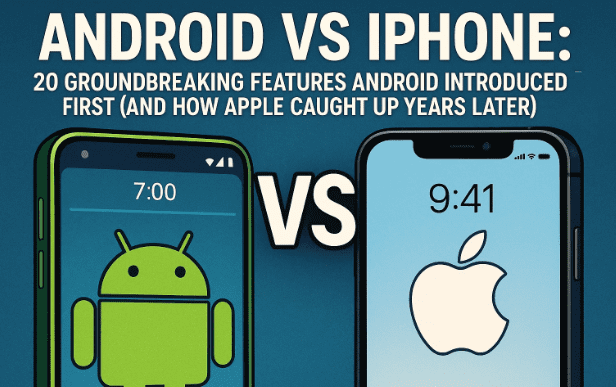
When people talk about smartphones, it often turns into a debate: Android vs iPhone.
Apple is known for its premium ecosystem and polished user experience, while Android is famous for innovation, customization, and pushing boundaries.
But did you know that many of today’s “modern iPhone features” were actually pioneered by Android years earlier?
In this article, we’ll explore the most important Android features that arrived first — some even five to ten years before Apple implemented them — and understand how Android changed the smartphone game forever.
📱 The Innovation Race Between Android and iPhone
When Android first launched in 2008, it was considered the “open” alternative to the iPhone’s tightly controlled ecosystem. Google’s vision was to make smartphones more flexible and user-driven — allowing customization, faster feature rollouts, and innovation across brands.
Apple, on the other hand, focused on refinement over experimentation. It often waited for features to mature before introducing them — but with a cleaner, more integrated design.
Still, there’s no denying this: Android set many trends first.
Let’s explore how Android led the way.
✂️ 1. Copy and Paste (Android: 2008 | iOS: 2009)
A simple yet essential feature — copy and paste — debuted on Android in September 2008, allowing users to easily select text, copy it, and paste it anywhere.
Apple users had to wait until March 2009 (with iOS 3.0) to get the same functionality.
💡 Fun fact: Early iPhone users often relied on third-party “copy utilities” before Apple’s official implementation.
🔔 2. Push Notifications (Android: 2008 | iOS: 2009)
Android introduced push notifications right from its early versions — delivering instant alerts for emails, messages, and updates.
Apple added this feature nearly a year later in June 2009, with iOS 3.0.
However, Android had already moved ahead with interactive notifications by 2012 — something iOS didn’t implement until 2014.




🔄 3. OTA (Over-The-Air) Updates (Android: 2008 | iOS: 2011)
Android devices were capable of over-the-air software updates since their launch — no need to connect to a PC.
Apple’s iPhone, meanwhile, required iTunes until 2011, when iOS 5 finally brought OTA updates.
Android had made wireless updating a norm three years earlier.
🧭 4. Notification Center (Android: 2008 | iOS: 2011)
Android’s pull-down notification bar revolutionized how we interact with alerts. It allowed quick access to messages, toggles, and app notifications — first appearing in 2008.
Apple didn’t introduce the Notification Center until October 2011 (iOS 5).
Even then, Android’s version remained more functional for years, allowing quick replies and actions.
🎥 5. Video Recording (Android: 2008 | iOS: 2009)
Believe it or not, the first Android phones could record video — something the original iPhone couldn’t do.
Apple enabled video recording only in June 2009 with the iPhone 3GS.
Today, iPhones are known for video quality — but Android had the capability first.
🧩 6. Home Screen Widgets (Android: 2008 | iOS: 2014)
From day one, Android offered home screen widgets — live, interactive components like weather, music controls, or calendars.
Apple added widgets much later, in iOS 8 (2014) — nearly six years later — and initially restricted them to the Notification Center instead of the home screen.
⌨️ 7. Predictive Typing (Android: 2008 | iOS: 2014)
Android’s predictive keyboard debuted in 2008, offering word suggestions while typing — a major productivity boost.
Apple didn’t bring QuickType (its predictive typing feature) until iOS 8 in 2014 — six years behind.
👆 8. Gesture Typing (Android: 2010 | iOS: 2014)
Android’s gesture typing (also known as “swipe typing”) appeared with Google Keyboard in 2010, allowing users to glide fingers over letters.
Apple added QuickPath Typing only in 2014 — again, four years later.
🖼️ 9. Wallpaper and Live Wallpapers (Android: 2008 | iOS: 2015)
Android let users set wallpapers since 2008 and introduced live wallpapers in 2010, adding animation and personalization.
Apple only allowed wallpaper customization in 2010 and live wallpapers in 2015 — five years after Android.
🎙️ 10. Voice Search (Android: 2008 | iOS: 2010)
Google launched Voice Search in 2008, long before Siri existed.
Apple introduced Siri in 2010, marketing it as revolutionary — but Android users were already voice-searching for two years.
🔋 11. Battery Saver Mode (Android: 2014 | iOS: 2015)
Android’s battery optimization feature rolled out with Android 5.0 Lollipop in 2014, allowing background process control and power conservation.
Apple followed a year later with Low Power Mode in iOS 9.
⚡ 12. Wireless Charging (Android: 2012 | iOS: 2017)
Wireless charging made its Android debut in 2012 with the Nexus 4, while Apple adopted it five years later in 2017 with the iPhone 8.
By then, many Android devices had already embraced the Qi wireless standard, offering faster charging speeds.
👆 13. Tap-to-Wake (Android: 2013 | iOS: 2017)
Android phones like the LG G2 introduced Tap to Wake in 2013 — a simple yet convenient feature to wake up the phone by tapping the screen.
Apple added it to iPhones in 2017 with the iPhone X.
💳 14. Mobile Payments (Android: 2011 | iOS: 2014)
Google Wallet launched in May 2011, marking the beginning of mobile NFC payments.
Apple Pay followed in October 2014, branding it as a breakthrough — but Android had pioneered it three years earlier.
📸 15. Dual Cameras and Optical Zoom (Android: 2011 | iOS: 2016)
Android introduced dual-camera setups in 2011, enhancing portrait photography and depth effects.
Apple adopted this concept in 2016 with the iPhone 7 Plus — including optical zoom, which Android devices like the Galaxy S4 Zoom (2013) already had.
🏠 16. Customizable Home Screens (Android: 2010 | iOS: 2022)
Android users have been rearranging, resizing, and customizing icons since 2010.
Apple’s home screen remained rigid until iOS 16 (2022) — twelve years later — when it finally allowed widget placement and theme options.
🎞️ 17. 4K Video Recording (Android: 2013 | iOS: 2015)
Samsung’s Galaxy Note 3 (2013) became the first smartphone to record in 4K resolution.
Apple brought 4K recording in 2015 with the iPhone 6s and 6s Plus.
🧠 Why Does Apple Take Longer to Introduce Features?
You might wonder — if Android already had these features, why does Apple take so long?
There are two main reasons:
- Optimization over speed
Apple prefers to wait until a feature can be deeply integrated into its ecosystem. For example, wireless charging on iPhone wasn’t the first — but it became smoother, faster, and safer once released. - Marketing and timing
Apple uses a “wait-and-see” strategy. It waits for trends to stabilize, then introduces a refined, high-quality version that feels new — even if Android had it for years.
When Apple introduces something, it markets it as “reimagined” or “the most advanced ever”, giving even existing ideas a fresh identity.
🔍 Feature Comparison Table
| Feature | Android Introduced | iPhone Introduced | Time Gap |
|---|---|---|---|
| Copy & Paste | 2008 | 2009 | 1 Year |
| Push Notifications | 2008 | 2009 | 1 Year |
| OTA Updates | 2008 | 2011 | 3 Years |
| Notification Center | 2008 | 2011 | 3 Years |
| Video Recording | 2008 | 2009 | 1 Year |
| Widgets | 2008 | 2014 | 6 Years |
| Predictive Typing | 2008 | 2014 | 6 Years |
| Gesture Typing | 2010 | 2014 | 4 Years |
| Wallpapers | 2008 | 2010 | 2 Years |
| Live Wallpapers | 2010 | 2015 | 5 Years |
| Voice Search | 2008 | 2010 | 2 Years |
| Battery Saver | 2014 | 2015 | 1 Year |
| Wireless Charging | 2012 | 2017 | 5 Years |
| Tap-to-Wake | 2013 | 2017 | 4 Years |
| Mobile Payments | 2011 | 2014 | 3 Years |
| Dual Camera | 2011 | 2016 | 5 Years |
| Optical Zoom | 2013 | 2016 | 3 Years |
| 4K Recording | 2013 | 2015 | 2 Years |
| Home Screen Customization | 2010 | 2022 | 12 Years |
❓ Frequently Asked Questions (FAQs)
Q1. Does Android always innovate faster than Apple?
Not always — but historically, Android has been quicker to experiment with new technologies like foldable screens, customizable UI, and AI-driven tools.
Q2. Why do Apple features feel more refined even if they come later?
Because Apple focuses on ecosystem-level integration and quality control. Each feature is tested across all devices for consistency before release.
Q3. Which platform is better for innovation today?
Android still leads in hardware diversity and feature flexibility, while iOS excels in stability and long-term software optimization.
🚀 Final Thoughts
From copy and paste to customizable home screens, Android has repeatedly proven itself as the innovation pioneer in the smartphone industry.
Apple, however, has mastered the art of refinement — waiting until features can be seamlessly woven into its ecosystem before presenting them as polished innovations.
In the end, both platforms push each other to improve — and users benefit from the competition.
So whether you’re on Team Android or Team iPhone, one thing’s clear:
Without Android’s early innovation, the smartphone world would look very different today.
⚠️ Disclaimer
This article is based on factual release timelines from Google and Apple’s official announcements. All comparisons are made for educational and informational purposes only.
For more information on Android’s development history, visit developer.android.com.
Tags
Android vs iPhone, Android features first, iOS comparison, mobile technology history, smartphone innovation, Android timeline, Apple vs Android, Android customization, Android vs iOS features
Hashtags
#Android #iPhone #TechHistory #MobileInnovation #AndroidVsApple #Smartphones #AndroidFeatures #iOS #Gadgets #Technology