If you’ve recently booted up your Windows 11 PC and noticed the Wi-Fi option is mysteriously missing from your settings or system tray, you’re not alone. This issue is surprisingly common and can be caused by anything from a driver glitch to disabled services. Fortunately, there are several ways to get your Wi-Fi back — and this article walks you through each method step by step.
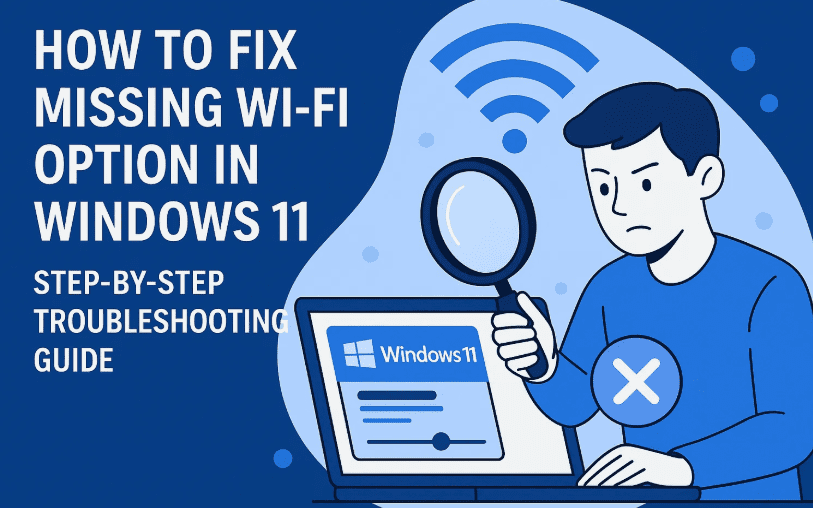
🔧 Why is the Wi-Fi Option Missing?
Before diving into the fixes, let’s understand what might be causing the issue:
- ❌ Missing or outdated Wi-Fi drivers
- ⚙️ Disabled or misconfigured services
- 💻 Network adapter issues
- 🔒 System settings or registry errors
✅ Method 1: Reset Advanced Internet Settings
This is a quick fix that often works if the issue is caused by corrupted settings.
Steps:
- Type
Control Panelin the Windows search bar and hit Enter. - Navigate to Network and Internet > Internet Options.
- In the Advanced tab, click Restore Advanced Settings.
- Click Apply, then OK.
- Check the taskbar to see if the Wi-Fi icon has returned.
✅ Method 2: Check WLAN-Related Services
Sometimes critical Wi-Fi services stop running. Here’s how to restart them:
- Open the Search bar and type
Services, then hit Enter. - In the Services window, switch to Extended view.
- Locate WLAN AutoConfig and right-click it.
- Set Startup type to Automatic.
- Click Start, then Apply and OK.
- Also check for WWAN AutoConfig and ensure it’s set to Automatic and is running.
✅ Method 3: Toggle the Wi-Fi Adapter
Sometimes, simply disabling and re-enabling the adapter fixes the problem.
- Go to Control Panel > Network and Internet > Network and Sharing Center.
- Click Change adapter settings on the left pane.
- Right-click your Wi-Fi adapter.
- If it’s enabled, choose Disable.
- Wait a few seconds, then Enable it again.
- Reboot your PC and check for the Wi-Fi option.
✅ Method 4: Update or Reinstall Wi-Fi Drivers
If the adapter is missing or acting up, you’ll need to update or reinstall the driver.
- Type
Device Managerin the search bar and press Enter. - Expand Network adapters.
- Right-click your Wi-Fi adapter (e.g., Intel, Qualcomm, Broadcom) and select Update driver.
- Choose Browse my computer for drivers > Let me pick from a list.
- Check Show compatible hardware and pick the first driver.
- Click Next and install.
- If nothing works:
- Disable and then re-enable the adapter.
- Uninstall the device and restart your PC (Windows will reinstall it).
- In Power Management, uncheck “Allow the computer to turn off this device to save power”.
✅ Method 5: Run Windows Troubleshooter
Windows has built-in tools that can fix network-related issues automatically.
- Go to Settings > System > Troubleshoot > Other troubleshooters.
- Find Network and Internet and click Run.
- Follow the prompts and apply any suggested fixes.
- Restart your PC if needed.
✅ Method 6: Reset Network Settings
This will remove all saved networks and reset networking components.
- Open Settings > Network & Internet > Advanced network settings.
- Scroll down and click Network reset.
- Click Reset Now, then confirm with Yes.
- Your PC will restart automatically.
✅ Method 7: Run Network Reset Commands
This is especially useful if there’s a socket API error or registry misconfiguration.
- Open Command Prompt as Administrator.
- Run these commands one at a time:
netsh winsock reset netsh int ip reset - Restart your computer.
✅ Method 8: Enable All Startup Services
Sometimes, startup services may have been disabled, affecting the Wi-Fi.

- Open System Configuration by typing
msconfig. - Under the General tab, select Normal Startup.
- Go to the Services tab:
- Either enable all or use “Enable All” after “Disable All”.
- Click Apply > OK and reboot your system.
✅ Method 9: Download Wi-Fi Driver from Manufacturer
If you’re missing the correct driver altogether:
- On another device with internet access, search for your PC’s model + Wi-Fi driver.
- E.g., “HP Pavilion x360 Wi-Fi Driver”.
- Go to the official manufacturer’s website (HP, Dell, Lenovo, etc.).
- Download the latest WLAN or Wi-Fi driver.
- Transfer the file using a USB drive.
- Install the driver on your affected PC and reboot.
🔗 Visit Macrium Reflect (if you’re creating system backups)
✅ Method 10: Reset Wi-Fi Adapter Using PowerShell
This advanced method resets the network configuration of the Wi-Fi adapter.
- Search for PowerShell, right-click and select Run as Administrator.
- Type:
netcfg -d -n:WiFi - Press Enter and restart your system.
❓ FAQ: Common Questions About Missing Wi-Fi Option
Q: What if my Wi-Fi adapter is not listed in Device Manager?
A: It may be physically disconnected or dead. Try checking BIOS settings or reinstalling the driver manually.
Q: Is this problem common after Windows Updates?
A: Yes, especially after major feature updates or driver changes. Always double-check services and driver integrity.
Q: Can a USB Wi-Fi dongle help as a temporary fix?
A: Absolutely. If your internal adapter fails, a plug-and-play USB Wi-Fi adapter is a good workaround.
📝 Final Thoughts
It can be frustrating when something as basic as Wi-Fi goes missing on your Windows 11 PC. But as you’ve seen, with a little patience and the right steps, it’s usually fixable. Whether it’s resetting services, updating drivers, or doing a deep reset via PowerShell, one of these methods is bound to get your connection back.
📌 Tags:
wifi missing windows 11, windows 11 wifi fix, windows wifi driver, wlan autoconfig fix, wifi adapter reset, troubleshoot windows wifi, no wifi in settings
📢 Hashtags:
#wifiFix #Windows11 #TechHelp #NetworkTroubleshooting #WiFiDriver #PCSupport
🛡️ Disclaimer:
This article is intended for educational and troubleshooting purposes. Always ensure you download drivers from official manufacturer websites. Making system-level changes carries risks, so proceed with caution and back up important data beforehand.