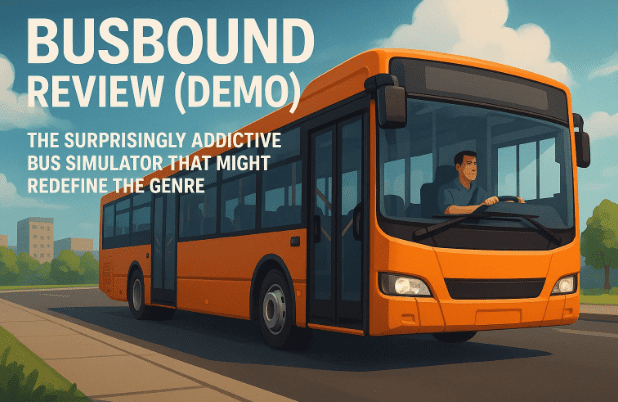
There are some games you never expect to enjoy — and for me, bus simulators were one of them. Yet somehow, BusBound, the upcoming driving sim from StillAlive Studios and Saber Interactive, managed to change that perception entirely.
Developed by the same studio known for earlier Bus Simulator titles (which ranged from decent to forgettable), BusBound feels like a fresh start — a reinvention rather than a rehash. I tried the demo during Steam Next Fest, expecting another slow, clunky sim. But within minutes, I realized something was different.
Let’s explore in detail why BusBound might just become the next sleeper hit in the world of simulation gaming — what makes it stand out, what still needs work, and why it’s winning over even those who never cared about virtual public transport.
The Developers and Their New Direction
Before we even start the engine, it’s important to recognize who is behind BusBound. The game is developed by StillAlive Studios, the same team behind Bus Simulator 18 and Bus Simulator 21. Those earlier releases were… fine, but not groundbreaking. They suffered from awkward AI, inconsistent physics, and a general sense of “functional but forgettable.”
This time, however, things feel very different. Saber Interactive, known for publishing titles like SnowRunner, World War Z, and MudRunner, is publishing BusBound. That’s a big deal. Saber has a track record of transforming niche simulation titles into critically respected franchises. Their influence is clearly visible here — everything feels more polished, purposeful, and player-focused.
First Impressions: Starting the Engine
The BusBound demo begins with a simple, charming cutscene: you’re hired by an up-and-coming bus company in the fictional city of Emberville. No over-the-top drama, no lengthy setup — just you, your bus, and your first route.
You’re immediately placed behind the wheel for a short tutorial, covering the basics:
- Starting the ignition
- Adjusting lights
- Opening doors
- Stopping accurately at bus stops
Unlike many sims that drown you in menus and tooltips, BusBound gets you moving quickly. The tutorial feels clean, concise, and natural, teaching through action rather than walls of text. It’s a small but meaningful improvement over its predecessors.
And then — you’re off, navigating the morning streets, passengers waiting at the next stop. That’s when the game’s biggest surprise starts to show itself.
Visuals and Presentation
At first glance, BusBound doesn’t reinvent the graphical wheel — but it does something far more important: it feels coherent and believable.
The city is rendered with subtle depth. Reflections on bus windows, ambient lighting during sunrise, and the way traffic headlights cut through early fog — it all looks carefully tuned rather than overdone.






Textures are clean, models are consistent, and nothing feels “copy-pasted.” Emberville’s design feels handcrafted, with varied neighborhoods, realistic signage, and diverse architecture.
The UI (user interface) deserves special mention — it’s modern, minimal, and extremely readable while driving. Having a clear interface makes a massive difference when navigating tight corners or switching routes.
Is it photorealistic? No. But it nails the most important visual principle in simulation: readability and atmosphere over raw fidelity.
Audio Design and Realism
If there’s one area where BusBound genuinely excels, it’s the sound design.
From the first moment you accelerate, the hum of the diesel engine, the gear whine, and the hiss of air brakes feel deeply satisfying. The developers even modeled retarder sounds (engine braking) — something only hardcore sim fans appreciate.
You can actually adjust the strength of engine braking on the fly. As you coast downhill, you hear that mechanical hum and the realistic change in tone. It’s pure bliss for anyone who loves the small details that separate arcade from authentic simulation.
Little touches like this — the squeak of suspension, the subtle difference between inside and outside audio when the driver’s window is open — make BusBound far more immersive than you’d expect from a “bus game.”
The City of Emberville: A Living Environment
Let’s move to the next big highlight — the world itself. Emberville isn’t just a static map; it’s alive.
Traffic density changes with time of day. Morning rush hour feels hectic, with honking cars, construction work, and impatient commuters. As the evening sets in, roads clear, and neon reflections dance off wet asphalt.
Pedestrians cross unpredictably, construction zones block lanes, garbage trucks reverse mid-street — creating dynamic obstacles that force you to think like a real driver.
While other bus sims often feel sterile, BusBound gives its city character. You feel like part of an evolving ecosystem rather than a robotic loop of stops.
Passenger Satisfaction System: How Driving Earns Respect
Here’s where BusBound really separates itself from traditional simulators.
Unlike older titles where you grind money through fares, there are no ticket sales here. Instead, your performance is scored through passenger satisfaction.
Your passengers react to:
- Smooth driving
- Accurate stopping
- Courtesy on the road (no honking or hard braking)
Drive recklessly — hit curbs, brake sharply, or honk excessively — and passenger happiness drops. But maintain steady control and politeness, and your reputation climbs with multipliers.
This system adds genuine tension to each route. You’re not just driving a bus — you’re shaping public trust. It rewards careful, mindful play rather than just reaching the next checkpoint.
Bus Handling and Physics
Bus handling can make or break a simulator, and here BusBound delivers.
The vehicles feel weighty but responsive. When turning corners, you can sense the inertia shift through the chassis. Suspension reacts believably when driving over bumps, and braking feels appropriately gradual.
Even though the demo includes only two mid-sized buses, the final game will feature double-deckers and articulated (“bendy”) buses. Navigating those through Emberville’s narrow streets will definitely test players’ control — but that’s part of the fun.
It’s not just about driving; it’s about mastering the rhythm of a heavy machine in motion.
Interactivity Inside the Cabin
Many simulators treat vehicle interiors as static. BusBound doesn’t. It’s full of small interactive features that enhance immersion:
- Roll down the driver’s window (which affects ambient sound).
- Toggle interior or dashboard lights for night driving.
- Adjust the speed limiter and engine brake strength.
- Check mirrors that actually work — yes, real reflections.
Every button, every knob serves a purpose. It’s a level of interactivity that invites you to behave like a real bus driver instead of a casual observer.
Route Customization and Progression System
Now let’s move to something that truly makes BusBound special — its route progression system.
You’re assigned to a district in Emberville and must earn reputation by completing routes with high passenger satisfaction. Once enough “likes” are earned, you unlock new stops and areas.
Here’s where it gets clever:
You can customize your own route. Open the city map, rearrange stop order, choose which roads to include, and even edit traffic flow patterns.
This makes route-building feel personalized and strategic, not just linear. You’re essentially designing your own public transport network, one successful district at a time.
🔄 Replayability and City Growth Mechanic
Your performance doesn’t just affect your company — it shapes the city itself.
As your bus service gains popularity, Emberville evolves dynamically. An empty lot might turn into a shopping plaza, or roads might expand due to improved public transport.
This subtle cause-and-effect system creates a sense of long-term impact. You’re not grinding for XP — you’re watching the world respond to your success.
Few simulators manage to make progress feel visible, and BusBound nails it beautifully.
⚙️ What Needs Improvement
No demo is perfect, and BusBound still has room to grow.
- AI Traffic: Occasionally unpredictable. Cars sometimes cut you off or brake too suddenly.
- Visual Fidelity: While clean, the graphics could use more variety in textures and lighting during rainy weather.
- Short Demo Limitation: The demo ends abruptly, leaving you wanting more — though that’s arguably a good sign.
These aren’t deal-breakers. They’re simply polish points that can be refined before full release.
❓ Frequently Asked Questions
Q1: Who is developing and publishing BusBound?
Developed by StillAlive Studios and published by Saber Interactive, two names with solid experience in simulation games.
Official site: https://www.saberinteractive.com
Q2: Is BusBound connected to the older Bus Simulator series?
Yes. It’s a spiritual successor built by the same studio but with redesigned systems, improved physics, and an entirely new city.
Q3: Will there be multiplayer or co-op?
The developers haven’t confirmed yet, but given community demand, a co-op or shared-world mode is highly possible in post-launch updates.
Q4: How realistic is the driving model compared to Bus Simulator 21?
It’s noticeably more refined. The weight distribution, braking physics, and turning feel more believable without being punishing.
Q5: When is BusBound releasing?
No official release date has been announced yet, but based on demo polish and Saber’s track record, early-to-mid 2026 seems likely.
🏁 Final Verdict: The Bus Simulator We Didn’t Know We Needed
For a genre often dismissed as “boring,” BusBound manages to be relaxing, challenging, and oddly satisfying all at once.
The combination of dynamic city life, deep customization, authentic handling, and attention to tiny mechanical details makes it more than just a driving game — it’s a living simulation of urban rhythm.
Sure, it’s still a niche title, but it might be the one that finally makes non-sim players stop and take notice. If the full version builds on what the demo has shown — with more buses, routes, and maybe even multiplayer — BusBound could easily become the definitive bus-driving simulator for years to come.
⚠️ Disclaimer
This article is based on impressions from the official Steam demo of BusBound during Steam Next Fest (October 2025). Game content and features may change in the final release. All trademarks are property of their respective owners.
Official Steam page: https://store.steampowered.com
#BusBound #BusSimulator #SimulationGames #DrivingSim #PCGaming #SaberInteractive #StillAliveStudios #SteamNextFest #GameReview #BusGames