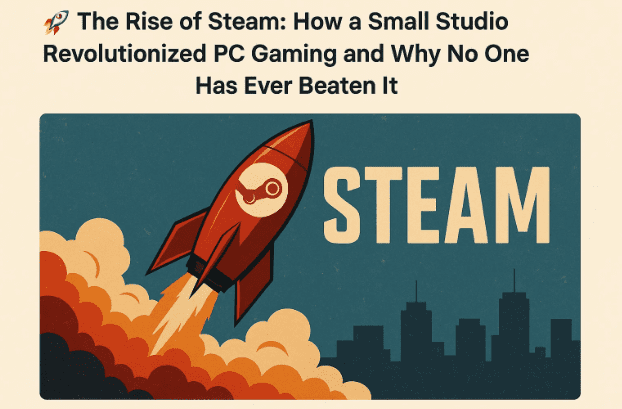
When we think of buying, downloading, or discussing PC games, one name instantly comes to mind — Steam. With over 120 million monthly active users, it’s more than just a digital store; it’s the heart of PC gaming itself.
What’s fascinating is that Steam isn’t owned by tech giants like Microsoft, Amazon, or Apple. Instead, it was built by a relatively small studio — Valve, a company that started not as a retailer but as a group of passionate game developers who simply wanted to fix how game patching worked.
So how did a team of just 300-odd people create something that trillion-dollar companies have repeatedly failed to compete with? To understand that, we need to go back to the messy early days of PC gaming.
1️⃣ The Chaotic Era of Early PC Gaming
Let’s begin from the start — the early 2000s, when PC gaming was already outpacing both music and film industries in revenue. Despite its growing popularity, the experience was anything but smooth.
At that time, buying and playing a game was a tedious ritual:
- You had to buy physical discs, often multiple CDs or DVDs.
- Installation was a gamble — sometimes the disc was scratched or incomplete.
- If the game had a bug or crash, you were on your own.
Developers had no mechanism to push updates, and users had to hunt for patches manually on sketchy websites. Many gamers remember downloading files from unreliable sources just to fix a simple bug — a process full of malware risks.
Worse yet, developers had no control once their game shipped. If a bug appeared, they had to release new patch discs in retail boxes. It was expensive, slow, and inefficient.
This was the environment that pushed two Microsoft engineers to do something radical.
2️⃣ How Two Microsoft Engineers Founded Valve
The founders of Valve, Gabe Newell and Mike Harrington, weren’t random enthusiasts — they were veteran software engineers at Microsoft.
Gabe Newell had spent over a decade helping build early versions of Windows and shaping Microsoft’s development ecosystem. But in 1996, he noticed something others didn’t: gaming was about to become more important than productivity software.
While Microsoft focused on Excel, Word, and Windows, Gabe saw the future in interactive entertainment. So, in 1996, he and Mike left Microsoft to start their own studio — Valve Corporation — entirely self-funded.












Their philosophy was simple yet revolutionary:
“Make games our way, fix what’s broken, and push the industry forward.”
And out of that vision came their debut masterpiece — Half-Life (1998).
3️⃣ Half-Life and the Problem of Piracy
When Half-Life released, it completely redefined the first-person shooter genre. Critics and gamers alike were stunned — the storytelling, the AI, and the physics were years ahead of their time.
Half-Life didn’t just make Valve famous; it made them the studio every gamer respected.
But success came with a nightmare: rampant piracy.
Even people who could afford the game preferred playing pirated versions. Why? Because cracked copies often came pre-patched, easier to install, and worked offline without issues.
Valve realized something profound — pirates weren’t the enemy; the problem was that the legitimate experience was worse.
In one of his famous interviews, Gabe Newell said:
“The easiest way to stop piracy isn’t anti-piracy. It’s by offering a service better than what pirates can provide.”
That insight would become the seed that grew into Steam.
4️⃣ The Birth of Steam: Fixing What Was Broken
Valve didn’t set out to build a digital store. Steam was never meant to sell games at first. It was designed to solve one technical pain point — how to automatically update games.
In 2003, they launched the first version of Steam with a simple mission:
“Make playing games easier, better, and frictionless.”
The initial goal was modest:
- Streamline game patching.
- Automatically push updates.
- Reduce the burden on developers.
- Keep players focused on gaming, not troubleshooting.
Steam’s launch on September 13, 2003, marked a pivotal moment in gaming history. Yet, it wasn’t a smooth start.
5️⃣ Steam’s Rocky Start and Ultimate Acceptance
When Steam first appeared, gamers hated it.
It was slow, buggy, and mandatory. To play games like Half-Life 2 or Counter-Strike: Source, you were forced to install Steam. Many saw it as intrusive “bloatware.” Forums were full of complaints.
But behind the scenes, something magical was happening.
Players began noticing that:
- Their games were auto-updating without effort.
- Cheat protection was improving through built-in systems like VAC (Valve Anti-Cheat).
- They were spending less time fixing games and more time playing.
Gradually, Steam stopped feeling like a burden and started feeling like a relief.
Valve continued listening to user feedback — that’s what made the difference. They kept improving the UI, download speeds, community features, and library organization. Steam evolved from a technical patching tool into a complete ecosystem for gamers.
By the mid-2000s, Steam became the default digital home for PC gaming.
6️⃣ Why Competitors Like Epic and Microsoft Failed
As Steam grew, major corporations tried to challenge it — and every single one failed.
Here’s a look at the main contenders and why they couldn’t dethrone Steam:
| Competitor | Year Launched | Strategy | Why It Failed |
|---|---|---|---|
| Epic Games Store | 2018 | Free games & exclusive titles | Focused only on sales, lacked features and community tools |
| Origin (EA) | 2011 | Exclusive EA titles | Buggy, poor user trust, limited ecosystem |
| Ubisoft Connect | 2009 | Integration with Ubisoft games | Forced usage, slow performance |
| Amazon Luna | 2020 | Cloud gaming platform | Limited library, subscription fatigue |
| Microsoft Store / Xbox App | 2012–present | Integrated with Windows | Confusing UI, poor DRM, technical glitches |
All these companies had massive funding and partnerships, but they missed one crucial element — community.
Steam wasn’t just a storefront; it was an ecosystem where every gamer’s identity, achievements, screenshots, and save files lived together in one place.
Valve didn’t chase profit first — they built for gamers, not investors.
7️⃣ Community, Trust, and Why Steam Still Wins
Let’s take a step back and ask — what truly makes Steam unbeatable?
It isn’t technology alone. It’s the relationship Steam has built with its users.
Over two decades, Steam has become:
- A social network for gamers (profiles, achievements, chat, screenshots).
- A modding hub (Steam Workshop).
- A marketplace (community market for skins and items).
- A review and discovery engine (user ratings and curator lists).
All your games, progress, mods, and memories stay linked to your account — permanently.
This creates something no other platform can replicate: familiarity and trust.
When gamers buy a title on Steam, they know it will:
- Work across systems, even after years.
- Receive automatic updates.
- Be refunded easily if something goes wrong.
- Support cloud saves and achievements.
Even during tough times — like competitors giving away free titles — users kept returning to Steam because it feels like home.
That emotional bond is priceless.
8️⃣ Steam Deck, SteamOS, and Valve’s Next Frontier
Now, Valve isn’t just sitting still. After dominating digital distribution, it’s moving to hardware and operating systems — areas that could reshape the gaming landscape again.
🔹 Steam Deck
In 2022, Valve launched the Steam Deck — a portable PC-console hybrid running SteamOS (a custom Linux-based operating system).
Official site: https://www.steamdeck.com
It was an instant success. Gamers loved that they could carry their entire Steam library anywhere. Competing devices like ASUS ROG Ally or Lenovo Legion Go followed, but none matched Steam Deck’s integration with the platform and consistent updates.
🔹 SteamOS and Microsoft’s Anxiety
Valve’s SteamOS project, available at https://store.steampowered.com/steamos, is a long-term vision to free gaming from Windows.
Microsoft’s Windows has never been optimized purely for gaming — it’s a general-purpose OS built for spreadsheets, not shooters. SteamOS, by contrast, is lean, open, and built for performance.
If Valve succeeds, it could reduce dependence on Windows, a scenario that even Microsoft reportedly fears.
9️⃣ Frequently Asked Questions
Q1: Why can’t other companies just copy Steam’s model?
Because what makes Steam strong isn’t just the store; it’s the ecosystem and trust built over 20 years. You can copy design, but not community history.
Q2: How does Valve make money if they don’t focus on investors?
Steam takes a revenue share (around 30%) from game sales and in-game transactions. That’s enough to keep Valve highly profitable without ads or data-driven monetization.
Q3: What about the Epic Games Store giving free games every week?
It’s a short-term tactic to attract users, not a sustainable ecosystem. Steam wins by providing stability, reliability, and community — not bribes.
Q4: Is Steam still innovating?
Absolutely. Between Steam Deck, Proton (for Linux compatibility), and SteamOS, Valve is continuously expanding how and where you can play your games.
Q5: What’s Valve’s employee culture like?
Valve famously operates without formal hierarchy. Employees choose what they work on. This freedom often leads to slow but highly innovative outcomes — like Steam and Steam Deck.
🏁 Conclusion: Why No One Can Beat Steam
Steam isn’t unbeatable because it was first — it’s unbeatable because it never stopped listening.
While competitors chased exclusives, ads, and investors, Valve focused on players. It built not just software but a culture of trust and continuity.
Steam evolved from a humble patch-delivery system into the epicenter of global gaming — a place where your memories, friends, and digital identity live together.
Even today, when others give away free games, gamers return to Steam because:
“It’s not just where we play. It’s where we belong.”
🔒 Disclaimer
This article is for educational and informational purposes only. All company names, trademarks, and logos mentioned are the property of their respective owners. Steam and Valve are trademarks of Valve Corporation. Always verify official sources for the latest updates.
#Steam #Valve #PCGaming #SteamDeck #SteamOS #GamingHistory #GabeNewell #EpicGames #WindowsGaming #GameDevelopment