For the past 25 years, Google’s business model has remained remarkably consistent. You type in a query, Google shows you a list of results, and advertisers bid to place their ads alongside those searches. This simple model has generated over $200 billion in annual ad revenue, making Google one of the most powerful companies on the planet.
But the next update is not just another tweak—it’s a fundamental shift. Google is fully integrating ads into its AI Mode, a system where searches are no longer about typing keywords but about having real conversations. This means businesses will need to adapt how they advertise, optimize, and engage if they want to stay visible.
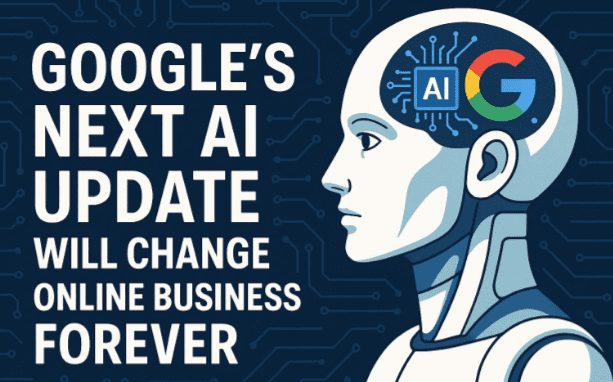
Let’s dive deep into what’s changing, why it matters, and how you can prepare for this new era.
1. 🔄 The Death of Google’s Old Business Model
For decades, advertisers lived in the world of keywords:
- “Best running shoes”
- “Pizza near me”
- “How to lose weight”
Advertisers paid Google when users clicked on links, and the system thrived.
But tools like ChatGPT changed user behavior. People no longer want to sift through ten websites; they want a direct conversation:
“I’m training for my first marathon, I over-pronate, and I need running shoes under $300. What’s the best choice?”
This kind of rich, contextual query contains far more intent than a short keyword. Google realized it had two options: fight this behavior or own it. They chose to own it, even if it cannibalizes their own ad revenue in the short term.
2. 🤖 Google’s AI Mode and the New Search Experience
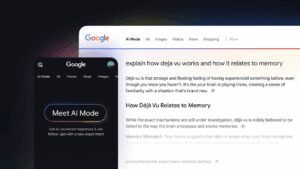
Google’s AI Mode has already been tested with over 100 million users. Unlike traditional search, AI Mode keeps users inside a conversational loop. Instead of clicking ten blue links, you get direct answers, clarifications, and follow-up suggestions.
For businesses, this means:
- Users spend longer inside Google’s ecosystem.
- Google collects richer intent signals about the user’s needs.
- Ads will be displayed in the middle of conversations, not just at the top of a results page.
In practice, that could mean a user discussing travel plans with AI might be shown ads for flights, hotels, and travel insurance—without ever visiting an external website.







3. 📊 From Keywords to Conversations
The biggest change is how ads are triggered.
Old Model: Keyword-Based
Advertisers bid on “running shoes.” Ads showed up when people typed those exact words.
New Model: Contextual Conversations
Now, Google’s AI evaluates entire conversations:
- Training for a marathon
- Needs help with pronation
- Budget of $300
Even if the words “running shoes” aren’t used, Google’s AI knows exactly what the person wants and shows the right ad.
This means keywords are no longer enough. Businesses must focus on intent, relevance, and context.
4. 🕵️ Brand Profiles and AI Context
Here’s where things get even more interesting.
Google’s AI doesn’t just look at what people type. It looks at:
- Your website quality (speed, design, copy).
- Your social media consistency.
- Your reviews and customer feedback.
- Your overall brand positioning.
Think of it as Google building a brand dossier. If your online presence is messy—outdated site, bad reviews, inconsistent messaging—you’re training the AI to work against you.
But if your brand is consistent, polished, and data-rich, the AI will favor you in showing ads to high-quality prospects.
Google calls this “feed hygiene”:
- Garbage in = garbage out.
- Rich, updated product data = better ad placements.
For example, if someone asks:
“What’s the best laptop for video editing under $1500?”
Your product feed should highlight GPU power, RAM, creative features, not just generic specs. Otherwise, your ad may never show.
5. 🛠️ How Google Ads Becomes an AI Training System
In the past, advertisers micromanaged:
- Adjusting bids daily.
- Splitting campaigns into dozens of tiny audiences.
- Testing individual keywords.
That no longer works. Google’s AI is now better at optimizing these micro-decisions than any human.
Your new role is to train the AI with the right signals:
- Track real conversions, not just clicks.
- Feed data on high-value customers, not just leads.
- Use smart bidding strategies to tell Google what kind of customer is worth more.
Think of it like training a dog:
- Reward sitting → the dog sits.
- Reward rolling over → the dog rolls over.
Google does more of what you reward it for. If you reward low-quality leads, that’s what you’ll get. If you reward high-value buyers, the system will learn to find more of them.
Over time, this compounds like interest—small improvements add up until your campaigns dominate competitors who didn’t adapt.
6. 🛒 Will Users Still Click Ads?
A natural question arises: if AI keeps people inside conversations, will they still click out to websites?
Possibly less. Google may shift towards:
- Per impression billing (you pay for being seen inside AI mode).
- Per action billing (you pay when the AI books a ticket or buys a product for the user).
What’s clear is that when users do click, their intent will be much stronger. After discussing their exact needs with AI, they’ll be closer to purchase than any keyword search ever allowed.
This makes early adoption even more important—training Google’s AI to recognize your brand now will lock in advantages that competitors may never catch up to.
7. 📈 Steps to Win in the AI-Driven Search Era
So, what can you do right now to prepare? Let’s break it down.
Step 1: Audit Your Brand Presence
- Is your website modern, fast, and mobile-friendly?
- Are your product descriptions rich and conversational?
- Do your reviews support the image you want?
Step 2: Clean Your Data Feeds
- Update product catalogs with real use cases.
- Add contextual details (budget ranges, audience fit, problems solved).
- Maintain consistency across platforms.
Step 3: Shift to Smart Bidding
- Stop chasing individual keywords.
- Set clear values for different customer types.
- Reward the system for delivering high-value buyers.
Step 4: Track What Matters
- Don’t just measure clicks or leads.
- Track repeat customers, lifetime value, and conversions.
- Import this data into Google Ads so AI can learn.
Step 5: Stay Flexible
- AI advertising is evolving fast.
- Experiment with Performance Max and Max for Search campaigns—they’re the first to integrate with AI mode.
- Review results monthly and adapt.
8. ❓ Frequently Asked Questions (FAQs)
Q1. Is keyword targeting dead?
Not completely, but it’s being replaced by intent-based targeting. Keywords alone won’t be enough.
Q2. How soon will this roll out?
Google has briefed agencies that full rollout will start before Q4 2025, but AI mode is already live for millions of users.
Q3. Will small businesses be able to compete?
Yes—if they focus on data quality and brand consistency. AI doesn’t just reward budget; it rewards relevance.
Q4. What’s the biggest mistake businesses will make?
Feeding Google poor data—thin product descriptions, outdated websites, or irrelevant tracking. This trains the AI to ignore them.
Q5. Can AI ads replace websites entirely?
In some cases, yes. AI agents may complete purchases directly. But your website will still matter—it trains the AI about your brand.
9. ⚠️ Disclaimer
The information here is based on Google’s announced directions and industry insights as of 2025. Actual rollout details, ad formats, and billing methods may change as AI Mode expands. Always check the official Google Ads documentation for the latest updates before making major strategy changes.
10. ✅ Conclusion
Google’s shift to AI-driven advertising is the biggest change in digital marketing in a quarter-century. The keyword era is ending, and the conversation era is beginning.
For businesses, this means two things:
- Massive opportunity to engage customers more deeply than ever.
- Huge risk for those who ignore the shift and keep playing by the old rules.
Your Google Ads account is no longer just an ad platform—it’s an AI training system. Every signal you send will shape how the AI sees your brand. Get it right now, and you’ll compound advantages that competitors may never overcome.
The future of online business is here. The question is: will you adapt or be left behind?
Tags
google ai ads update, google ai mode, future of google ads, ai driven marketing, conversational search, keyword vs intent targeting, google performance max, ai digital marketing 2025, online business trends
Hashtags
#GoogleAI #GoogleAds #DigitalMarketing #AIAdvertising #ConversationalSearch #MarketingTrends #OnlineBusiness