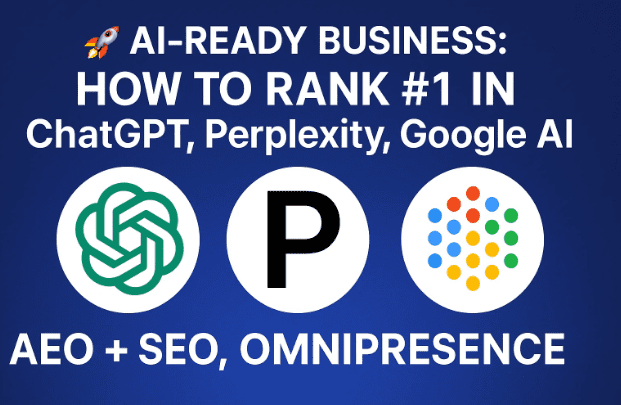
You and I grew up trying to “get to Google’s first page.” That’s still valuable—but the game just expanded. Today, customers ask AI answer engines—ChatGPT, Perplexity, Grok, and others—questions like “best X near me,” “which course should I take,” or “what brand solves Y?” If your brand isn’t discoverable to them, you’ll be missing out—even if your traditional SEO is solid.
In this no-shortcuts guide, we’ll translate that idea into a practical playbook: Answer Engine Optimization (AEO) + classic SEO, a clean omnipresent footprint, user-generated signals (UGC), and ruthless content freshness. Along the way, we’ll clear common misconceptions about “how AI finds answers,” then build a step-by-step roadmap (with examples), a comparison table, FAQs, and a short, sensible disclaimer.
Official links for mentioned tools (no promotions, just utility):
• ChatGPT — https://openai.com/chatgpt
• Perplexity — https://www.perplexity.ai
• Grok (xAI) — https://x.ai
• Google Search Central (docs for E-E-A-T, structured data, etc.) — https://developers.google.com/search
• Instagram — https://www.instagram.com
• YouTube — https://www.youtube.com
• LinkedIn — https://www.linkedin.com
• Reddit — https://www.reddit.com
• Quora — https://www.quora.com
• Schema.org — https://schema.org
1. Why “AI Optimization” Matters (It’s Not Replacing SEO—It’s Layering On)
A few years ago the question was, “How do we get to Google’s first page?” Today the better question is: “How do we ensure AI systems can confidently recommend us?” Answer engines summarize the web and reply conversationally. If you’re not a credible source across the open web and your brand footprint isn’t machine-legible, the model has little reason to surface you.
Let’s move to the mindset shift: classic SEO is still a must—but AEO (Answer Engine Optimization) adds how machines assemble answers. That means trust, coverage, recency, clear entities, and omnipresence matter more than ever.
2. How AI Answer Engines Actually Surface Answers (Reality Check)
Before tactics, let’s align on how tools like ChatGPT (OpenAI), Perplexity, and Grok (xAI) produce responses:
- They rely on a mix of training knowledge + retrieval.
Some models browse or query the web at answer time (Perplexity does this by default with citations; some ChatGPT modes can browse; Grok can pull live info via xAI). Others lean on training data or partner sources. The common thread: they reward trustworthy, recent, multi-sourced signals. - They do not magically “know everything” or “save all user conversations into a global public database.”
Models improve via further training and product-level feedback options; however, you should assume they reward public, crawlable, verifiable content far more reliably than isolated private data. - They correlate identities (entities).
If your name/brand appears across multiple authoritative sites (press, directories, social, UGC forums) in consistent ways, the engine can “resolve” your entity with more confidence.
So our job isn’t to “register with ChatGPT” (there’s no such switch), but to become the most crawlable, verifiable answer to the questions our buyers ask.
3. E-E-A-T to “Network Building”: Turning Signals into Trust
Google popularized E-E-A-T—Experience, Expertise, Authoritativeness, Trustworthiness—and the mindset extends naturally to AEO. Think of E-E-A-T as “network building”:
- Experience & Expertise: Real authors, real work, case studies, demos.
- Authoritativeness: Mentions and links from established sites; consistent profiles.
- Trustworthiness: Clear identity, contact info, transparent policies, real reviews.
When AI tools triangulate answers, they lean on who’s credible and consistently referenced. Big brands get recommended because their entity network is everywhere. The good news: you can build your own network—deliberately.
4. Omnipresence Strategy: “Be Everywhere” (But Organized)
Before we dive into steps, here’s the principle: be present where your audience and the crawlers look, and make all those presences point back to your entity (you/your brand).
Minimal omnipresence stack (start here):

- Website (fast, secure, with structured content and schema)
- YouTube (explainers, demos, updates) — https://www.youtube.com
- Instagram (visual proofs, reels) — https://www.instagram.com
- LinkedIn (thought leadership, case studies) — https://www.linkedin.com
- UGC Forums (Reddit, Quora) — https://www.reddit.com • https://www.quora.com
We’re not chasing vanity. We’re building consistent, corroborated mentions that answer engines can verify.
5. UGC, PR, and Backlinks: The Modern Trust Cocktail
Let’s be honest—anyone can buy a press mention. What AI tools and modern ranking systems deeply value is user-generated content and third-party corroboration:
- PR & Backlinks still matter: credible media and niche publications provide authority.
- UGC on forums (Reddit, Quora) shows organic chatter—engines treat it as high-signal because it’s harder to fake at scale.
- Reviews everywhere: site reviews, Google Business Profiles, marketplace reviews, social proof.
If you’re an e-commerce brand, photo/video reviews plus authentic customer posts are gold. If you’re a service/education brand, case studies, student outcomes, alumni mentions, and community discussion build durable trust.
Transitioning to our next point… building signals isn’t enough if they go stale. AI engines increasingly privilege recency when the query implies freshness.
6. Content Freshness: Winning on “What’s New” (Even If You Don’t Rank #1)
You may have noticed this pattern: some sites rarely rank #1 in Google, yet AI tools cite them for breaking updates. That’s the content freshness advantage.
- Cover new features, policy changes, launches, and data updates in your niche fast.
- Publish concise “What changed?” posts within hours or a day, then expand to a full guide later.
- Keep a rolling “Updates” page so engines can scan a single feed.
Freshness is a powerful wedge: when nobody else has content yet, your post becomes the immediate answer a model can find.
7. Multi-Format Content: One Topic → Blog, Video, Short, Audio, Summary
Now let’s multiply discoverability from a single idea. Say “Instagram launched Feature X”:
- Blog post (structured, with schema; your hub)
- YouTube video (demo)
- Shorts/Reels (60–90s take)
- Audio snippet (TL;DR summary or podcast)
- Answer-optimized summary (at the top: what is it, who is it for, steps)
- UGC prompts (Reddit/Quora threads asking/answering real questions)
This multi-format approach ensures whatever the engine prefers parsing, you’ve got it. It’s also exactly how you’ll nurture omnipresence without burning out—one topic → five outputs.
8. AEO + SEO Foundations: Structured Data, Entities, and Answer Patterns
Time to roll up sleeves. AEO isn’t magic—it’s good SEO + machine-legible structure:
- Entity clarity:
Use consistent brand and author names, bios, logos, and “sameAs” links across platforms. (Website → Organization & Person schema, with links to your YouTube/Instagram/LinkedIn profiles.) - Schema markup:
Add Article, FAQ, HowTo, Product, Organization, Person as relevant via JSON-LD. See https://schema.org. - Answer patterns:
Start key pages with a one-paragraph answer (definition/steps/value), then detail. This mirrors how engines lift summaries. - Topical depth & internal linking:
Cluster content (pillar + supporting posts) so engines can see you as comprehensive on each topic. - Citations & outbound links:
When you reference data, cite authoritative sources. It helps engines understand your context and improves trust. - Technical SEO basics:
Core Web Vitals, HTTPS, mobile responsiveness, clean sitemaps, and no index bloat. Documentation: https://developers.google.com/search
So far, so good. Let’s convert this into a plan you can follow without second-guessing.
9. Step-by-Step Implementation Plan (90 Days)
Weeks 1–2: Audit & Entity Setup
- Brand/Author entities:
- Create/verify consistent bios, headshots/logos, and sameAs links (YouTube, Instagram, LinkedIn, GitHub/Behance where relevant).
- Add Organization + Person schema on site (JSON-LD).
- Platform footprint:
- Ensure your brand handle/name is consistent across YouTube, Instagram, LinkedIn.
- Claim/complete Google Business Profile if local-relevant.
- Tech baseline:
- Fix HTTPS/mixed content, ensure sitemap & robots.txt are correct, compress images, check CWV basics.
Weeks 3–4: Content Sprint #1 (Freshness + Pillar)
- Pick 1 high-intent topic and 1 newsy/feature update.
- For the high-intent topic:
- Publish pillar (2,000+ words), add FAQ schema, internal links, and an at-top summary.
- Repurpose to YouTube video + Short/Reel + audio TL;DR.
- For the update:
- Publish quick update post within 24–48 hours of news.
- Share to LinkedIn/Instagram with a short explainer.
- Seed UGC: Ask a genuine question on Reddit/Quora and answer helpfully, linking only if it’s truly useful (no spam).
Weeks 5–6: PR + Reviews + Citations
- Pitch niche publications or community newsletters (case study, data insight, tutorial).
- Encourage photo/video reviews (e-com) or case outcomes (courses/services).
- Create a “Reviews & Results” hub on your site and link to external proof.
Weeks 7–8: Content Sprint #2 (Cluster + Comparisons)
- Build three supporting posts around your pillar (e.g., step-by-step, mistakes, tooling).
- Add comparison table posts (Tool A vs Tool B vs Your Method).
- Record short “how-to” reels from the cluster content.
Weeks 9–10: AEO Enhancements
- Add FAQ blocks to key pages with JSON-LD.
- Convert 2–3 popular tutorials into HowTo schema.
- Publish an Updates page with a chronological changelog; link it site-wide (footer).
Weeks 11–12: Measure & Iterate
- Track queries people ask on your own site search + social comments. Turn them into FAQs.
- Review YouTube retention and comments—promote winning topics into full clusters.
- Re-pitch PR with results (“we shipped feature/content X; here’s what happened”).
10. Comparison Table: ChatGPT vs Perplexity vs Grok vs Classic Search
| Platform | Typical Answer Style | Live Web Access | Citations | Best Content to Target | Notes |
|---|---|---|---|---|---|
| ChatGPT (OpenAI) — https://openai.com/chatgpt | Conversational synthesis; can be step-by-step | Available in some modes | Sometimes (varies by mode/prompt) | Clear answer summaries, robust how-tos, authoritative pillars | Strong for how-to and explanatory content when entity trust is high |
| Perplexity — https://www.perplexity.ai | Concise, source-linked answers | Default browsing | Yes | Fresh updates, well-cited explainers, newsy posts | Excellent for freshness + citations; favors clearly sourced pages |
| Grok (xAI) — https://x.ai | Conversational with a live-info bent | Designed for live data | Varies | Timely insights, technical summaries, contrarian takes with sources | Focus on timeliness + clarity; ensure entity consistency |
| Classic Search (Google) — https://developers.google.com/search | SERP with links, snippets, People-Also-Ask | Crawled index | N/A | Strong SEO foundations: schema, internal links, CWV | Still a major traffic source; AEO builds on top of this base |
(This table emphasizes patterns you can optimize for—without assuming any proprietary internals.)
11. Measuring Success: KPIs for AI-Visibility
Let’s keep it practical and honest.
- Entity coverage: # of consistent external profiles, directories, and mentions (track in a spreadsheet).
- UGC footprint: # of organic Reddit/Quora threads mentioning the brand (you didn’t create) + sentiment.
- Freshness cadence: time-to-publish for updates; # of “update” posts/month.
- AEO conversions: # of inbound leads/messages saying “found you via ChatGPT/Perplexity.” Add this field to your lead form.
- SEO baselines: impressions/clicks to entity queries, branded search growth, topically clustered rankings.
- Engagement by format: YouTube retention %, Instagram save/share rates, blog scroll depth, FAQ clicks.
If you can measure it, you can improve it. These KPIs tell you if engines (and people) trust and reference you more over time.
12. FAQs
Q1. Can I “submit” my business to ChatGPT/Perplexity/Grok?
A. There’s no universal “submit” button. You earn inclusion by being visible, verifiable, and valuable across the web: website + schema, social/video, UGC, PR, and consistent entities.
Q2. Is SEO dead now that AI answers exist?
A. No. SEO is your foundation—crawlability, site quality, schema, topical depth. AEO layers on top to make your content more likely to be summarized and recommended.
Q3. Will forum posts alone make me rank in AI answers?
A. Forums are signals, not a replacement for your own high-quality content. Combine UGC with robust on-site resources, clear authorship, and structured data.
Q4. Do I need to post everywhere daily?
A. No. Pick two primary channels + one UGC forum, ship consistently, and repurpose one topic into multiple formats. Quality > spam.
Q5. What if I’m new and don’t have authority?
A. Start with short, timely updates + in-public build threads on LinkedIn/Twitter, and contribute to niche subreddits/Quora spaces. Land small PR in credible niche outlets; compound from there.
Q6. Can I use AI to generate all content?
A. Use AI to draft, but add real experience, data, and proof. Engines and users can tell the difference. Add author bios, methods, and outcomes.
Q7. How fast will AI start recommending me?
A. It varies. Expect weeks to months. Focus on repeatable freshness, entity consistency, and clear, cited answers—your probability rises steadily.
13. Disclaimer & Good-Citizen Notes
- Be ethical. Don’t astroturf or spam forums. Contribute genuinely, disclose affiliations when appropriate, and respect community rules.
- Respect privacy and IP. Cite sources, credit creators, and follow licensing.
- Stats change. Platform behaviors, features, and traffic shares evolve. Treat any single metric as directional, not absolute.
- Your goal is trust. E-E-A-T is not a hack—it’s how you show real people (and machines) that you’re worth recommending.
Tags
answer engine optimization, aeo, eeat, content freshness, omnipresence strategy, ugc marketing, reddit quora strategy, multi format content, structured data schema, entity seo, perplexity optimization, chatgpt optimization, grok xai optimization, digital marketing 2025
Hashtags
#AEO #SEO #E_E_A_T #ChatGPT #Perplexity #Grok #ContentFreshness #UGC #DigitalMarketing #Schema #Omnipresence