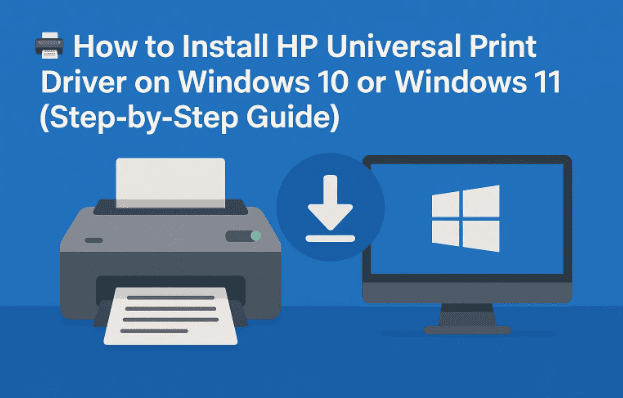
If your HP printer isn’t working properly or Windows fails to recognize it, you might not need to throw the printer away just yet — you might only need the HP Universal Print Driver (UPD).
This powerful driver package from HP works across a wide range of HP LaserJet and DeskJet printers, including many older models that no longer have dedicated Windows 10 or Windows 11 drivers.
In this article, we’ll go through the entire process of downloading, installing, and setting up the HP Universal Print Driver (UPD) on your PC or laptop. We’ll also explain which version you should choose, how to handle 32-bit vs 64-bit systems, and how to troubleshoot installation issues.
Let’s start by understanding what this driver actually does before moving into the step-by-step process.
🧩 What Is the HP Universal Print Driver?
The HP Universal Print Driver (UPD) is a single driver designed by HP to support multiple printer models — especially LaserJet and enterprise printers.
Instead of downloading a specific driver for every model, this universal package can automatically detect your HP printer and configure it. It’s especially useful when:
- Your printer model is old and no longer listed on HP’s website.
- You’ve upgraded to Windows 10 or 11, but your printer driver stopped working.
- You use multiple HP printers at your home or office and want a single driver for all.
- You need to connect to printers via network (Ethernet/Wi-Fi) instead of USB.
The UPD comes in three main formats:
| Version | Description | Recommended For |
|---|---|---|
| PCL5 | Classic printing command language, best for legacy printers | Older HP LaserJet models |
| PCL6 | Faster, modern version, optimized for Windows 10/11 | Most modern HP printers |
| PostScript (PS) | Supports graphics-heavy documents | Design/creative workflows |
⚙️ Step 1: Check Your Windows System Type (32-bit or 64-bit)
Before downloading, it’s important to know whether your computer is running a 32-bit or 64-bit version of Windows.
- Press Windows + I to open Settings.
- Go to System → About.
- Under Device specifications, find System type.
- If it says 64-bit operating system, download the 64-bit driver.
- If it says 32-bit, choose the 32-bit version.
This ensures that you install the correct version of the HP Universal Print Driver for your system.
🌐 Step 2: Download the HP Universal Print Driver
Now that you know your system type, let’s download the driver.
🪜 Steps:
- Open your preferred web browser (Chrome, Edge, or Firefox).
- Go to the official HP download page:
👉 HP Universal Print Driver Series for Windows - HP’s website will automatically detect your operating system version.
- Scroll down to find:
- HP Universal Print Driver for Windows PCL6 (recommended)
- You may also see PCL5 or PostScript (PS) options if you need them.
- Click Download next to the version you want.
Depending on your internet speed, the file (around 20–30 MB) should download within a few minutes.






💡 Tip: Save it to your Desktop for easy access later.
🗂️ Step 3: Extract the Downloaded File
Once the download finishes, locate the file in your Downloads folder or Desktop.
It will usually have a name like:
upd-pcl6-x64-7.1.0.26186.exe
🪜 Steps:
- Right-click the file and choose Run as Administrator.
- The driver setup will first extract files into a folder (usually under
C:\HP Universal Print Driver). - Once extraction is complete, you’ll see an installation wizard window open automatically.
- Click OK when prompted to begin installation.
If it doesn’t start automatically, you can go to the extracted folder and manually double-click install.exe.
🧰 Step 4: Choose Installation Type
When the setup wizard starts, you’ll see two installation options:
- Traditional Mode (Manual Setup) – Recommended if you want to manually select your printer and port.
- Dynamic Mode (Plug and Play) – Automatically detects printers connected to your system or network.
For this guide, we’ll go with Traditional Mode, as it offers more control — especially useful when dealing with older printers.
🪜 Steps:
- Select Traditional Mode.
- Click Next to proceed.
- Wait a few seconds for the setup wizard to load necessary components.
🔌 Step 5: Add Printer Manually Using Ports
Once the wizard opens the “Add Printer” window, you’ll be asked to choose how to connect your printer.
- Select Add a local printer or network printer with manual settings.
- Click Next.
- You’ll now see a list of available ports on your computer (like USB001, LPT1, etc.).
If you’re using a USB printer, look for:
USB001 (Virtual printer port for USB)
If you see something like:
DOT4_001 HP Printer Device
— that’s even better, as it indicates the printer is recognized by the system.
If you don’t see either, select USB002 or another port as a fallback.
Click Next once your port is selected.
🖨️ Step 6: Select the HP Universal Printer Driver
This is the stage where you’ll see a list of available printer drivers included in the installation package.
You’ll usually find two main entries:
- HP Universal Printing PCL5
- HP Universal Printing PCL6 (v6.1.0)
🪜 Steps:
- Select HP Universal Printing PCL6 (v6.1.0) (recommended).
- Click Next.
- When asked to name your printer, you can enter something descriptive like:
HP LaserJet (UPD PCL6)
The installation will now begin. It may take a minute or two depending on your system speed.
📄 Step 7: Choose Printer Sharing Options
After the driver installs successfully, the wizard will ask if you want to share the printer.
- If you’re using it personally, choose Do not share this printer.
- If it’s part of a network setup, you can choose to share it and enter a printer share name.
Click Next when done.
🧾 Step 8: Print a Test Page (Optional)
Before finishing the setup, Windows gives you the option to print a Test Page to confirm that the printer is working correctly.
- Click Print a Test Page.
- If the page prints successfully — congratulations! Your printer is now ready.
- If not, double-check your port selection and cable connection.
Click Finish to close the wizard.
🧭 Step 9: Verify the Installation in Control Panel
To ensure everything is installed correctly:
- Press Windows + R, type:
control printersand hit Enter. - This opens Devices and Printers.
- Look for your newly added printer in the list. It should appear as:
HP Universal Printing PCL6
Right-click it → Choose Printer Properties → Click Print Test Page if you didn’t test earlier.
🧹 Step 10: Set It as Default Printer (Optional)
If this is the only printer you use, it’s better to make it the default printer to avoid confusion in the future.
🪜 Steps:
- In Devices and Printers, right-click your HP Universal Printer.
- Click Set as Default Printer.
You’ll now see a green checkmark beside the printer — indicating it’s the default one.
💡 Why Use HP Universal Print Driver Instead of a Model-Specific Driver?
While HP provides model-specific drivers for most printers, the Universal Print Driver has several advantages:
- ✅ Works with hundreds of HP printer models — ideal for offices with multiple HP devices.
- ✅ Compatible with both USB and network connections.
- ✅ Simplifies driver management in enterprise setups.
- ✅ Regularly updated by HP to support new versions of Windows.
- ✅ Works even when your printer model is discontinued or not listed.
So, if your old HP LaserJet printer (like P1005, 1010, or 1320) no longer works on Windows 10 or 11, the UPD is your best solution.
🧩 Common Installation Issues and Fixes
Sometimes, installation doesn’t go smoothly due to driver conflicts or old remnants from previous setups.
Here are some common problems and their fixes:
1. Printer Not Detected
- Make sure your printer is powered on and properly connected via USB or network.
- Try switching USB ports.
- Run the setup as Administrator.
- Reboot and retry the installation.
2. Driver Not Installing
- Disable your antivirus temporarily — it can sometimes block driver files.
- Delete any existing HP printer entries from Control Panel > Devices and Printers.
- Reinstall the driver after a restart.
3. Printer Prints Blank or Error Pages
- Reinstall using the PCL5 version if PCL6 causes issues (older printers sometimes work better with PCL5).
- Check the toner cartridge and paper alignment.
- Make sure you selected the correct USB port during setup.
4. Duplicate Printer Entries
If you see multiple HP printer icons, delete the extra one:
- Open Control Panel → Devices and Printers → Right-click → Remove device.
💬 Frequently Asked Questions (FAQ)
Q1: What is the difference between HP Universal Print Driver PCL5 and PCL6?
PCL5 is older and supports a wider range of legacy printers, while PCL6 is newer and provides better speed and graphics rendering. For modern printers, always choose PCL6.
Q2: Can I use HP Universal Print Driver for Wi-Fi printers?
Yes. During installation, select “Add a network printer” and choose your printer’s IP address or hostname.
Q3: Will this work on Windows 11?
Absolutely. HP UPD supports Windows 7 through Windows 11, both 32-bit and 64-bit.
Q4: My HP LaserJet 1010 doesn’t have drivers for Windows 10. Will this work?
Yes. The HP Universal Print Driver PCL5 often helps older printers like the LaserJet 1010, 1020, or 1320 work smoothly on modern systems.
Q5: Can I install it without an internet connection?
Yes. Once the driver file is downloaded, the installation is completely offline.
🧾 Step-by-Step Recap
Here’s a quick recap of everything we’ve done so far:
- Check if your Windows is 32-bit or 64-bit.
- Visit HP’s official UPD page.
- Download the correct UPD version (preferably PCL6).
- Extract and run the setup as Administrator.
- Choose Traditional Mode installation.
- Select Add a local printer with manual settings.
- Pick the correct USB port (like USB001).
- Choose HP Universal Printing PCL6 driver.
- Skip printer sharing (or enable if needed).
- Print a test page and finish the setup.
After this, your HP printer should be fully functional even on the latest Windows 11 build.
🧠 Pro Tip: Use HP Print and Scan Doctor (for Troubleshooting)
If you encounter printing or connection problems even after installation, HP offers a free utility called HP Print and Scan Doctor. It can automatically detect and repair printer-related issues.
Download it from:
👉 HP Print and Scan Doctor
Simply run the tool, select your printer, and follow on-screen instructions. It will check connectivity, driver errors, and even spooler service problems automatically.
⚠️ Important Disclaimer
The HP Universal Print Driver is officially provided and maintained by HP. Always download it from HP’s official website only. Avoid third-party driver downloaders or unofficial sources — they may contain outdated or unsafe software.
Additionally, if you’re modifying system ports or settings, ensure you have administrative access to your PC.
✅ Final Thoughts
Installing the HP Universal Print Driver is one of the easiest and most reliable ways to get your HP printer working again on Windows 10 or 11 — especially if your specific model’s driver is no longer supported.
With this single driver, you can connect to almost any HP LaserJet printer, whether via USB, Ethernet, or Wi-Fi.
It’s flexible, future-proof, and designed to make printer management much simpler across multiple devices.
So next time your HP printer fails to respond, skip the model-specific driver hunt — just use the HP Universal Print Driver and get printing again in minutes!
#HPLaserJet #HPDriver #Windows11 #PrinterFix #HPUniversalPrintDriver #TechGuide