Uninstalling apps on a Mac might sound like a simple drag-and-drop task, but if you’ve ever noticed leftover files or settings even after deleting an app, you know it can be a little more complex. Whether you’ve installed apps from the Mac App Store or downloaded them directly from a developer’s website, the way you uninstall them matters.
In this guide, we’ll explore every method you can use to uninstall apps on macOS, from the built-in options to manual cleanup. Along the way, we’ll cover:
- Removing App Store apps through macOS.
- Using System Settings to remove apps.
- Finder-based uninstallations.
- Special cases for web-downloaded apps.
- Cleaning up leftover files in the Library folder.
- When and why you might want to keep some app data.
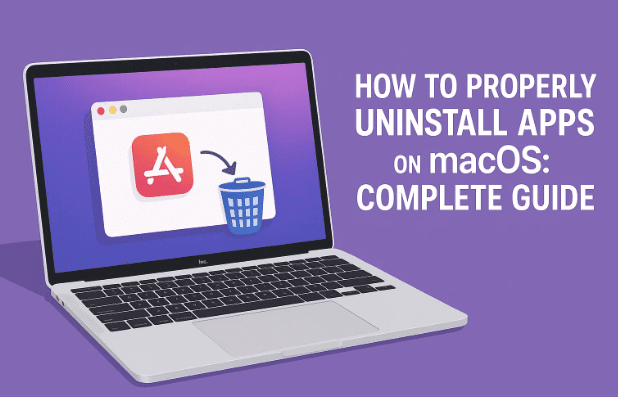
By the end, you’ll know exactly how to uninstall any Mac app properly, without relying on third-party “cleaner” software.
📌 Understanding How Apps Work on macOS
Before diving into methods, it’s worth knowing why uninstalling apps on a Mac isn’t always as straightforward as on other systems.
Unlike Windows, macOS applications are typically self-contained bundles. This means that in many cases, dragging the app to the Trash really does remove it. However, some apps also install supporting files in places like the Library folder—cache files, preference files, databases, or background services.
👉 This is why you sometimes hear about “leftover files” even after uninstalling an app. Most of these are harmless and take up very little space, but if you want a clean system, you may want to remove them too.
🔹 Method 1: Uninstalling Apps Installed via the Mac App Store
If you installed your app from the official Mac App Store, the easiest way to uninstall it is using macOS’s built-in tools.
Here’s how:
- Open the App Store application.
- Click on your profile icon in the lower-left corner.
- Under “Purchased Apps,” you’ll see a list of all apps linked to your Apple ID.
- If an app is currently installed, you’ll see Open next to it. Hover your mouse over it and click the three dots (…) menu.
- Select Delete App.
- Confirm deletion when prompted.
This works the same way as the old Launchpad deletion method (which existed in earlier macOS versions).
💡 Why this is useful:
- Simple and official method.
- Works only for App Store apps.
- Does not affect apps installed from websites.
🔹 Method 2: Using System Settings (Storage Management)
Another way to uninstall apps is through System Settings > General > Storage. This method has the advantage of showing you all installed applications (App Store or otherwise) along with how much space they take.





Here’s how to use it:
- Go to System Settings.
- Click General > Storage.
- You’ll see a storage graph and recommendations. Scroll down to find Applications.
- Click the “i” (information) button next to Applications.
- A list of all apps appears with their sizes.
- Select an app and click Delete.
- Confirm the deletion.
This is a convenient method if you want to free up disk space quickly since you can see which apps are consuming the most space.
🔹 Method 3: Uninstalling Apps Using Finder
The Finder method is the most traditional approach and works for almost every app.
- Open a Finder window.
- From the Go menu, select Applications (or press
Shift + Command + A). - Locate the app you want to uninstall.
- Drag it to the Trash (or right-click and select Move to Trash).
- Empty the Trash to reclaim disk space.
💡 Tip:
- If you hold the Option key while selecting Move to Trash, the option changes to Delete Immediately, which skips the Trash and frees space instantly.
- You’ll need to authenticate with your password or Touch ID to confirm.
This method works for both App Store apps and apps downloaded from websites.
🔹 Method 4: Special Case – Apps Downloaded from the Web
Many apps you download directly from developer websites (like Zoom, Adobe Creative Cloud, or Steam) also land in the Applications folder. You can delete them just like App Store apps. However, there’s a key difference:
👉 Some web-downloaded apps need their own uninstallers.
Examples:
- Adobe Creative Cloud – requires running Adobe’s own uninstaller tool.
- Steam – has specific instructions on its support page.
- Microsoft Office – Microsoft provides an official uninstaller for Office apps.
Why this matters: If you only drag these apps to the Trash, leftover services, daemons, or configuration files might still remain. Always check the developer’s support page before deleting such apps.
🔗 Apple Official Guide on Deleting Apps
🔹 Method 5: Using Built-in Uninstall Options
Some apps include their own uninstall feature inside the app menu. For example:
- Zoom has an “Uninstall Zoom” option in the Zoom menu.
- Antivirus tools or VPN apps often include uninstallers.
Always check the app’s main menu or Preferences before dragging it to the Trash—you might save yourself extra cleanup steps.
📂 Cleaning Up Leftover Files in the Library Folder
Now that we’ve covered uninstalling apps, let’s address the big question:
“What about leftover files?”
When you uninstall an app, some supporting files may remain in the Library folder. These might include:
- Cache files.
- Preferences.
- Saved databases.
- Logs.
While these usually don’t harm your Mac, you may want to delete them for privacy or to reclaim space.
Here’s how you can manually check:
- Open Finder.
- Go to the Go menu and hold down the Option key.
- Select Library (this reveals your user’s Library folder).
- Look inside these folders:
~/Library/Caches~/Library/Application Support~/Library/Preferences~/Library/Logs
Search by app name or developer name to locate files. If you’re sure you no longer need them, drag them to the Trash.
⚠️ Caution: Only delete files you are certain belong to the uninstalled app. Removing the wrong files may affect other apps.
💡 Pro tip: If you think you may reinstall the app later, consider keeping its preferences and support files so your settings remain intact.
🔍 Do You Really Need Third-Party Uninstallers?
Many developers promote third-party “cleaner” or “uninstaller” apps. In reality, macOS already gives you all the tools you need.
- Finder + Library access = full manual uninstall.
- System Settings = app management with space overview.
- Official developer uninstallers = safest way for complex apps.
Unless you’re managing dozens of apps at once, you don’t need extra tools that could themselves bloat your system.
❓ FAQs About Uninstalling Apps on Mac
Q1: Will uninstalling an app delete my documents created with it?
No. For example, deleting Microsoft Word won’t delete your Word documents. Your files remain unless you manually delete them.
Q2: Why do leftover files exist?
Because apps sometimes save cache, settings, or licensing information in the Library folder. These aren’t automatically deleted in case you reinstall later.
Q3: How much space do leftover files take?
Most take up very little (often kilobytes). But apps like Adobe or Xcode can leave behind gigabytes of data.
Q4: Can I reinstall an app after deleting it?
Yes. If it’s from the App Store, just re-download. If from a website, download the installer again.
Q5: Should I always use an app’s own uninstaller if available?
Yes. That ensures related services and background files are removed properly.
⚠️ Disclaimer
Uninstalling apps from macOS is safe if done correctly. However, always:
- Back up your important data before removing apps.
- Avoid deleting random Library files unless you’re certain of their purpose.
- Follow official instructions from the developer for complex apps.
This guide is for educational purposes and may not cover every third-party app. Always verify with the software vendor when in doubt.
🔚 Final Thoughts
Uninstalling apps on your Mac doesn’t have to be complicated. Whether you use the App Store, System Settings, or Finder, the built-in methods cover most cases. For web-downloaded apps, always check for uninstallers or support guides. And if you’re worried about leftover files, a quick visit to the Library folder will give you full control.
By combining these methods, you’ll keep your Mac lean, organized, and running smoothly—without unnecessary third-party software.
Tags
macOS uninstall apps, delete Mac apps, remove leftover files Mac, uninstall App Store apps, uninstall web apps Mac, clean up Library Mac
Hashtags
#MacOS #UninstallApps #AppleTips #MacBook #SystemCleanup #MacSupport