macOS is an elegant and powerful operating system, but let’s be honest—sometimes small features get in the way of how we want to work. Many users, especially those transitioning from Windows or Linux, notice that macOS adds little behaviors that may feel “annoying” at first.
The good news? Almost every one of these quirks exists for a reason, and Apple usually gives us a way to disable or customize them. In this guide, we’ll walk through 20 common annoyances in macOS and how to fix them.
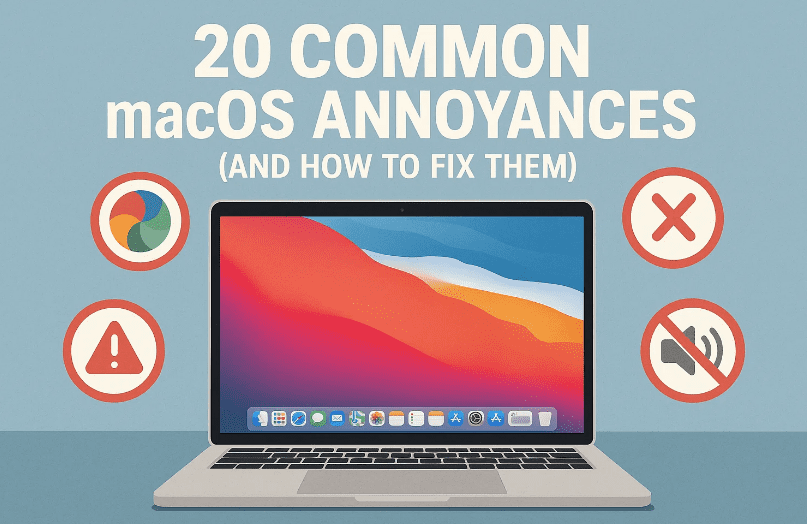
This is not just a list of quick fixes—you’ll find context, reasoning behind the features, and step-by-step instructions to make macOS behave exactly the way you want.
1. Clicking the Desktop Hides All Windows
By default, when you click anywhere on the Desktop in macOS, all your app windows slide away, revealing files and folders on your Desktop.
Some people love this. Others (including me) find it frustrating because most of the time I click the Desktop just to bring Finder forward, not to hide everything.
Fix:
- Open System Settings.
- Go to Desktop & Dock.
- Under Desktop & Stage Manager, look for “Click wallpaper to reveal Desktop.”
- Change it from Always to Only in Stage Manager.
Now you can click the Desktop without having all your windows vanish.
👉 Pro tip: If you still want a way to reveal the Desktop, go to System Settings → Keyboard → Shortcuts → Mission Control. Assign Show Desktop to a key like F11.
2. Double-Clicking a Window Title Doesn’t Fill the Screen
When you double-click a window’s title bar, you might expect it to expand fully. But macOS instead “zooms” the window to fit just its content, leaving gaps at the sides.
Fix:
- Open System Settings → Desktop & Dock.
- Find “Double-click a window’s title bar to…”
- Change Zoom to Fill.
Now, a double-click fills the entire screen width, just like on Windows.







3. Window Tiling Leaves a Gap
When you tile a window to the left or right, you’ll notice a margin between the window and the edge of the screen.
Fix:
- Go to System Settings → Desktop & Dock.
- Turn off “Tiled Windows Have Margins.”
Windows will now snap neatly to the screen edges with no wasted space.
4. Dragging Windows to Edges Tiles Them
Some people like snapping windows by dragging them to screen edges. But if you’re moving windows frequently, this can trigger accidentally.
Fix:
- Go to System Settings → Desktop & Dock.
- Turn off “Drag windows to screen edges to tile.”
5. The Dock Takes Too Much Space
The Dock is iconic, but it eats into screen real estate.
Fix options:
- Go to System Settings → Desktop & Dock.
- Adjust Size (make smaller).
- Position it on the left or right side instead of the bottom.
- Enable Automatically hide and show Dock.
6. Dock Shows Recent Apps
By default, macOS adds a section of “recent apps” to the Dock, which can clutter it.
Fix:
- In System Settings → Desktop & Dock, turn off “Show Suggested and Recent Apps in Dock.”
7. Apps Reopen Old Windows
Quit Pages, reopen it, and—surprise—all your old documents come back. Some people find this useful; others don’t.
Two solutions:
- Hold Option when quitting → changes Quit to Quit and Close All Windows.
- Or permanently: System Settings → Desktop & Dock → Close windows when quitting an application → Turn ON.
8. Cursor and Highlight Colors
macOS lets each app use its own accent color for highlights and text cursor. If you prefer one universal color:
- Open System Settings → Appearance.
- Change Accent color from Multicolor to your preferred color.
- Adjust Highlight color if needed.
Now all apps will share the same scheme.
9. Accidental Caps Lock Presses
If you keep accidentally shouting in ALL CAPS, disable the Caps Lock key:
- Go to System Settings → Keyboard → Modifier Keys.
- Set Caps Lock key to No Action.
10. Caps Lock Indicator Popup
In macOS Sequoia, turning on Caps Lock shows a small popup. Helpful, but distracting for heavy typers.
Fix (requires Terminal):
Run this command in Terminal:
defaults write com.apple.keyboard CapsLockNotify -bool false
Then log out and back in.
11. Too Many Notifications
Notifications piling up on the right side of the screen can kill focus.
Fix:
- Open System Settings → Notifications.
- Configure per-app: allow, deny, or set to banners/alerts.
- In Safari, go to Settings → Websites → Notifications and remove sites that tricked you into allowing alerts.
12. App Badges with Red Numbers
Those little red numbers (badges) can stress you out.
Fix:
- Open the app’s Settings inside System Settings → Notifications.
- Toggle off Badge Application Icon.
13. Trackpad Gesture Brings Up Notification Center
If swiping with two fingers near the right edge of your trackpad keeps opening Notification Center:
- Go to System Settings → Trackpad → More Gestures.
- Turn off Notification Center gesture.
14. Safari Automatically Opens Downloads
If Safari launches downloaded files immediately, stop it:
- Safari → Settings → General.
- Disable Open “safe” files after downloading.
15. Safari Jumps to New Tabs
Command-click a link, and Safari switches you to the new tab.
Fix:
- Safari → Settings → Tabs.
- Change “When a new tab or window opens, make it active” → OFF.
16. Spotlight Shows Too Many Results
Spotlight can overwhelm you with results you don’t care about.
Fix:
- System Settings → Spotlight.
- Uncheck categories like Fonts, Messages, or Mail to streamline results.
17. Menu Bar Hides in Full Screen
Some users prefer the Menu Bar always visible, even in full screen.
Fix:
- System Settings → Control Center → Automatically hide and show the Menu Bar.
- Choose Never.
18. Full Screen on Multiple Displays Blanks Other Screen
When you fullscreen an app, your second display goes blank.
Fix:
- System Settings → Desktop & Dock → Displays have separate Spaces.
- Turn ON. (Requires logout to apply.)
19. Screenshots Always Save to Desktop
By default, screenshots save to Desktop. You can change this.
Fix:
- Press Shift + Command + 5.
- Click Options.
- Choose a different folder (Downloads, Documents, etc.), or select Preview to edit before saving.
20. Annoying Finder Warning Messages
Finder sometimes nags you with confirmations when deleting, moving from iCloud, or emptying Trash.
Fix:
- Finder → Settings → Advanced.
- Uncheck:
- Show warning before changing an extension.
- Show warning before removing from iCloud Drive.
- Show warning before emptying the Trash.
❓ Frequently Asked Questions
Q: Are these settings permanent?
Yes, until you update macOS. Major updates may reset some preferences.
Q: Will disabling warnings or Caps Lock break anything?
No, but be mindful. Without warnings, you could accidentally delete files more easily.
Q: Do these fixes apply to older versions of macOS?
Most apply to Ventura and newer, but some (like Caps Lock indicator) are unique to macOS Sequoia.
⚠️ Disclaimer
These steps are safe to perform and rely only on built-in macOS settings. Terminal commands should be entered carefully, as mistyped commands may cause unintended behavior. Always back up important data before making system-wide changes.
🎯 Conclusion
macOS comes packed with thoughtful features, but not all of them suit every workflow. By tweaking a few system settings, you can turn annoyances into conveniences—or simply disable them entirely.
Whether it’s taming notifications, resizing windows properly, or reclaiming screen space, these fixes make macOS feel more under your control.
So go ahead—customize your Mac to match your style of work. That’s the real beauty of macOS.
Tags: macOS tips, macOS customization, macOS Sequoia, Mac settings, Mac annoyances, Finder, Dock, Spotlight, Safari
Hashtags: #macOS #AppleTips #MacBook #Productivity #Sequoia