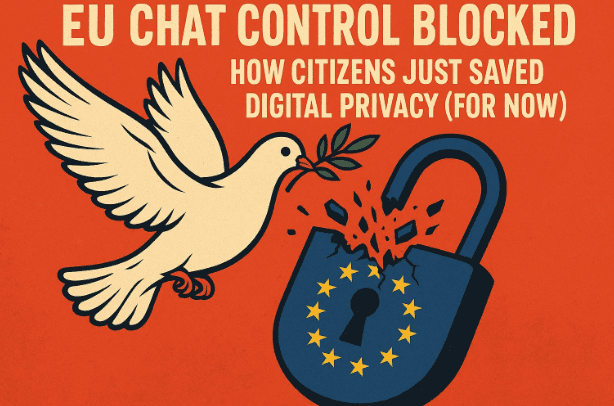
For years, privacy advocates have warned that the European Union’s proposed Chat Control law would be the end of private communication online. It would force encrypted messaging apps like Signal, Proton Mail, and even open-source chat tools to include backdoors, giving governments direct access to users’ private messages — all in the name of “child safety.”
This week, after tireless opposition from citizens, scientists, technologists, and digital rights organizations, the proposal has been halted — at least for now. The turning point came when Germany withdrew its support, collapsing the EU majority needed for passage.
For anyone who values privacy, security, or freedom of speech, this is a victory worth celebrating. But it’s not the end of the story.
Let’s break down exactly what happened, what Chat Control is, why this moment matters, and what comes next in the ongoing battle for digital freedom.
🧩 1. What Is “Chat Control” and Why It Matters
Before celebrating, it’s important to understand what the Chat Control law (officially the “CSAM Regulation”) was trying to do — and why so many experts warned it could become the most invasive mass-surveillance system in modern Europe.
The proposal, introduced by the European Commission, would have required all digital communication services to scan user messages, photos, and files — even those sent through end-to-end encrypted apps like Signal, WhatsApp, or Threema.
This process, known as client-side scanning, means that messages would be analyzed before they are encrypted and sent. In practice, that eliminates the very protection encryption provides.
The stated goal:
To detect and prevent the spread of child sexual abuse material (CSAM).
The real risk:
A built-in backdoor for mass surveillance, capable of scanning everyone’s private communication — including journalists, whistleblowers, and ordinary citizens.
Imagine if every letter you mailed had to be opened and inspected “just in case” it contained something illegal. That’s essentially what client-side scanning does to your digital messages.
⚖️ 2. The Moment Germany Said “No”
The key event happened in mid-November, when Germany’s government publicly announced that it would not support the Chat Control proposal.











That decision immediately ended any possibility of passing the regulation through the EU Council, since a majority vote among member states is required.
The announcement, translated from a statement by the CDU/CSU parliamentary group, included this remarkable comparison:
“We are against the control of chats without cause. That would be like opening all letters as a precaution to see if there is anything forbidden in them. That’s not possible. That won’t happen with us.”
In a single statement, Germany reaffirmed what privacy experts have said for years — mass surveillance is not compatible with democracy.
Of course, the group also clarified that protecting children remains essential, but any law must do so without undermining encryption or the confidentiality of communication.
🌍 3. How Citizen Activism Turned the Tide
So how did this shift happen?
According to Patrick Breyer, a long-time digital rights advocate and member of the European Parliament, the victory was achieved through public pressure — plain and simple.
Thousands of citizens:
- Emailed and called their Members of the European Parliament (MEPs)
- Signed petitions through organizations like FightChatControl.eu
- Shared information across social media
- And supported NGOs such as the EDRi (European Digital Rights) and the Chaos Computer Club
Even conservative political groups, usually more cautious about privacy, reported being “flooded with letters” from concerned citizens. Public pressure made the cost of supporting the proposal politically untenable.
For once, democracy worked exactly as it should.
As Breyer wrote:
“Our protest has the power to stop a totalitarian surveillance system that has no equal in the free world. Freedom is only as valuable as our willingness to fight for it.”
🧠 4. What Chat Control Would Have Done
Now that we’ve seen how it was stopped, let’s understand why it was so dangerous.
🔍 1. It targeted everyone, not just criminals.
The system would have scanned every message, image, and file — from private family photos to business communications — all under the pretext of “safety.”
🧱 2. It required backdoors in encryption.
End-to-end encryption ensures that only the sender and receiver can read a message. Chat Control would break that principle, forcing apps to “peek” inside messages before encryption.
💾 3. It lacked proper oversight and technical safeguards.
No clear limits were defined for data retention, false positives, or misuse. Essentially, it handed enormous surveillance power to both governments and private companies.
🌐 4. It set a global precedent.
If the EU — long considered a leader in privacy (thanks to GDPR) — adopted this kind of law, it would embolden other regions to follow suit.
This wasn’t just an “EU issue.” It was a global test of whether citizens could resist the normalization of permanent, preemptive surveillance.
💬 5. How Other Countries Are Reacting
The EU isn’t alone in exploring “anti-encryption” measures.
- The UK’s Online Safety Act contains similar scanning powers, prompting Signal to threaten withdrawal from the UK.
- Australia passed the “Assistance and Access Act” in 2018, which allows authorities to compel service providers to weaken encryption.
- The United States periodically revives the EARN IT Act, which could make encrypted services legally risky.
Each time, the pattern is the same: a well-intentioned goal (protecting children) gets used to justify policies that could monitor everyone.
That’s why Germany’s decision matters far beyond Europe — it signals that privacy and child safety are not mutually exclusive.
🚨 6. Why the Fight Isn’t Over
While this is a huge win, privacy advocates warn that the threat isn’t gone.
The European Commission may revise and reintroduce the proposal under different branding or with minor adjustments to regain support. Lawmakers may use softer language — “content moderation,” “safety scanning,” “AI detection tools” — but the technical implications remain the same.
Patrick Breyer put it bluntly:
“The proponents of chat control will use every trick in the book and will not give up easily.”
This means vigilance is essential. Today’s win could easily turn into next year’s defeat if public awareness fades.
✊ 7. What You Can Do to Keep the Momentum Going
We’ve done a good job stopping the law for now — but the next step is ensuring it doesn’t return.
Here’s how ordinary citizens can keep the pressure up:
🪜 Step 1: Stay Informed
Bookmark FightChatControl.eu and follow updates from privacy organizations like EDRi, Privacy International, and Access Now.
Knowledge is the first defense against manipulation.
🪜 Step 2: Keep Contacting Representatives
Even if your country opposed Chat Control, reach out to thank them for standing up.
Acknowledging good behavior encourages them to continue doing the right thing.
If your representatives supported it, remain polite but firm — express how these laws endanger both privacy and security.
🪜 Step 3: Support Digital Rights NGOs
Organizations like NOYB, La Quadrature du Net, and EFF Europe depend on public donations and volunteers. They often do the technical, legal, and advocacy work that individuals can’t.
🪜 Step 4: Educate Your Circle
Talk to friends and family about what Chat Control means.
Many people still think “I have nothing to hide” — until they realize these systems expose everyone’s personal communications to false flags, misuse, and data breaches.
🪜 Step 5: Use and Promote Encrypted Tools
Protect your own communications using apps that prioritize privacy:
- Signal (messaging)
- Proton Mail (email)
- Session (anonymous messaging)
- Tutanota (secure email)
- Mullvad VPN (browsing privacy)
All of these services maintain transparency about encryption protocols and user control.
Supporting them means supporting the broader fight for privacy-respecting technology.
🧩 8. The Role of Germany’s Decision
Germany’s stance is especially symbolic because of its historical context. The country’s post-war constitution emphasizes the right to privacy and protection from state surveillance — principles born from lessons of totalitarian regimes.
By rejecting Chat Control, Germany reaffirmed those values and reminded the EU that security cannot come at the cost of freedom.
It also shows that public engagement still matters in the digital era. Phone calls, petitions, and emails may feel small individually, but collectively, they can shape history.
🧭 9. Common Questions (FAQ)
Q1: Does this mean encryption is completely safe now?
No. This is one victory in a long struggle. Many governments still see encryption as an obstacle rather than a fundamental right.
Constant vigilance is necessary.
Q2: Can the EU revive Chat Control later?
Yes, the European Commission could modify and resubmit the bill under a new name. The infrastructure and political appetite for surveillance still exist.
Q3: Why can’t we just “scan for illegal content” without breaking privacy?
Because scanning requires access to content — which means encryption must be weakened or bypassed.
Once that backdoor exists, it can be misused for other purposes (like political monitoring or data mining).
Q4: I’m not in the EU. Why should I care?
Technology is global. If major markets like the EU enforce backdoors, companies will either implement them worldwide or abandon privacy features entirely.
What happens in Europe shapes the internet everywhere.
Q5: Isn’t protecting children worth sacrificing some privacy?
Protecting children is vital — but mass surveillance harms them too. Data leaks, identity theft, and the erosion of trust in technology make everyone, including minors, less safe.
The right approach is targeted law enforcement, not blanket scanning of every message.
🔍 10. Lessons Learned: Why Protest Works
For many, this moment is proof that collective action isn’t futile.
Governments are powerful, but public scrutiny remains their weakness. Citizens voicing opposition in emails, forums, and social media can stop even multinational legislative efforts when pressure is unified and consistent.
This win reminds us that democracy isn’t automatic — it has to be actively maintained, especially in digital policy, where decisions are often buried under technical jargon.
So yes — breathe, celebrate, and maybe take a day to relax.
But after that, stay alert. Because the same forces that tried to ban private encryption will be back.
🔐 11. Why This Win Matters Globally
Europe has long set the global tone for data privacy. The General Data Protection Regulation (GDPR) reshaped how tech companies handle data worldwide.
Had Chat Control passed, it could have done the same — but in the opposite direction, normalizing state-level message scanning and data access everywhere.
By stopping it, the EU just protected global privacy standards and gave hope to activists in other regions fighting similar battles.
It also proves that freedom and safety don’t have to conflict. You can protect children without destroying encryption, just as you can fight crime without reading everyone’s mail.
💡 12. A Call to Keep Building Privacy-Respecting Technology
Finally, this moment should inspire technologists and developers to double down on privacy-by-design software.
Projects like Signal, Proton, Matrix, and Tor show that it’s possible to build secure, transparent communication tools that respect users.
But they also need legal room to exist — and that’s why public support matters just as much as engineering innovation.
Technology alone cannot defend privacy.
Society must defend the right to use that technology freely.
🧾 Final Thoughts
The defeat of Chat Control is more than just a political event — it’s a rare reminder that citizen activism still matters in the digital age.
Germany’s refusal to endorse the bill stopped what could have become the largest mass surveillance law in EU history. But the fight isn’t over. Governments will rebrand, rewrite, and reattempt such measures, hoping fatigue silences resistance.
So for now, celebrate. Take pride in knowing that emails, protests, and open discussions made a difference.
But when the next proposal appears — and it will — be ready.
Because privacy, once lost, is almost impossible to reclaim.
🧾 Disclaimer
This article is for educational and informational purposes only.
It does not represent legal advice or political affiliation. Readers are encouraged to consult official EU legislative documents and follow updates via verified digital rights organizations such as FightChatControl.eu, EDRi, and Privacy International.
#ChatControl #Privacy #Encryption #DigitalRights #MassSurveillance #EU #FightChatControl #dtptips