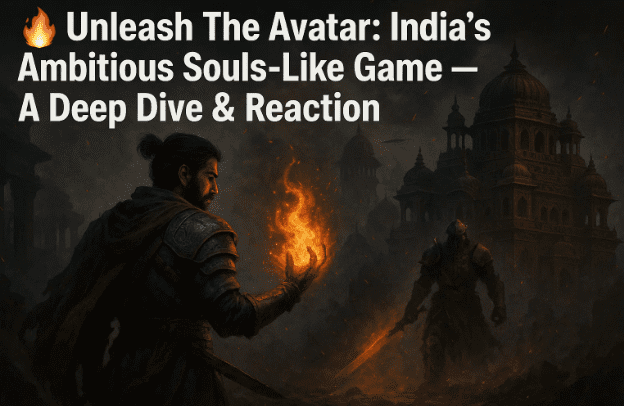
As gamers, we often see big-budget titles from major studios. But every now and then, a small team sets out to defy expectations — and that’s exactly what Aeos Games is attempting with Unleash The Avatar. This is a Dark-Souls–inspired, action RPG built in Unreal Engine 5, developed in India, and currently in early alpha.
In this article, we’ll walk through:
- What the game shows so far (from your supplied script + additional material)
- Technical and design observations (cinematics, mechanics, environment)
- Strengths, concerns, and fan reception
- What’s next and when to expect around release
- FAQs, disclaimers, and a final verdict
Let’s begin with what we saw, and then dig deeper into why this matters for Indian game development — and for you as a player.
🎬 First Impressions: What Does the Alpha Reveal?
Before breaking down pieces, here’s how the footage and the reactions unfold:
- The game is clearly an early alpha build — which means many systems might still be unpolished or placeholders.
- The team size is mentioned: around 40 people total, with ~20 core persons.
- Many environmental elements are made via photogrammetry: real-world assets are scanned, processed, and imported into Unreal.
- The setting is an alternate India / mythological India (called “Vishwapur” in official sources) where the boundary between Earth and Naraka (hell) has broken. (unleashtheavatargame.com)
- You see cinematic sequences, character animations, environment — trees, camera moves, fire, water ripples, cloth physics, and more.
- Combat mechanics include melee, ranged (throwing “chakra” weapon that can curve or return), dodging, parrying, transformations (“godlike powers”), and boss fights.
- Character design, lighting, and aesthetic flourishes (Indian mythic, temple-like structures, shadows, ambient cues) are emphasized.
- Some sequences show character revival, enemy transformations, special powers (flames, teleportation), and spectacle transitions.
From your script and those additional sources, we can extract what works, what’s promising, and what raises questions.
So far, we’ve done a good job summarizing the visual and mechanical reveals — now, let’s move into the deep analysis.
🛠️ Technical and Design Breakdown
In this section, I’ll analyze what the alpha shows in terms of:
- Environment & Art Direction
- Animation, Cinematics & Motion Capture
- Combat Design & Mechanics
- Performance & Optimization Challenges
- Narrative & Worldbuilding
Environment & Art Direction
Photogrammetry usage:
It’s mentioned explicitly that many assets are made via photogrammetry — meaning scanning physical objects (e.g. stones, temple walls, props) to get very realistic textures and geometry. This helps with visual fidelity without needing artists to manually sculpt each texture from scratch. (unleashtheavatargame.com)
This approach can bring authenticity: cracks, rust, dust, imperfections all look natural. But it also poses a challenge — level of detail (LOD) management and performance optimization are vital, especially for lower-end PCs.
Lighting, shadows, and water effects:
The footage shows strong use of lighting — moonlit scenes, soft shadows, silhouettes. The water ripples in the footage drew praise. Good lighting can elevate environments even when geometry is simpler.
Plants reacting to movement:
One reaction in the script: “plants react when character walks” suggests some level of interaction or responsiveness. That detail, while small, adds to immersion.










Scene composition & camera work:
Cinematic camera swoops, drone-like establishing shots, transitions to close-ups — these help sell mood. The team appears to be investing effort in camera direction, not just raw visuals.
Concerns / caveats:
- Sometimes real-scanned environment + stylized character can feel mismatched (a comment from Reddit: “environment looks like scans, but character looks animated, out of phase”).
- Static vs dynamic scenes: Many photogrammetry assets might be static; adding destructible or interactive elements is a heavier lift.
- LOD and draw calls: On lower hardware, too many high-res assets can kill frame rates.
Animation, Cinematics & Motion Capture
Motion capture / skeletal animation:
The review mentions that they use motion capture for character movement and cinematic sequences. This helps produce more natural human movement compared to purely keyframe animations.
Cloth simulation & secondary motion:
You noted “cloth reacting” — this is a good sign that the team is implementing secondary physics (cloth, hair, drapery) to enhance realism. In the alpha footage, seeing cloth physics is encouraging.
Cinematics / storytelling sequences:
There are several cutscenes or cinematic-like interludes: characters reviving, conversations with godlike voices, transformation sequences, etc. These help frame the narrative beyond pure combat.
Concerns / caveats:
- Facial detail seems underwhelming from script commentary (“face details not there,” “facial expressions missing”).
- Synchronization of lip sync, expression, motion is tricky — especially in early builds.
- Seamless blending between gameplay and cinematic transitions is hard; jarring shifts may break immersion.
Combat Design & Mechanics
This is the crux for a Souls-like, so I’ll treat it carefully.
Weapon & Chakra mechanics:
One key mechanic: the protagonist wields a chakra (throwable weapon) that can curve, return, and be rethrown. Also, sword-based melee combat is present. This hybrid of ranged + melee is interesting, akin to some modern action RPGs. The official site describes that as a “core combat system.”
You see parrying / counter mechanics, dodging / perfect dodge, blending in of “blink” (reposition) and transformations (godlike powers) during combat.
Spectacle & flair:
Some animations are Bollywood-inspired — dramatic strikes, slow-motion transitions, flamboyant moves — these can give uniqueness. The reviewers in the script mention “Bollywood move right there,” “cocky protagonist,” etc.
Enemy revival / transformations:
In the footage, you see enemies reviving, growing horns, changing forms, entering new phases (e.g. fire, stronger attacks). This suggests a layered boss system where the fight evolves mid-battle.
Weakness hunting, learning curve:
As one reaction says, Dark Souls games demand patience, strategic reading, learning boss weaknesses. Expect Unleash The Avatar to follow this design philosophy: players die, learn, adjust strategy, retry.
Concerns / caveats:
- How deep is the ability progression / skill tree system? This wasn’t shown in footage.
- How responsive is the combat in real play (hit detection, latency, frame-accuracy)?
- Are there UI cues, balance, difficulty scaling, and variety in enemy behavior?
Performance & Optimization Challenges
Given photogrammetry, cinematic sequences, and intense combat systems, performance is a major concern. The game is currently in alpha; optimizing is not done.
Consider these challenges:
- Frame rate targets: To keep combat smooth, 60 fps (or more) is usually essential for Souls-like. If environments or effects cause frame drops, gameplay suffers badly.
- Memory / GPU load: High-res textures, shadows, post-processing effects can blow VRAM.
- Draw distance & culling: For wide-open areas, effective culling and level-of-detail streaming will be essential.
- Input latency and responsiveness: Especially for a parry/dodge-based combat system, input lag must be minimal.
- Platform optimization: If targeting PC and possibly consoles, each has its constraints.
Alpha state often has stutters, visual glitches, or inconsistent performance — all expected, but the later builds must focus heavily on polish.
Narrative & Worldbuilding
From the official site and the footage:
- The lore places the game in Vishwapur, an alternate mythic India. The boundary between Naraka (hell) and Earth has broken, bringing demonic incursions.
- The protagonist is Vikram — initially arrogant, forced to grow in wisdom and power.
- Lore includes deity interactions, sacred sanctuaries, gods vs mortals, revenge, betrayal, and cosmic stakes.
- The visuals hint at temple architecture, forested sanctums, ruins, mythic environments, and reverence for Indian thematic elements (gods, spirits, chakra, etc).
This fusion of Indian mythology with a Souls-like structure is compelling if executed well — but must navigate cultural sensitivities, narrative depth, and consistency.
👍 Strengths & 🚧 Concerns: What Works, What Needs Caution
Let’s pause and assess pros, risks, and what to watch out for.
✅ Strengths & Promising Aspects
- Ambitious scope by an indie team
A ~40-person team working on a Souls-like is bold. The fact they’re applying photogrammetry, motion capture, etc., shows ambition. - Strong visual potential
The environments, lighting, water effects, asset fidelity are visually striking in parts. The use of real scanned assets helps. - Unique Indian setting
Mythological India, use of deities, chakra mechanics, local flavor — all help the game stand out in a saturated global market. - Hybrid combat mechanics
The mix of ranged chakra + melee + transformation provides gameplay depth if tuned well. - Narrative potential
The lore is rich and has potential to connect with cultural motifs, hero’s journey arcs, and conflict between gods, men, demons.
⚠️ Risks, Criticisms & Watchouts
- Alpha mismatch and visuals vs character coherence
Several critiques cite that while environments look photorealistic, the character models and animations appear less polished. This mismatch can feel jarring. - Limited demo of core mechanics
Footage shows spectacle, camera work, and cutscenes, but we haven’t seen deep gameplay loops, skill trees, UI, long-term progression. - Performance & optimization danger zone
High visual ambition can backfire if frame rates, stutters, memory issues are not addressed. - Overpromise vs deliverable
Some users on Reddit flagged concerns: claims of “68 % done,” bold marketing language, lack of depth in shown mechanics. - Cultural & mythological balance
When using religious or mythic themes, especially from Indian heritage, it’s easy to unintentionally offend. The story must handle symbolism, depiction of deities or spiritual beings, and sacred motifs carefully. - Development timeline and marketing realism
Many indie projects suffer from scope creep. Without solid planning, deadlines may slip or features drop. The community is cautious about big promises made early.
📅 Development, Release Window & What’s Next
Based on public sources:
- Official site: Unleash The Avatar – Official Site outlines the features and story.
- Recent news: Aeos Games has released trailers for Unleash the Avatar.
- It appears the aim is to release on PC (Steam) by possibly 2026 (or around that timeframe).
Given the scale of the project and current alpha state, it’s reasonable to expect further delays, additional features, and significant polishing required.
What to watch for in future updates:
- More gameplay reveals (boss fights, level design, UI, progression)
- Platforms targeted (PC, consoles?)
- Performance optimization news (fps targets, hardware spec requirements)
- Beta or playtest access for players
- Marketing tone: whether the team tempers expectations
❓ Frequently Asked Questions (FAQs)
Q1: Is Unleash The Avatar a real game or just a tech demo?
It is a real game in development by Indian indie developer Aeos Games. The current version is early alpha, meaning many systems are unfinished.
Q2: Why use photogrammetry for assets?
Photogrammetry captures real-world textures and geometrics by scanning physical objects, reducing manual texture work, and enhancing realism. The tradeoff is heavier resource needs and optimization complexity.
Q3: What makes its combat different?
The standout mechanic is the throwing “chakra” weapon that can curve, return, reposition; combined with melee sword combat, dodges, parries, transformations. This hybrid could add strategic depth.
Q4: Will it be available on consoles?
As of now, confirmed info is limited. Official sources focus on PC/Steam. Future announcements may clarify console support.
Q5: When might it release?
Publicly, 2026 is mentioned in news sources as a target timeframe. (The Times of India)
Q6: How worried should players be about performance issues?
Very — because photogrammetry, cinematic visual effects, and dense environments demand strong hardware and optimization. The team must aggressively optimize.
Q7: What criticisms has the community voiced?
Some feel the build shown is inconsistent (environment vs character), features shown are shallow, and marketing promises may overshoot the deliverables.
🧾 Final Thoughts & Takeaway
Unleash The Avatar is a bold, risky, and exciting project. It blends Indian mythology with Souls-like gameplay ambitions, visual fidelity via photogrammetry, and cinematic drives. If it pulls off polished combat, stable performance, and a compelling story, it might become a standout Indian indie title.
But as of the alpha reveal, there’s much work ahead: syncing character and environment styles, refining gameplay depth, and ensuring the experience is smooth and immersive.
For Indian gamers, this project is symbolic — not just a game, but a statement: that deeply local stories, mythic tradition, and technical ambition can converge in the global gaming space.
If you’d like, I can also compare Unleash The Avatar with Black Myth: Wukong, Elden Ring, or Sekiro in terms of systems, visuals, and ambition. Do you want me to add a “comparative analysis” section?
⚠️ Disclaimer
This analysis is based on publicly available early alpha footage, transcripts, and announced information. The game is in active development; many features, visuals, mechanics, and timelines may change before final release. This article is speculative and interpretive, not definitive.
🏷 Tags & Hashtags
Tags: Unleash The Avatar, Aeos Games, Indian indie game, Souls-like RPG, Unreal Engine 5, photogrammetry, Indian mythology, game development, gameplay analysis, action RPG
Hashtags: #UnleashTheAvatar #IndianIndieGame #SoulsLike #UnrealEngine5 #GameDev #IndianMythology #ActionRPG #Photogrammetry #IndieGamers #2026Release