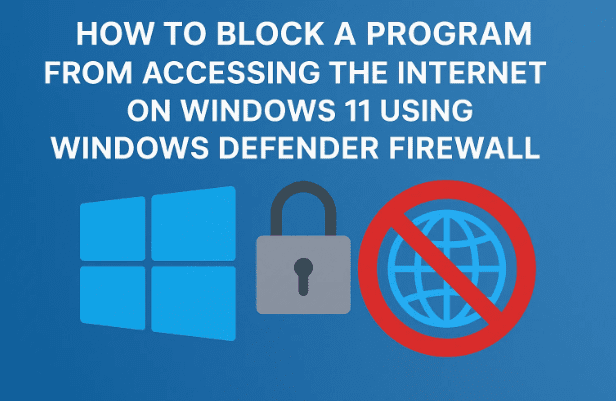
In today’s connected world, almost every program installed on your computer communicates with the internet — whether for updates, analytics, license verification, or background data sync. While this is often harmless, there are legitimate cases where you might want to block a program from going online.
Maybe you have an application that constantly checks for updates even when you don’t want it to, or perhaps you’re troubleshooting network activity and need to isolate a specific app. In such cases, Windows 11’s built-in firewall gives you a powerful way to stop outgoing connections safely — without installing any third-party software.
This guide will walk you step by step through the entire process using Windows Defender Firewall with Advanced Security, explaining each setting in detail and providing extra context about when and why you might use it.
🧠 Why You Might Want to Block an App from the Internet
Before we get into the “how,” let’s quickly understand the “why.” There are several practical reasons to restrict internet access for a program:
- Prevent forced updates: Some tools automatically update themselves and remove old features. Blocking internet access stops these unwanted updates.
- Improve privacy: Many applications silently send usage data or telemetry. Restricting them prevents background data leaks.
- Save bandwidth: Apps that constantly ping servers can consume your limited network data.
- Enhance security: If you suspect a program could be infected or unsafe, blocking its network access reduces potential risks.
- Testing and development: Developers and IT professionals sometimes need to simulate offline conditions or check how a program behaves without the internet.
Fortunately, Windows includes all the tools you need to do this — no downloads, no extra software, and no cost.
⚙️ Step 1 – Open Windows Defender Firewall
To start, we’ll access the Windows Firewall configuration area.
- Click on the Start menu or press Windows + S to open the search bar.
- Type “firewall” into the search box.
- You should see Windows Defender Firewall appear in the search results.
- Click Windows Defender Firewall with Advanced Security.
💡 Tip: If you only click the regular “Windows Defender Firewall” option, you can still navigate to “Advanced settings” from the left panel later. Both paths lead to the same place.
Once opened, a new window titled Windows Defender Firewall with Advanced Security will appear. This is where all inbound and outbound connection rules live.
🔍 Step 2 – Understand Inbound vs. Outbound Rules
When you first open the Advanced Firewall window, you’ll notice two major rule categories on the left sidebar:
- Inbound Rules – These control connections coming into your computer (e.g., when someone tries to access your PC remotely or a service receives data).
- Outbound Rules – These control connections going out from your computer to the internet.
Since we want to stop a program from connecting to the internet, we’ll be working with Outbound Rules.
🧱 Step 3 – Create a New Outbound Rule
Now, let’s actually create the blocking rule.






- In the left panel, click Outbound Rules.
- On the right-hand side of the window, click New Rule…
A “New Outbound Rule Wizard” window will appear. This wizard helps you specify exactly what type of connection you want to block.
🧩 Step 4 – Choose the Rule Type
You’ll see four main options:
- Program – Blocks or allows a specific program (.exe file).
- Port – Blocks network access through a specific port (useful for servers or specific protocols).
- Predefined – Uses one of Windows’ pre-built templates (like File and Printer Sharing).
- Custom – Allows you to create an advanced rule with multiple criteria.
Since our goal is to block a specific program, select Program and click Next.
📁 Step 5 – Locate the Program You Want to Block
Now you need to specify the program’s executable file (.exe).
You’ll see two options:
- All programs
- This program path
Choose This program path, and then click the Browse… button.
Next, navigate to the folder where your program is installed. For example:
C:\Program FilesC:\Program Files (x86)
As an example, let’s use CCleaner, a common utility application.
- Open C:\Program Files.
- Locate the CCleaner folder.
- Select CCleaner64.exe (for 64-bit systems) or CCleaner.exe (for 32-bit systems).
- Click Open.
Now you’ll see the program’s full path filled in, something like:
C:\Program Files\CCleaner\CCleaner64.exe
Click Next to continue.
🚫 Step 6 – Choose the Action: Block the Connection
This is the heart of the rule.
You’ll see three options:
- Allow the connection
- Allow the connection if it is secure
- Block the connection
Select Block the connection, then click Next.
This tells Windows to prevent this program from sending or receiving any network data, regardless of network type.
🌐 Step 7 – Select the Profile(s) the Rule Applies To
Windows uses three network “profiles” to differentiate between environments:
- Domain – When your PC is part of an organization’s network (like at work).
- Private – When you trust the network, such as your home Wi-Fi.
- Public – When connected to public Wi-Fi in cafes or airports.
It’s generally safe to apply this rule to all three profiles, ensuring the app is blocked everywhere.
Leave all boxes checked and click Next.
✏️ Step 8 – Name and Describe the Rule
Finally, you’ll give your rule a name and description.
You can type something like:
- Block CCleaner Internet Access
- Prevent CCleaner from Connecting Online
If you want, add a short description such as:
“This rule blocks CCleaner’s update and telemetry connections for privacy and offline use.”
Click Finish to create the rule.
You’ll now see your new rule appear in the Outbound Rules list with the status Enabled and the action Block.
Congratulations — you’ve successfully prevented that program from accessing the internet!
✅ Step 9 – Verify That the Block Works
Let’s make sure your rule is effective.
- Open the program you just blocked (e.g., CCleaner).
- Try to perform an action that requires internet access, such as checking for updates.
If the rule is active, you’ll see an error message such as:
“Unable to connect to the server”
or
“Could not establish an internet connection.”
That confirms the program can no longer access the web.
🧰 Step 10 – Manage, Disable, or Delete the Rule Later
At some point, you might want to restore the program’s internet access. You can do that directly within the Firewall Manager:
- To disable the rule temporarily:
Right-click on the rule → Disable Rule.
(You can re-enable it anytime.) - To delete the rule permanently:
Right-click on the rule → Delete. - To edit properties:
Right-click → Properties → adjust as needed (e.g., only block on public networks).
This flexibility lets you test, troubleshoot, or refine your settings without uninstalling or reinstalling anything.
🧩 Advanced Tips and Variations
Once you’ve mastered the basics, there are several ways to make your blocking setup more advanced.
🔸 1. Block Multiple Programs at Once
You can repeat the same steps for other executables. For example:
- A game launcher that auto-updates.
- A photo editor that checks for cloud integration.
- A system utility that sends telemetry.
Each rule can be named individually for easy tracking.
🔸 2. Use Inbound Rules to Restrict Remote Access
If you want to stop programs or services from receiving connections (for example, blocking a local server or remote desktop app), follow the same steps under Inbound Rules instead of Outbound.
🔸 3. Create a Custom Rule for Ports or IPs
For IT professionals or network administrators, custom rules allow targeting specific IP addresses or ports.
Example: Block all traffic to a specific update server address.
🔸 4. Combine Rules for Security Hardening
If you’re managing a shared computer or test system, combining outbound rules (blocking unwanted apps) with inbound rules (restricting access from external sources) can dramatically reduce your attack surface.
⚠️ A Few Things to Keep in Mind
Blocking a program’s internet access can occasionally cause unexpected side effects. Here are some points worth noting:
- Automatic updates will fail. The program won’t be able to download new versions.
- Licensing or activation checks may stop working for subscription-based software.
- Some apps may hang or show error messages if they rely on online verification.
- Don’t block essential Windows processes like
svchost.exeorexplorer.exe. Doing so may break important system functions.
If you’re unsure whether it’s safe to block something, do a quick web search for the executable name before proceeding.
🔧 Alternative: Use Windows “App Rules” in Security Settings
If you prefer not to navigate the advanced firewall console, Windows 11 also provides a simpler path:
- Open Settings → Privacy & Security → Windows Security → Firewall & Network Protection.
- Click Allow an app through firewall.
- Click Change settings, then uncheck the app you want to restrict.
However, this interface is limited — it only manages pre-approved apps and doesn’t give fine-grained outbound control. The “Advanced” method covered earlier is far more powerful and reliable.
💬 Frequently Asked Questions
Q1. Can I block only specific features of a program?
Yes, by creating custom rules, you can restrict certain ports or protocols (for example, HTTP/HTTPS) while leaving others open.
Q2. What happens if I block a Windows system service by mistake?
You can always go back to your rule list, disable or delete the rule, and reboot if needed. Windows automatically restores connectivity once the rule is gone.
Q3. Is this the same as disabling Wi-Fi for the entire system?
No. Firewall rules block internet access only for specific programs, leaving others unaffected. This gives you precision control.
Q4. Will my antivirus conflict with this rule?
Most antivirus software respects Windows Firewall settings. However, if your security suite manages its own firewall (like Norton or Kaspersky), apply the rule within that software too.
Q5. Can I monitor blocked connections?
Yes. Under the Firewall’s Monitoring section, you can view logs of blocked or allowed traffic to confirm your rules are working as expected.
🧭 Wrapping Up
So far, we’ve done an excellent job walking through every step of how to block a program from accessing the internet using Windows Defender Firewall on Windows 11.
To summarize the process quickly:
- Open Windows Defender Firewall (Advanced Settings).
- Go to Outbound Rules.
- Create a New Rule → Program.
- Select the executable (.exe) file.
- Choose Block the Connection.
- Apply to all profiles.
- Name and save your rule.
And that’s it — from this point forward, the chosen program can no longer send or receive data online unless you reverse the rule.
⚠️ Disclaimer
This article is intended for educational purposes. Blocking applications from the internet should be done responsibly. Avoid blocking core system services or security programs. Always double-check the executable paths before applying firewall rules to prevent accidental disruptions.
For detailed reference, you can learn more about Windows Defender Firewall from Microsoft’s official documentation:
👉 https://learn.microsoft.com/en-us/windows/security/threat-protection/windows-firewall/windows-firewall-with-advanced-security
Tags
Windows 11 firewall, block program internet, outbound rules, firewall settings, network security, Windows Defender, CCleaner firewall rule, internet blocking, privacy protection
Hashtags
#Windows11 #Firewall #NetworkSecurity #Privacy #TechTutorial #WindowsTips