In 2025, YouTube has taken a bold step into using machine learning for age verification. On paper, the goal is simple: protect children from harmful or inappropriate content. But as with many tech policies, what’s marketed as “safety” may also serve as another way to track users, collect sensitive data, and increase online surveillance.
If you’ve noticed YouTube asking for credit card details or even a government-issued ID to prove your age, you’ve already seen the early stages of this rollout. This raises an important debate: is this really about child protection, or about giving Google more power over your online identity and habits?
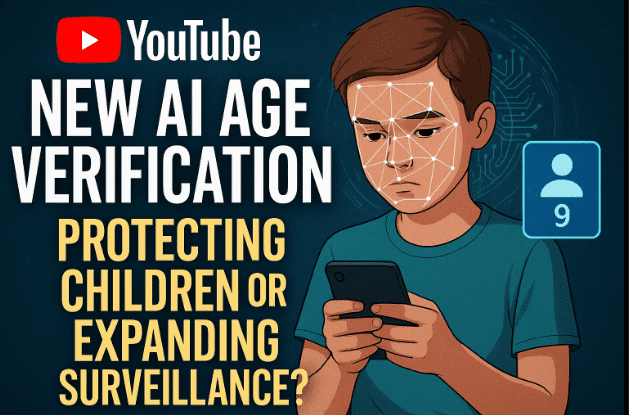
In this article, we’ll break down exactly what YouTube is doing, how this system works, what risks it brings, and how users might navigate these changes without putting their privacy at risk.
📑 Table of Contents
- 1. Background: YouTube’s Child Protection Narrative
- 2. How YouTube’s Machine Learning Age Verification Works
- 3. Why Old Accounts Aren’t a Free Pass
- 4. Real-World Impacts: Gamers, Students, and Casual Users
- 5. What Happens if You’re Flagged as Underage?
- 6. Data Privacy Concerns with ID and Credit Card Verification
- 7. The Bigger Picture: Google, Meta, and the Teen Advertising Market
- 8. Can You Outsmart the Algorithm?
- 9. Risks of Misidentification and False Positives
- 10. What Parents Should Really Do to Protect Kids
- 11. Frequently Asked Questions (FAQs)
- 12. Final Thoughts
1. Background: YouTube’s Child Protection Narrative
YouTube first teased this shift in early 2025. In a blog post titled Our Big Bets for 2025, YouTube’s CEO emphasized their focus on “protecting our youngest users.”
This wasn’t new—YouTube has long used:
- Age-restricted content flags
- YouTube Kids app
- Supervised accounts
- Manual review and reporting systems
These systems already restricted children from inappropriate videos. But the new AI-driven approach takes it a step further by monitoring what you search, what you watch, and even the age of your account to decide if you’re really an adult.
2. How YouTube’s Machine Learning Age Verification Works
Instead of relying on birthdays entered during signup, YouTube now uses AI-powered behavioral analysis. According to their blog post, Gemini-based machine learning looks at:
- Types of videos you search for (e.g., cartoons vs. finance tutorials)
- Categories of content you watch frequently (e.g., gaming vs. documentaries)
- Account longevity (how old your YouTube/Google account is)
At first glance, account age should be enough. A Gmail account from 2004 is obviously owned by an adult today. But YouTube explicitly states that even old accounts will not automatically bypass AI verification.
This means that regardless of when your account was created, your viewing habits may trigger YouTube to demand proof of age.
3. Why Old Accounts Aren’t a Free Pass
Think of it like buying alcohol at a store. Even if you look like you’re 70, the cashier might still demand ID “just to be safe.”
YouTube’s approach is similar:





- An 18+ year-old Gmail account won’t exempt you.
- Watching “youth-heavy” content may override account longevity.
- AI doesn’t assume—it judges your behavior, not just your credentials.
So, if your teenage cousin uses your account to binge Fortnite streams, don’t be surprised when YouTube starts asking you to upload an ID scan.
4. Real-World Impacts: Gamers, Students, and Casual Users
This is where the policy hits everyday users the hardest.
- Gamers: Adults who watch walkthroughs of Call of Duty, Minecraft, or Fortnite may be flagged, because those same games are watched by millions of kids.
- Students: Imagine a university student watching a geometry video. YouTube’s AI could confuse that with middle school content.
- DIY Hobbyists: Adults watching “how to build roof rafters” or “basic algebra” tutorials may be misclassified because kids also watch those videos.
The problem isn’t what you’re watching—it’s that YouTube’s AI may misinterpret your viewing history.
5. What Happens if You’re Flagged as Underage?
If YouTube suspects your account belongs to someone under 18, your access to age-restricted content will be locked.
To unlock it, you must:
- Submit a scan of your government-issued ID, or
- Provide credit card details to confirm your age.
This is controversial because many users are uncomfortable handing over such sensitive data just to continue using an account they’ve had for years.
6. Data Privacy Concerns with ID and Credit Card Verification
Here’s where things get serious. Your ID card and payment data are among the most sensitive forms of personal information. If mishandled, they could expose you to:
- Identity theft
- Fraud
- Targeted tracking
We’ve seen similar cases go wrong before. For example, an app once leaked 70,000 ID scans when hackers breached its servers. If a giant like Google mishandled data at scale, the consequences could be catastrophic.
7. The Bigger Picture: Google, Meta, and the Teen Advertising Market
Let’s be honest: Google is an advertising company first, video platform second. The more accurately they know a user’s age, the more precisely they can target ads.
Meta (Facebook/Instagram) has already been accused of:
- Tracking teen girls who repeatedly delete and re-upload selfies.
- Using this behavior to target ads for makeup and beauty products at vulnerable ages.
If YouTube’s age detection can reliably identify teens, it opens the door for highly manipulative advertising strategies, all under the disguise of “safety.”
8. Can You Outsmart the Algorithm?
Some users speculate that you could “train” YouTube’s AI by mixing your viewing history:
- Balance gaming content with “adult” content like news or car repair videos.
- Watch finance tutorials, tech reviews, or home improvement guides.
- Avoid letting kids use your logged-in account.
Of course, this is only a theory. Ultimately, Google has far more control over your account than you do. But being mindful of your watch history may reduce the chance of false age flags. However Google always do experiments like this, but do you know 99% of YouTube Channels Never Grow (And How You Can Be the 1%) and there can be ways to Fix a Dead YouTube Channel in 7 Days: A Step-by-Step Guide That Actually Works.
9. Risks of Misidentification and False Positives
False positives are inevitable. Here’s why this matters:
- A 35-year-old gamer may be blocked for watching too many Fortnite highlights.
- A math teacher preparing lessons may be flagged for browsing geometry tutorials.
- A parent letting kids use their account could be forced to upload ID scans.
This blanket approach ignores context and punishes normal adult behavior.
10. What Parents Should Really Do to Protect Kids
While YouTube pushes AI verification, there are already effective, parent-controlled tools:
- YouTube Kids app (tailored for children’s viewing)
- Supervised accounts with parental oversight
- Network-level filters like OpenDNS or router-based restrictions
- Good old-fashioned monitoring and communication
True child safety comes from parental involvement, not from AI that watches everyone indiscriminately.
11. Frequently Asked Questions (FAQs)
Q1. Will old Gmail/YouTube accounts be automatically considered adult?
No. Even accounts created 15–20 years ago may still be flagged.
Q2. What proof of age does YouTube require?
Government-issued ID or credit card information.
Q3. Can I refuse verification?
Yes, but you’ll lose access to age-restricted videos.
Q4. Is my data safe with Google?
Google claims to secure all PII, but no system is 100% safe from breaches or misuse.
Q5. Does this affect all countries?
Currently rolling out in the U.S., with similar tests in other markets. Expansion is expected.
12. Final Thoughts
YouTube’s AI-driven age verification system represents a major shift in online identity management. While it’s framed as a way to protect kids, it also expands surveillance, forces users to hand over sensitive documents, and risks misclassifying adults.
Parents already have tools like YouTube Kids and supervised accounts. AI verification, therefore, feels less about protection and more about data collection and control.
As users, the best defense is awareness. Be mindful of your watch history, protect your account from kids borrowing it, and think carefully before uploading sensitive documents to a for-profit advertising network.
The bottom line? Protecting children is important, but not at the cost of turning every adult on YouTube into a monitored subject.
Tags
youtube ai, youtube age verification, google surveillance, youtube privacy, youtube child protection, machine learning youtube, digital privacy
Hashtags
#YouTube #Privacy #Google #AI #Surveillance #OnlineSafety